
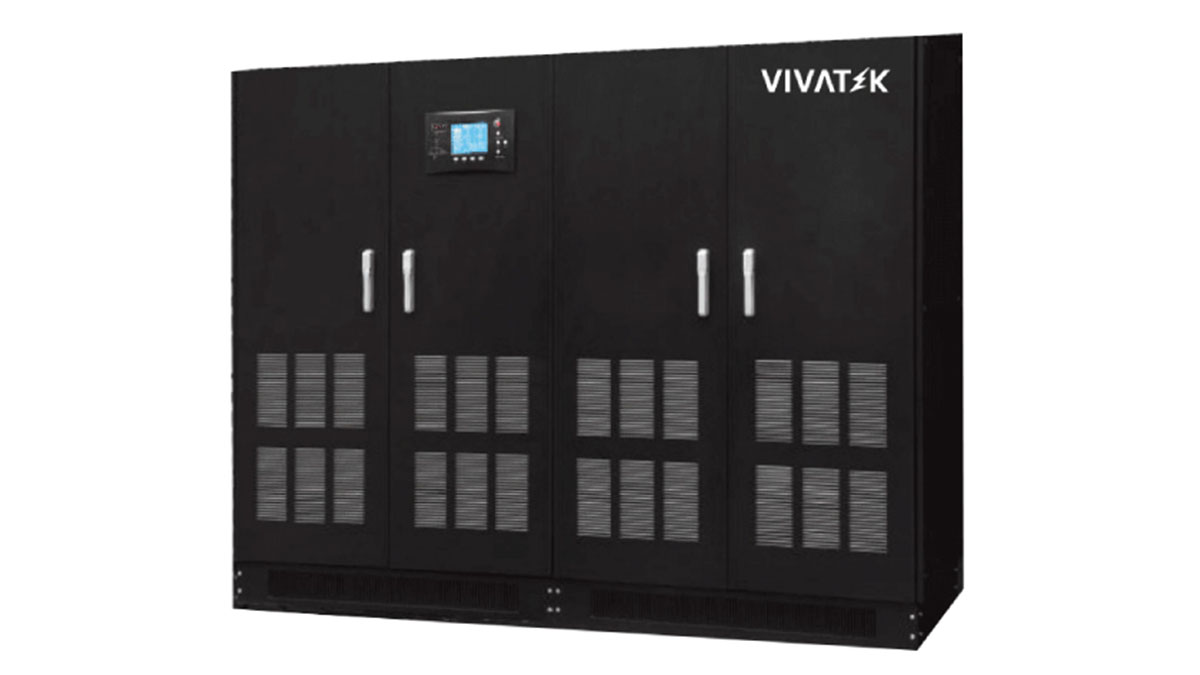
Factories, offices, hospitals, data centers and infrastructure facilities depend on electrical equipment that must remain available throughout the day. A brief interruption can stop a production process, restart automation equipment, disconnect IT systems or affect critical operations.
Power problems are not limited to complete blackouts. Voltage variations, electrical noise, surges, frequency changes and other disturbances can also affect sensitive equipment.
An Online UPS provides a controlled power path between the electrical supply and connected equipment. It continuously regulates the output and uses stored battery energy when the normal supply is unavailable.
VIVATEK provides UPS solutions for industrial and commercial applications where dependable power continuity, equipment protection and long-term serviceability are important.
What Is an Online UPS?
An Online UPS, or Uninterruptible Power Supply, is a power protection system that continuously supplies the connected load through an inverter.
It generally uses double-conversion technology. Incoming AC power is converted into DC and then converted back into regulated AC before reaching the equipment.
Because the inverter is continuously supplying the load, the system can maintain power during an input interruption without the conventional transfer delay associated with standby UPS systems.
This makes the technology suitable for applications where an unexpected interruption can have a significant operational impact.
How Does an Online UPS Work?
The operating process is straightforward.
AC to DC Conversion
The incoming AC supply enters the rectifier, which converts it into DC power for the system’s DC bus.
Battery Charging
The charging system maintains the connected battery bank at the appropriate charge level during normal operation.
DC to AC Conversion
The inverter converts DC power back into regulated AC power for the connected equipment.
Battery Operation
When the incoming supply fails or moves outside the acceptable range, the battery provides energy to the inverter.
The load continues to receive power from the inverter, helping avoid an interruption during the transition to battery operation.
Automatic Bypass
A bypass path can provide an alternative supply to the load under defined operating conditions, such as certain overload or maintenance situations.
Why Businesses Need Power Protection
Electrical reliability directly affects productivity.
A factory may lose production when a control system trips. A server room may experience an unexpected shutdown. A healthcare facility may need continuous availability for selected electronic systems.
Power protection can help organizations reduce the operational impact of:
- Unexpected outages
- Voltage fluctuations
- Voltage sags and swells
- Surges and spikes
- Electrical noise
- Frequency variation
- Certain power-quality disturbances
The appropriate level of protection depends on the equipment, electrical environment and consequences of an interruption.
Power Quality Problems and Their Impact
Not every electrical problem is visible to the operator.
Voltage Sag
A temporary reduction in voltage may cause sensitive equipment or motor-driven systems to trip.
Voltage Swell
A temporary increase can place additional electrical stress on connected equipment.
Surge and Spike
Short-duration high-voltage events may affect electronic components and control systems.
Electrical Noise
Noise on the supply can interfere with sensitive electronic equipment and communication systems.
Harmonic Distortion
Non-linear equipment such as drives, rectifiers and other power-electronic loads can contribute harmonics to an electrical system.
Frequency Variation
Some equipment requires a stable frequency reference for proper operation.
An Online UPS can provide a regulated output and help isolate connected equipment from many variations in the incoming supply. The exact protection capability depends on the selected model and installation.
Key Components of an Online UPS
Several systems work together to provide continuous power.
Rectifier
Converts incoming AC into DC power.
Inverter
Converts DC power into regulated AC output.
Battery Bank
Stores energy for use when the normal electrical supply is unavailable.
Charger
Maintains the battery at the required charging level.
Static Switch
Provides rapid transfer to the bypass supply when the operating conditions require it.
Digital Controller
Monitors and controls important UPS functions.
Cooling System
Removes heat generated during operation and helps maintain suitable internal temperatures.
Protection System
Monitors conditions such as overload, temperature and electrical abnormalities and responds according to the system design.
VIVATEK Online UPS Solutions
VIVATEK offers different UPS configurations for varying application requirements.
Single-Phase Online UPS
Single-phase systems can be considered for offices, laboratories, networking equipment, smaller IT installations and other electronic loads.
The appropriate capacity depends on the actual connected equipment and required backup duration.
Three-Phase Online UPS
Three-phase configurations are suitable for larger electrical systems such as manufacturing facilities, data centers, healthcare infrastructure and industrial installations.
They can support higher-capacity loads and provide a suitable architecture for larger electrical distribution systems.
Modular Online UPS
Modular systems can provide a scalable approach where capacity or redundancy requirements may increase over time.
Additional modules can be incorporated according to the system architecture and manufacturer’s specifications.
Transformer-Based UPS
Transformer-based configurations may be considered where electrical isolation, specific overload characteristics or demanding industrial operating conditions are important.
Transformerless UPS
Transformerless designs generally offer compact construction and high operating efficiency and can be suitable for many modern commercial, IT and industrial applications.
The correct technology depends on the actual load and installation requirements.
Long-Backup UPS
Where longer battery operation is required, the battery bank can be designed according to the desired runtime.
Runtime should be calculated from the actual load and battery discharge characteristics rather than using a generic backup-time assumption.
How to Select the Right UPS Capacity
Selecting the correct capacity is one of the most important stages of system design.
Consider:
- Total connected load
- Actual operating load
- Power factor
- Starting or inrush current
- Critical and non-critical equipment
- Future expansion
- Required redundancy
- Required backup duration
A system should not be selected solely because it has a high kVA rating.
Oversizing may increase the initial investment, while undersizing can result in overload conditions and insufficient capacity.
The final rating should be determined from the actual electrical requirements.
How Is Battery Backup Time Determined?
Backup duration depends on several factors:
- UPS load
- DC bus voltage
- Battery capacity
- Number of batteries
- Battery technology
- Discharge characteristics
- Ambient temperature
- Battery condition
- Required end-of-discharge voltage
If a facility needs longer runtime, the battery configuration must be designed accordingly.
Battery sizing should use manufacturer-provided discharge data and the customer’s actual load profile.
Battery Options
Different battery technologies offer different characteristics.
VRLA Batteries
VRLA batteries are commonly used where a compact, relatively low-maintenance battery arrangement is required.
Tubular Batteries
Tubular batteries can be considered for applications requiring longer backup durations.
Lithium Batteries
Lithium technology can provide high energy density, compact installation and potentially longer service life, depending on the application.
Ni-Cd Batteries
Nickel-cadmium batteries can be considered for demanding environments where temperature tolerance and durability are important.
The appropriate choice depends on runtime, environment, maintenance requirements, expected service life and lifecycle cost.
Online UPS vs Offline UPS
An Offline UPS normally supplies utility power directly to the load and switches to battery operation when the supply fails.
An Online UPS continuously supplies the load through its inverter.
| Feature | Online UPS | Offline UPS |
|---|---|---|
| Operating principle | Double conversion | Standby |
| Load supply | Through inverter | Normally utility supply |
| Transfer during outage | No conventional transfer | Required |
| Voltage regulation | Continuous | Limited |
| Typical application | Critical systems | Basic electronic loads |
For applications where power continuity and conditioning are important, Online UPS technology generally provides a higher level of protection.
Online UPS vs Line-Interactive UPS
Line-interactive systems generally use automatic voltage regulation to correct certain input variations.
An Online UPS continuously processes the incoming power through its conversion system.
| Feature | Online UPS | Line-Interactive UPS |
|---|---|---|
| Main technology | Double conversion | AVR + battery |
| Load transfer | No conventional transfer | Required during battery operation |
| Power conditioning | High | Moderate |
| Critical applications | Well suited | Application dependent |
| Cost | Generally higher | Generally lower |
The decision should be based on the consequences of power disturbances rather than price alone.
Single-Phase vs Three-Phase UPS
The electrical architecture of the facility determines which configuration is appropriate.
| Feature | Single Phase | Three Phase |
|---|---|---|
| Typical load | Small to medium | Medium to large |
| Supply | Single phase | Three phase |
| Common applications | Offices, labs, small IT | Industry, data centers, infrastructure |
| Expansion | Application dependent | Suitable for larger systems |
A technical assessment should be completed before deciding the configuration.
Transformer-Based vs Transformerless UPS
Transformer-based and transformerless systems serve different application requirements.
Transformer-based designs may be preferred where isolation and certain industrial-duty characteristics are required.
Transformerless designs can be attractive where efficiency, compact dimensions and reduced weight are priorities.
There is no universal choice. Load characteristics, electrical architecture, installation conditions and project requirements should determine the selection.
UPS Redundancy and N+1 Configuration
Some facilities require greater availability than a single UPS installation can provide.
An N+1 arrangement includes one additional capacity unit beyond the minimum required for the connected load.
This approach can be considered for:
- Data centers
- Healthcare facilities
- Industrial automation
- Telecom infrastructure
- Critical control systems
The redundancy architecture should be designed according to the required availability and load profile.
Automatic and Maintenance Bypass
A bypass provides an alternative route for supplying the load under specified conditions.
An automatic bypass can transfer the load when the UPS system requires it according to its control logic.
A maintenance bypass can allow qualified technicians to isolate the UPS for servicing while keeping the load supplied through an alternate source, where the installation supports this arrangement.
Proper bypass coordination is important for critical installations.
UPS Efficiency and Energy Management
UPS efficiency affects both energy consumption and heat generation.
For systems operating continuously, even small efficiency differences can influence annual operating costs.
When comparing systems, consider:
- Efficiency at the actual operating load
- Input power factor
- Energy losses
- Operating modes
- Cooling requirements
- Annual operating hours
The manufacturer’s published performance data should be reviewed at the expected operating conditions.
Integration With DG Sets
Many industrial facilities use diesel generators as an additional backup source.
The UPS and generator should be evaluated as part of the same electrical design.
Important considerations include:
- Generator capacity
- Frequency stability
- Voltage regulation
- UPS input characteristics
- Load response
- Harmonic performance
- Generator loading
Proper coordination can help achieve stable operation when the generator is supplying the UPS.
Integration With Solar and BESS
Modern facilities may combine several energy sources.
A power architecture may include:
Grid + Solar + BESS + DG + UPS
The UPS can form part of this larger system, but the power flow, control strategy, battery arrangement and protection coordination need to be properly engineered.
Solar and BESS integration should therefore be evaluated based on the complete site architecture.
Integration With BMS, SCADA and PLC Systems
Modern facilities increasingly require centralized monitoring of critical electrical systems.
Depending on the selected model, monitoring may provide information such as:
- Input and output voltage
- Load level
- Battery status
- Operating mode
- Alarm condition
- Fault information
- Runtime information
Communication options can allow the UPS to be connected to BMS, SCADA or other monitoring platforms.
For automation environments, reliable power to PLCs and controllers can help reduce unexpected resets and process interruptions.
Industrial and Commercial Applications
Online UPS systems can support many types of facilities.
Manufacturing
Production automation, control panels, servers and critical electronic systems.
Automotive
Production equipment, testing systems and automation infrastructure.
Healthcare
Selected critical electronic and medical systems requiring continuous power.
Data Centers
Servers, storage, networking and communication equipment.
Telecom
Communication and network infrastructure.
Banking
IT infrastructure and transaction-related systems.
Pharmaceutical
Process control, laboratory and monitoring equipment.
Food Processing
Automation and production-control systems.
Infrastructure
Control, communication and monitoring equipment.
Commercial Buildings
IT systems, security, communication and building-control equipment.
UPS Installation and Commissioning
Correct installation is essential for reliable operation.
Before commissioning, the project team should verify:
- Incoming supply
- Output configuration
- Cable sizing
- Earthing
- Battery connection
- Protection devices
- Ventilation
- Maintenance clearances
- Load distribution
Commissioning may include functional checks, alarm verification, bypass testing, battery operation and load testing.
The exact commissioning procedure should follow the manufacturer’s documentation and project requirements.
UPS Room and Environmental Conditions
The installation environment can influence system performance and battery life.
Before installation, evaluate:
- Temperature
- Humidity
- Dust
- Ventilation
- Airflow
- Accessibility
- Battery safety
- Maintenance clearance
Excessive heat can significantly affect battery service life, making appropriate environmental control particularly important.
Preventive Maintenance
A UPS should be treated as an operational asset rather than equipment that only needs attention when a fault occurs.
Routine maintenance can include:
- Battery inspection
- Electrical connection checks
- Cooling-system inspection
- Cleaning
- Alarm review
- Battery performance checks
- Functional testing
The maintenance interval should be determined according to the manufacturer’s recommendations, operating conditions and criticality of the application.
Common Online UPS Problems
Some commonly reported conditions include:
- Overload
- Low battery
- Battery fault
- High temperature
- Input abnormality
- Output abnormality
- Bypass operation
- Communication fault
- Cooling-system fault
An alarm does not necessarily mean that the UPS itself has failed. The cause should be investigated using the system display, event information and manufacturer’s technical documentation.
Online UPS Troubleshooting Approach
When an abnormal condition occurs, maintenance teams should first identify the operating state of the system.
A practical approach is:
Check alarm → Check input → Check load → Check battery → Check temperature → Review event history → Escalate if required
For safety, internal UPS servicing should only be carried out by appropriately qualified personnel following the manufacturer’s procedures.
Common Buyer Mistakes
Choosing Only on Purchase Price
The cheapest system may not have the lowest lifecycle cost.
Selecting Capacity Without Load Assessment
Incorrect sizing can create either insufficient capacity or unnecessary expenditure.
Ignoring Battery Requirements
Battery selection directly affects runtime and long-term backup performance.
Forgetting Future Expansion
Expected load growth should be considered during the initial design.
Ignoring Installation Conditions
Heat, dust and ventilation can affect the equipment and battery system.
No Maintenance Plan
A critical power system needs scheduled inspection and service.
Comparing Products Only by kVA
Capacity alone does not explain efficiency, redundancy, monitoring, serviceability or application suitability.
How to Choose the Right Online UPS Manufacturer
A manufacturer should be evaluated on the complete support they can provide.
Consider:
- Engineering capability
- Manufacturing experience
- Testing facilities
- Product range
- Application knowledge
- Customization
- Technical documentation
- Installation support
- Spare-parts availability
- Service support
- AMC options
- Warranty
For industrial projects, dependable technical support can remain important long after the equipment has been installed.
VIVATEK – Power Protection for Industrial and Commercial Applications
VIVATEK focuses on UPS and power protection requirements across industrial and commercial environments.
Rather than treating every installation as identical, the selection process can consider the actual application, electrical load, backup requirement and operating conditions.
Technical evaluation can cover:
- UPS capacity
- Load characteristics
- Battery configuration
- Runtime
- Redundancy
- Installation environment
- Generator compatibility
- Solar and BESS integration
- Monitoring requirements
- Future expansion
This application-based approach helps customers make a more informed selection.
VIVATEK Manufacturing and Testing Approach
A reliable UPS requires controlled engineering, assembly and testing.
A typical production flow includes:
Design → Component inspection → PCB assembly → Mechanical assembly → Wiring → Integration → Functional testing → Load testing → Burn-in → Final inspection → Dispatch
Depending on the product and project, testing may include:
- Input and output verification
- Voltage regulation
- Battery charging
- Protection functions
- Alarm functions
- Load operation
- Thermal performance
- Bypass operation
The exact test procedure should be confirmed for the selected model.
Quality and Technical Documentation
Industrial customers often require clear documentation for procurement, installation and maintenance.
Depending on project requirements, documentation may include:
- Product datasheet
- Technical specifications
- General arrangement drawing
- Wiring information
- Battery details
- Installation instructions
- Operation manual
- Test documentation
- Warranty information
- Maintenance recommendations
Good documentation makes it easier for engineering and maintenance teams to manage the equipment throughout its operating life.
Standards, Compliance and Testing
Buyers should verify the actual standards and certifications applicable to the specific UPS model.
Depending on the project, evaluation may involve:
- Applicable IEC requirements
- Electrical safety requirements
- EMC requirements
- Environmental compliance
- Quality-management documentation
- Customer-specific technical specifications
Where required, Factory Acceptance Testing (FAT) and Site Acceptance Testing (SAT) can form part of the project process.
Specific compliance claims should always be confirmed from the manufacturer’s documentation.
Factory Acceptance Testing
FAT allows the customer and supplier to verify agreed technical requirements before dispatch.
Depending on the project, testing may cover:
- Electrical parameters
- Functional operation
- Protection functions
- Alarm operation
- Load performance
- Bypass operation
- Communication functions
The FAT procedure should be agreed before testing begins.
Site Acceptance Testing
SAT is performed after installation at the customer’s location.
It can verify:
- Input supply
- Output performance
- Load operation
- Battery operation
- Alarms
- Bypass operation
- Communication
- System functionality
This provides additional confirmation that the installed system performs correctly within the actual site environment.
UPS Selection by Application
Different applications have different priorities.
| Application | Key considerations |
|---|---|
| Manufacturing | Load characteristics, automation, expansion |
| Data Center | Redundancy, monitoring, scalability |
| Healthcare | Critical loads, availability, bypass |
| Telecom | Runtime, batteries, monitoring |
| Office | Capacity, runtime, operating cost |
| Automation | Power quality, controller continuity |
| Infrastructure | Availability, serviceability, project requirements |
The final configuration should always be based on the actual application.
Understanding Total Cost of Ownership
The initial purchase price is only one part of the investment.
Over its operating life, a UPS may involve:
Purchase → Installation → Energy consumption → Battery replacement → Maintenance → Spare parts → Repairs → Upgrades
A properly sized system with appropriate efficiency and serviceability can provide better long-term value than a system selected purely on initial price.
For B2B buyers, total cost of ownership should therefore be considered alongside the technical specification and purchase price.
Technical Information to Share With VIVATEK
For a preliminary evaluation, customers can provide:
Load: kW / kVA
Supply: Voltage and phase
Runtime: Required backup duration
Application: Industrial / Commercial / IT / Healthcare / Infrastructure
Battery: Preferred technology, if known
Environment: Temperature, dust and ventilation
Expansion: Expected future load
Integration: DG / Solar / BESS / BMS / SCADA
Redundancy: Required configuration
Even a basic load summary can provide a useful starting point for technical discussion.
Frequently Asked Questions
What is an Online UPS?
An Online UPS continuously supplies the connected load through its inverter while providing battery backup when the normal supply is unavailable.
How does double conversion work?
The incoming AC supply is converted into DC and then converted back into regulated AC for the connected equipment.
Does an Online UPS have transfer time?
The load remains supplied through the inverter during normal and battery operation, avoiding the conventional transfer associated with standby systems.
How do I calculate UPS capacity?
Capacity should be based on the connected load, power factor, starting characteristics, operating profile and future expansion.
How is backup time calculated?
Runtime depends on load, battery configuration, battery capacity, discharge characteristics and operating conditions.
Which battery should I choose?
VRLA, tubular, lithium and Ni-Cd technologies can all be suitable for different applications. Selection should consider runtime, environment, maintenance and lifecycle cost.
Can an Online UPS work with a diesel generator?
Yes. Generator capacity, frequency, voltage regulation and UPS input characteristics should be considered together.
Can an Online UPS integrate with solar?
Yes, depending on the overall electrical architecture and the selected equipment.
Can it work with BESS?
It can form part of a system containing battery energy storage, provided the complete architecture is correctly engineered.
What is N+1 redundancy?
It provides one additional capacity unit beyond the minimum required capacity, improving availability when properly designed.
What is a static bypass?
It is an alternate supply path that can transfer the load under specified operating conditions.
How often should a UPS be serviced?
The maintenance schedule should follow the manufacturer’s recommendations and the operating conditions of the installation.
How long do UPS batteries last?
Battery life varies with technology, temperature, charging conditions, discharge cycles and maintenance.
Can an Online UPS operate 24/7?
Online UPS systems are designed for continuous operation when correctly selected, installed and maintained.
What causes an UPS to go into bypass?
Possible causes include overload, internal operating conditions, maintenance requirements or protection events. The exact cause should be identified from the system alarms and documentation.
Can the UPS be monitored remotely?
Many systems provide communication options for remote monitoring, depending on the model and installed interface.
What is FAT?
Factory Acceptance Testing verifies agreed technical requirements before equipment is dispatched.
What is SAT?
Site Acceptance Testing verifies the system after installation at the customer’s location.
What should I provide when requesting a quotation?
Provide the load, supply voltage, phase configuration, required runtime, application, installation environment and future expansion requirements.
How do I choose an Online UPS manufacturer?
Evaluate engineering experience, manufacturing capability, testing, documentation, customization, service support, spare availability and lifecycle support.
Why Technical Evaluation Matters
Selecting a UPS should not be reduced to comparing kVA ratings and prices.
Two systems with similar capacity can differ considerably in architecture, efficiency, battery configuration, monitoring, redundancy and serviceability.
A better evaluation considers:
Electrical supply → Load → Power quality → UPS architecture → Battery → Redundancy → Installation → Monitoring → Maintenance
This gives procurement and engineering teams a clearer basis for making the final decision.
Conclusion
An Online UPS is more than a backup device. It is part of the electrical infrastructure that supports continuity for critical equipment and business operations.
The right solution depends on several factors, including load capacity, battery technology, backup duration, installation environment, redundancy, monitoring, integration and maintenance.
For this reason, the best approach is to understand the application first and then select the appropriate UPS architecture.
VIVATEK works with industrial and commercial customers to evaluate their power requirements and identify suitable power protection configurations for their applications.
Discuss Your Requirement With VIVATEK
Planning a new installation, replacing an existing UPS or expanding your facility?
Share your basic requirement with the VIVATEK team.
Email: sales@anushri.info
Phone: +91 9841698180 // +91 9566117188
Address:
No. 2/27, Luz Avenue 3rd Street, Mylapore, Chennai – 600004, Tamil Nadu, India.