
Introduction
Industrial energy costs continue to increase across India. Rising electricity tariffs, maximum demand charges, diesel generator expenses, power quality issues, and production downtime risks are forcing businesses to rethink how they manage energy.
For many industries, solar power alone is no longer enough.
Battery energy storage is becoming an important part of modern industrial energy infrastructure because it helps businesses store excess solar energy, reduce peak demand costs, improve power reliability, and reduce dependence on diesel generators.
A properly engineered solar system with battery backup provides more than energy savings. It helps create a more stable, predictable, and resilient operating environment.
For manufacturers, processing industries, warehouses, pharmaceutical facilities, cold storage operators, and industrial campuses, solar plus battery storage is rapidly becoming a strategic investment rather than an optional upgrade.
Why Energy Costs Are Becoming a Strategic Business Challenge
Electricity is one of the largest operating expenses for many industrial facilities.
As production volumes increase and energy tariffs continue rising, electricity costs can significantly affect profitability.
In addition to energy charges, many industries also face:
• Maximum demand charges
• Diesel fuel expenses
• Generator maintenance costs
• Production losses caused by outages
• Power quality issues
These factors make energy management a strategic business priority rather than simply a utility concern.
Businesses are increasingly seeking long-term solutions that help reduce operating costs while improving energy security.
Why Industries Are Looking Beyond Traditional Power Sources
For decades, industries depended primarily on utility power and diesel generators.
While these solutions remain important, they also create challenges.
Utility tariffs continue increasing.
Diesel fuel costs fluctuate unpredictably.
Generator maintenance requires ongoing investment.
Environmental regulations continue becoming stricter.
Solar and battery storage provide an alternative approach.
Instead of relying entirely on external energy sources, businesses can generate, store, and manage their own electricity more effectively.
This creates greater control over long-term energy costs while improving operational resilience.
What Is a Solar System with Battery Backup for Industries?
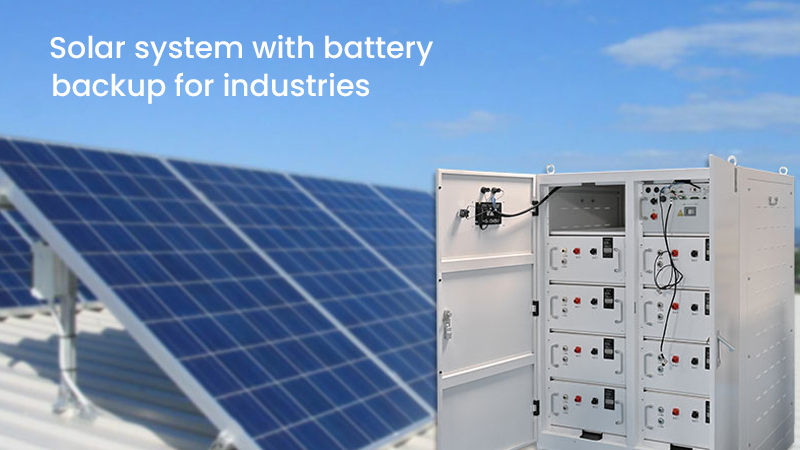
A solar system with battery backup combines solar generation, battery energy storage, intelligent controls, and utility integration into a single energy management solution.
During the day, solar panels generate electricity.
The generated power can be used directly by industrial loads while excess energy is stored within the battery system.
When solar generation decreases or demand increases, stored energy can be used to support operations.
This helps improve energy utilization while reducing dependence on the grid and diesel generators.
How a Solar + Battery Energy Storage System Works
Modern battery-backed solar systems are designed to optimize how energy is generated, stored, and consumed.
Solar Generation
Solar panels convert sunlight into electrical energy that can be used immediately by the facility.
During daylight hours, solar generation often offsets a significant portion of electricity consumption.
Battery Energy Storage
When solar production exceeds consumption, excess energy can be stored in batteries instead of being exported to the grid.
Stored energy becomes available when it is needed most.
Intelligent Energy Management
Advanced control systems continuously monitor energy production, storage levels, and facility demand.
These systems automatically determine when to store energy and when to discharge batteries for maximum
Intelligent Energy Management
Advanced energy management systems continuously monitor solar generation, battery storage levels, facility demand, and grid availability.
Based on operating conditions, the system automatically decides when to store solar energy, when to discharge batteries, and when to use grid power.
This intelligent control helps maximize solar utilization while improving overall energy efficiency.
Grid Integration
Industrial solar battery systems remain connected to the utility grid when required.
The grid acts as an additional energy source while the battery system helps optimize consumption patterns, reduce peak demand, and improve operational continuity.
The result is a more flexible and resilient energy infrastructure.
Why Industries Are Installing Solar + Battery Storage in 2026
Industrial energy management is evolving rapidly.
Businesses are no longer investing in solar power solely to reduce electricity bills.
They are investing in energy storage because it helps solve multiple operational challenges simultaneously.
Organizations are adopting solar and battery systems to:
• Reduce electricity costs
• Lower peak demand charges
• Improve energy security
• Reduce diesel generator dependency
• Improve sustainability performance
• Support future energy requirements
As battery technologies continue improving, energy storage is becoming an increasingly attractive solution for industrial applications.
Common Energy Challenges Faced by Industrial Facilities
Industrial facilities face a wide range of energy-related challenges that affect both operations and profitability.
Rising Electricity Tariffs
Energy costs continue increasing across many regions of India.
For energy-intensive industries, even small tariff increases can significantly impact operating expenses.
Maximum Demand Charges
Many industrial electricity bills include demand charges based on peak power consumption.
These charges can represent a substantial portion of total electricity costs.
Diesel Generator Costs
Diesel generators involve ongoing fuel expenses, maintenance requirements, and operational costs.
Over time, these costs can become significant.
Power Outages
Unexpected power interruptions can disrupt production, affect equipment performance, and create operational losses.
Voltage Fluctuations
Poor power quality can affect automation systems, process controls, industrial electronics, and manufacturing equipment.
These challenges are driving increased interest in integrated solar and battery storage solutions.
The Hidden Cost of Delaying Energy Storage Adoption
Many businesses continue evaluating energy storage without taking action.
However, every month of delay may result in:
• Higher electricity expenses
• Additional diesel consumption
• Continued demand charge penalties
• Lost solar self-consumption opportunities
• Reduced long-term savings potential
As electricity costs continue rising, delaying implementation often increases the total cost of ownership.
Organizations that act earlier frequently capture greater long-term financial benefits.
Benefits of Solar Systems with Battery Backup
Battery-backed solar systems provide benefits that extend far beyond simple electricity savings.
Reduce Electricity Bills
Stored solar energy can be used during periods when electricity costs are highest, helping reduce overall energy expenses.
Peak Demand Shaving
Battery systems can supply power during demand spikes, helping lower maximum demand charges.
Lower Diesel Consumption
Stored solar energy can reduce the need for diesel generator operation during outages and peak demand periods.
Improve Power Reliability
Battery storage helps maintain power continuity during interruptions and grid disturbances.
Increase Solar Self-Consumption
Rather than exporting excess solar energy, facilities can store and utilize it later when needed.
Future-Proof Energy Infrastructure
Battery storage helps organizations prepare for future tariff structures, energy regulations, and changing operational requirements.
Types of Industrial Solar + Battery Solutions
Every facility has different energy requirements.
Several battery-backed solar configurations are available depending on operational objectives.
Hybrid Solar Systems
Hybrid systems combine solar generation, batteries, and grid connectivity.
These solutions provide flexibility, backup capability, and improved energy management.
On-Grid Solar with Battery Storage
These systems remain connected to the utility grid while using batteries to optimize energy consumption and reduce demand charges.
Industrial Battery Energy Storage Systems (BESS)
Large-scale Battery Energy Storage Systems are designed for industrial campuses, manufacturing facilities, utilities, and large commercial operations.
BESS solutions provide advanced monitoring, scalability, and sophisticated energy management capabilities.
Industry Applications
Battery-backed solar systems are now widely used across numerous industrial sectors.
Manufacturing Plants
Manufacturers use battery storage to reduce electricity expenses while supporting continuous production.
Textile & Spinning Mills
Energy-intensive textile facilities benefit from reduced demand charges and improved energy management.
Food Processing Industries
Reliable power supports production consistency, refrigeration, and process equipment.
Cold Storage Facilities
Battery storage helps maintain operational continuity for temperature-sensitive products.
Pharmaceutical Manufacturing
Pharmaceutical facilities require dependable power for production, quality control, and environmental management systems.
Automotive & Engineering Industries
These facilities often have large electrical loads and can benefit significantly from peak demand management.
Warehousing & Logistics
Large rooftop areas and significant daytime energy consumption make warehouses ideal candidates for solar plus storage solutions.
Why Power Reliability Matters for Industrial Operations
Power reliability directly influences productivity.
Production schedules, automation systems, process controls, refrigeration systems, quality assurance equipment, and safety infrastructure all depend on stable electrical power.
Even brief interruptions can create operational disruptions that affect output and profitability.
Battery storage helps support continuity by providing power when utility supply becomes unavailable or unstable.
Business Impact of Unplanned Downtime
The financial impact of downtime often extends beyond lost production.
Businesses may experience:
• Missed delivery commitments
• Equipment restart costs
• Material losses
• Labor inefficiencies
• Reduced customer satisfaction
• Production schedule disruptions
For many industries, preventing downtime can be just as valuable as reducing electricity costs.
Battery-backed solar systems contribute to both objectives.
Why Peak Demand Charges Matter
Many industrial facilities focus primarily on electricity consumption charges while overlooking another major cost component—maximum demand charges.
Demand charges are often based on the highest level of power consumed during a specific billing period.
Even if this peak demand occurs for only a short duration, it can significantly increase monthly electricity expenses.
Manufacturing plants, process industries, engineering facilities, cold storage units, and large commercial operations frequently experience short periods of high power consumption caused by machinery startup, production surges, HVAC loads, or simultaneous equipment operation.
Battery storage systems help address this challenge by supplying stored energy during peak demand periods.
This reduces stress on the grid connection while helping lower demand-related electricity charges.
For many industries, demand charge reduction becomes one of the most valuable financial benefits of energy storage.
Solar + Battery Storage vs Diesel Generators
Diesel generators have traditionally been used to provide backup power during outages.
While generators remain useful in specific applications, many businesses are now evaluating battery storage as a more efficient and sustainable alternative.
Battery systems provide instant power without startup delays.
They operate silently without fuel consumption, exhaust emissions, or frequent maintenance requirements.
Unlike diesel generators, batteries can also be used daily to optimize energy costs, reduce peak demand, and increase solar self-consumption.
This means the investment creates value every day rather than only during outages.
| Factor | Solar + Battery Storage | Diesel Generator |
|---|---|---|
| Fuel Cost | None | Continuous |
| Noise | Silent | High |
| Maintenance | Low | Frequent |
| Emissions | Clean Energy | Carbon Emissions |
| Response Time | Instant | Startup Delay |
| Daily Cost Savings | Yes | No |
| Peak Demand Reduction | Yes | Limited |
For many industries, battery storage complements or partially replaces diesel generator operation while reducing long-term operating costs.
Why Energy Storage Is Becoming a Strategic Industrial Asset
Energy storage is no longer viewed only as a backup power solution.
Forward-thinking organizations increasingly view battery storage as a strategic business asset.
Modern battery systems support:
• Cost control
• Operational continuity
• Energy flexibility
• Sustainability objectives
• Future energy planning
As electricity pricing structures become more complex and businesses seek greater energy independence, battery storage becomes an important component of long-term infrastructure planning.
Organizations investing in energy storage today are positioning themselves for future operational and financial advantages.
Supporting Business Continuity & Production Stability
Production interruptions can create significant operational challenges.
Many manufacturing facilities operate continuous production lines where even short interruptions can affect output, quality, and scheduling.
Battery-backed solar systems help support business continuity by maintaining power availability during disturbances, outages, and critical operating periods.
Reliable power helps:
• Protect production schedules
• Reduce downtime risk
• Improve operational stability
• Protect sensitive equipment
• Support automation systems
• Improve overall productivity
For many facilities, reliability is just as important as energy savings.
Financial Impact & ROI Assessment
Every industrial energy project should be evaluated from both a technical and financial perspective.
The financial value of battery-backed solar systems is typically influenced by:
• Electricity cost reduction
• Demand charge reduction
• Reduced diesel fuel expenses
• Improved solar utilization
• Operational continuity benefits
• Long-term tariff protection
A comprehensive ROI assessment helps organizations understand the full economic value of the investment before implementation begins.
Rather than focusing only on installation cost, businesses should evaluate total lifecycle savings and operational benefits.
How to Evaluate ROI Beyond Payback Period
Payback period is one of the most common metrics used when evaluating solar and battery projects.
However, focusing only on payback can overlook several important benefits.
Organizations should also consider:
• Lifetime energy savings
• Demand charge reduction
• Diesel fuel savings
• Future tariff escalation
• Downtime avoidance
• Energy independence benefits
• Infrastructure value creation
A project that delivers strong long-term operational value may provide greater overall benefit than one evaluated solely on short-term payback.
Load Analysis & Battery Sizing Considerations
Proper battery sizing is critical to project success.
An undersized battery may fail to meet operational objectives, while an oversized system may increase investment costs unnecessarily.
Battery sizing should be based on:
• Connected load requirements
• Critical load identification
• Operating hours
• Backup duration requirements
• Solar generation profile
• Demand management objectives
• Future expansion plans
Accurate load analysis helps ensure the system is engineered according to actual operational needs rather than assumptions.
This improves both technical performance and financial outcomes.
Critical Load Identification
Not all equipment requires battery backup.
One of the first steps in system design is identifying which loads are critical to operations.
These may include:
• Process control systems
• Automation equipment
• Production machinery
• Refrigeration systems
• Data and communication infrastructure
• Safety systems
• Essential lighting
Prioritizing critical loads helps optimize battery capacity while improving project economics.
Backup Duration Planning
Different facilities have different backup requirements.
Some organizations require only short-duration support for operational continuity.
Others require extended backup capability to support production during longer outages.
Backup duration planning should consider:
• Outage history
• Production requirements
• Generator integration
• Operational priorities
• Financial objectives
A properly planned backup strategy ensures that energy storage delivers the intended operational benefits.
Future Expansion Planning
Industrial facilities rarely remain unchanged.
New production lines, additional machinery, facility expansions, and changing operating schedules often increase energy demand over time.
Battery-backed solar systems should therefore be designed with future growth in mind.
Scalable architectures allow organizations to expand storage capacity, increase solar generation, and adapt to evolving operational requirements without major redesign.
Planning for expansion during the initial design stage helps maximize long-term investment value while supporting future business growth.
Safety, Monitoring & Battery Management Systems
Safety is one of the most important considerations in any industrial energy storage project.
Modern battery storage systems are designed with multiple layers of protection to ensure safe, reliable, and efficient operation.
A professionally engineered Battery Management System (BMS) continuously monitors battery health, charging performance, temperature conditions, energy flow, and overall system status.
Advanced monitoring helps:
• Improve operational safety
• Prevent abnormal operating conditions
• Optimize battery performance
• Extend battery life
• Support preventive maintenance
• Provide real-time visibility
For industrial facilities, monitoring is not simply a convenience feature. It is a critical component of long-term system reliability.
Engineering & System Design Process
Every industrial facility has unique energy requirements.
This is why successful battery storage projects begin with engineering rather than equipment selection.
A structured design process typically includes:
• Site assessment
• Load analysis
• Solar generation evaluation
• Battery sizing calculations
• Critical load identification
• Backup duration planning
• Electrical integration design
• Protection and safety planning
The objective is to create a solution tailored to operational requirements rather than relying on standard configurations.
Engineering-driven projects consistently deliver better technical and financial outcomes.
Installation, Testing & Commissioning
Proper installation directly affects long-term system performance.
Industrial battery storage systems must be installed according to engineering specifications, safety requirements, and operational objectives.
The commissioning process typically includes:
• Equipment installation
• Electrical integration
• Communication setup
• Battery testing
• Functional verification
• Safety inspections
• Performance validation
Comprehensive commissioning ensures the system is ready to operate safely and efficiently from day one.
Monitoring, AMC & Long-Term Performance Support
Energy storage systems are long-term infrastructure assets.
Ongoing monitoring and preventive maintenance help maintain system performance while reducing operational risk.
Annual Maintenance Contracts (AMC) and long-term support services typically include:
• Health monitoring
• Preventive inspections
• Battery performance reviews
• Software updates
• System optimization
• Technical support
Long-term service support helps ensure that the system continues delivering expected savings and reliability throughout its operating life.
Scalability & Future Readiness
Industrial energy requirements rarely remain static.
Production expansion, new equipment installations, additional facilities, and changing operational requirements often increase electricity demand over time.
Modern battery storage solutions are designed with scalability in mind.
This allows organizations to:
• Expand battery capacity
• Add additional solar generation
• Increase backup capability
• Support future operational growth
A scalable design protects the original investment while providing flexibility for future energy requirements.
Real Industrial Energy Storage Example
A manufacturing facility operating multiple production lines faced rising electricity costs, high demand charges, and regular diesel generator usage during power interruptions.
Following a comprehensive energy assessment, a solar plus battery storage solution was designed to support critical loads, reduce peak demand, and improve solar utilization.
The system was engineered around the facility’s operating profile and future expansion plans.
The result included:
• Reduced electricity expenditure
• Lower demand charges
• Reduced diesel consumption
• Improved energy reliability
• Greater operational confidence
While every project is unique, this example demonstrates how properly engineered energy storage can create both financial and operational value.
Common Mistakes Industries Make When Selecting Battery Storage Systems
Many organizations focus on equipment price while overlooking factors that have a greater impact on long-term success.
Common mistakes include:
• Selecting systems without detailed load analysis
• Choosing battery capacity based on assumptions
• Ignoring future expansion requirements
• Overlooking demand charge reduction opportunities
• Failing to evaluate system safety features
• Prioritizing lowest cost over engineering quality
• Choosing suppliers without long-term support capability
Avoiding these mistakes can significantly improve project outcomes.
Why Engineering Matters More Than Equipment Price
Many energy projects are evaluated primarily on upfront investment cost.
However, equipment price alone does not determine long-term project success.
System performance is influenced by:
• Engineering quality
• Battery sizing accuracy
• Load analysis
• Safety design
• Monitoring capability
• Installation quality
• Operational support
A well-engineered solution often delivers significantly greater value than a lower-cost system designed without adequate technical analysis.
For industrial facilities, engineering quality is one of the most important drivers of long-term performance.
Why Businesses Choose Vivatek
At Vivatek, we focus on helping industrial organizations build reliable, cost-effective, and future-ready energy infrastructure.
Our approach begins with understanding operational requirements, energy consumption patterns, and business objectives.
We support customers through:
• Industrial energy assessments
• Load analysis
• Battery sizing
• Solar and storage system design
• Engineering support
• EPC execution
• Installation and commissioning
• AMC and long-term maintenance
• Performance optimization
Rather than supplying generic systems, we develop solutions tailored to each facility’s operational requirements and financial goals.
Frequently Asked Questions
What is a solar system with battery backup?
It is an integrated solution that combines solar generation, battery energy storage, intelligent controls, and grid connectivity to optimize energy usage and provide backup power.
How much battery capacity does my factory need?
Battery capacity depends on load requirements, backup duration objectives, demand management goals, and future expansion plans. A detailed load analysis is recommended.
Can battery storage reduce demand charges?
Yes. Battery systems can discharge during peak demand periods, helping reduce maximum demand charges and overall electricity costs.
Can batteries replace diesel generators?
In many applications, battery storage can significantly reduce generator usage. Some facilities use batteries alongside generators to create a more efficient hybrid energy strategy.
What industries benefit most from battery storage?
Manufacturing, textiles, pharmaceuticals, food processing, cold storage, engineering, logistics, warehousing, and industrial processing facilities can all benefit from energy storage.
Can the system be expanded later?
Yes. Most modern battery systems are designed to support future expansion.
Does Vivatek provide complete EPC support?
Yes. Vivatek supports customers from feasibility studies and engineering through installation, commissioning, and long-term support.
Conclusion
Solar systems with battery backup are transforming how industries manage energy.
They provide a practical solution for reducing electricity costs, lowering demand charges, minimizing diesel dependency, improving power reliability, and supporting long-term operational growth.
As energy costs continue rising and industrial operations become increasingly dependent on reliable power, battery storage is becoming an important part of modern energy strategy.
Organizations that invest in properly engineered solar and battery storage solutions today are building a more resilient, efficient, and future-ready energy infrastructure for tomorrow.
Free Industrial Energy Assessment
Want to understand whether battery storage is right for your facility?
Our technical team can evaluate your energy consumption profile, operational requirements, and savings opportunities.
✔ Energy Cost Analysis
✔ Demand Charge Evaluation
✔ Backup Power Assessment
✔ Battery Storage Feasibility Review
✔ Industrial Solar Integration Analysis
Free Load Analysis & Battery Sizing
Share your electricity bill, connected load details, and operational requirements.
Our engineers will provide:
• Recommended battery capacity
• Critical load analysis
• Backup duration recommendations
• Solar integration opportunities
• Technical feasibility guidance
Free ROI Assessment
Understand the financial value of battery-backed solar before investing.
Receive:
• Estimated electricity savings
• Demand charge reduction potential
• Diesel cost reduction analysis
• Payback assessment
• Long-term ROI projections
Download Solar + Battery Brochure
Explore our industrial energy storage solutions, battery technologies, engineering capabilities, and project approach.
Request Project-Based Quotation
Every facility is different.
Contact our team for a customized technical and commercial proposal tailored to your energy requirements.
Contact Vivatek Today
Whether you are planning a new solar project, evaluating battery storage, reducing diesel dependency, or improving energy reliability, Vivatek can help.
Speak with our energy experts today and discover how solar plus battery storage can support long-term operational efficiency, cost reduction, and business growth.
📞 Contact: +91 9566117188 / 9841698180
📧 Email: sales@anushri.info
🌐 Website: https://anushri.info/