
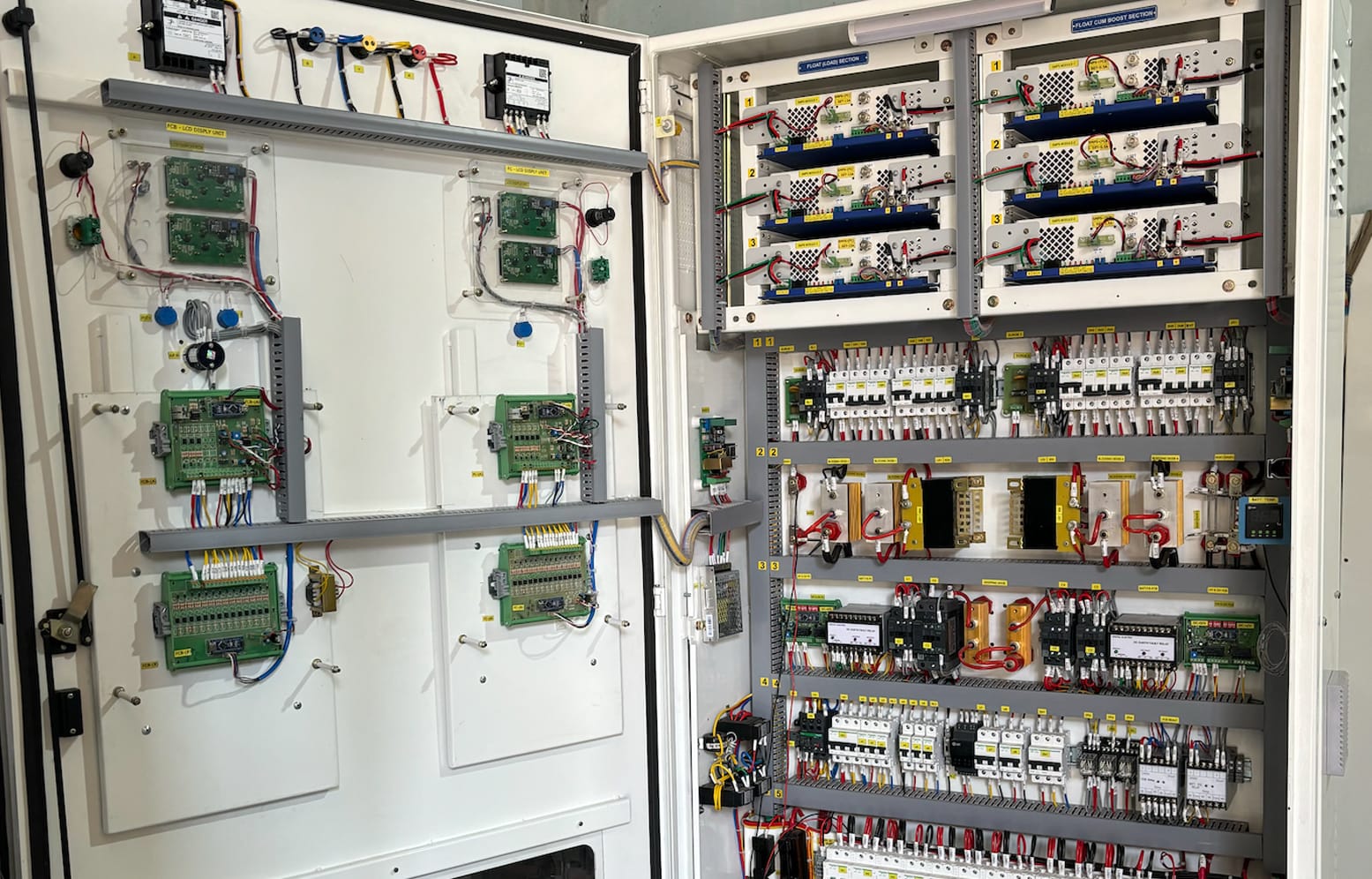
In an industrial facility, a battery charger does more than recharge a battery. It helps maintain the DC supply required by essential equipment when the normal power source is unavailable or when the system depends on a continuous DC supply.
For example, substations may use battery-backed DC systems for protection and control equipment. Telecom facilities depend on backup power to support communication infrastructure, while industrial plants may require reliable DC supplies for control and monitoring systems.
When selecting an industrial battery charger, engineers often compare two technologies: switch-mode power supply (SMPS) chargers and thyristor-controlled chargers.
Both can be suitable for industrial applications. However, the right choice depends on the required DC voltage and current, battery type, connected load, operating environment, redundancy requirements and project specifications.
This guide explains the differences and provides a practical way to evaluate the options before purchasing a charger.
What Is an SMPS Battery Charger?
An SMPS battery charger uses high-frequency switching electronics to convert incoming AC power into regulated DC power for battery charging and, where designed for it, connected DC loads.
Depending on the design, an industrial SMPS charger may include modular rectifier units, electronic protection, voltage and current monitoring, alarms and communication interfaces.
Potential advantages include:
Compact equipment design.
High conversion efficiency in appropriately designed models.
Precise electronic control of charging voltage and current.
Low output ripple when supported by the design and filtering.
Modular expansion or redundancy where these features are provided.
Remote monitoring when compatible communication facilities are available.
These characteristics can be useful when installation space, energy consumption, monitoring or system expansion is important.
However, not every SMPS charger includes every feature. Buyers should check the exact model’s datasheet rather than assume that modular operation, remote monitoring or redundancy is standard.
What Is a Thyristor Battery Charger?
A thyristor battery charger uses silicon-controlled rectifiers (SCRs), also called thyristors, to control the conversion of AC power into DC power.
Industrial thyristor chargers have been used in applications such as substations, power plants, switchgear systems and other facilities that require dedicated DC power infrastructure.
Depending on the design, they may offer:
Robust construction for industrial environments.
Configurations suitable for high-current applications.
Transformer-based isolation where specified.
Adjustable charging voltage and current.
Float and boost charging modes where provided.
Protection and alarm functions according to the selected configuration.
Some installations continue using thyristor chargers because they suit existing infrastructure, maintenance practices or project specifications. Their suitability should be evaluated using actual performance requirements, not technology type alone.
SMPS vs Thyristor Charger: Key Differences
| Selection factor | SMPS battery charger | Thyristor battery charger |
|---|---|---|
| Conversion method | High-frequency switching | SCR-based controlled rectification |
| Physical size | Often more compact | Often larger in comparable conventional designs |
| Efficiency | Can be high; verify rated-load performance | Depends on design, rating and operating conditions |
| Output ripple | Can be low with suitable design and filtering | Depends on rectifier configuration and filtering |
| Voltage regulation | Depends on control design and specification | Depends on control design and specification |
| Expansion | Modular expansion may be available | Depends on charger architecture |
| Redundancy | Modular or parallel redundancy may be available | Redundant arrangements may also be designed |
| Monitoring | Digital monitoring and communication may be available | Digital monitoring and communication may also be available |
| Maintenance | Depends on modules, controls, cooling and service arrangements | Depends on components, filters, cooling and service arrangements |
| Best selection approach | Evaluate efficiency, space, controls and expansion | Evaluate duty, environmental conditions, maintainability and project requirements |
Important: This is a general technology comparison, not a guaranteed performance comparison between every product. Request the relevant datasheets and compare equivalent ratings and test conditions.
Which Charger Is Better for Your Application?
There is no single answer for every industrial installation. The better option is the charger that meets the system requirements with appropriate reliability and lifecycle cost.
When an SMPS charger may be suitable
Consider an SMPS charger when your project places particular importance on:
Reducing equipment footprint.
Improving conversion efficiency.
Low ripple requirements for connected equipment or batteries.
Modular capacity expansion.
Monitoring alarms, voltage and current remotely.
Providing redundancy through compatible modules.
Confirm that the selected model supports the required DC output, operating temperature, load profile, battery chemistry and communication protocol.
When a thyristor charger may be suitable
Consider a thyristor charger when your project requires:
Compatibility with an established industrial DC system.
A configuration that meets the specified voltage and current ratings.
Construction suitable for the installation environment.
Maintainability consistent with the site’s available service skills and spare parts.
Compliance with an existing utility or project specification.
A conventional thyristor design should not be rejected solely because it is older technology. Likewise, an SMPS charger should not be selected solely because it is newer. The specification and actual performance must guide the decision.
Why Output Ripple Matters
Output ripple is the residual AC variation present in a charger’s DC output. Its significance depends on the battery type, connected DC equipment and operating arrangement.
For example, a substation DC system may supply protection relays, control circuits and other equipment that have defined supply requirements. Ripple performance can therefore be an important part of the charger specification.
When comparing products, ask the supplier to confirm:
The specified ripple limit.
Whether the value is RMS, peak-to-peak or expressed using another measurement.
Whether the measurement is taken with the battery connected or disconnected.
The load conditions and test method.
Whether additional filtering is required.
Do not compare ripple figures unless they use compatible measurement methods and operating conditions. A single generic ripple figure is not enough to establish that a charger is suitable for a particular installation.
How to Select the Correct Charger Capacity
Choosing a charger involves more than matching its ampere rating to the battery capacity.
The design should consider the battery manufacturer’s charging requirements, the DC load supplied during normal operation, the required recharge time and any specified emergency duty.
Start by gathering the following information:
DC system voltage: Confirm the nominal voltage and the permitted operating voltage range of the connected equipment.
Battery details: Record the battery chemistry, capacity in ampere-hours, configuration and manufacturer’s charging recommendations.
Continuous DC load: Establish the current required by connected equipment while the battery is being charged.
Recharge requirement: Determine how quickly the battery must recover after the expected discharge.
Duty and operating conditions: Identify any specified short-duration loads, environmental conditions and redundancy requirements.
Charger operating modes: Confirm whether float, boost, current limiting, temperature compensation or other functions are required.
The charger should then be selected and verified against the project’s electrical design and the battery manufacturer’s instructions. A simple rule of thumb cannot replace a proper calculation for a critical DC system.
Features to Check Before Purchasing
Before requesting a quotation, compare the following features against your project specification.
Electrical performance
Check input voltage and frequency, rated DC output voltage, current capacity, voltage regulation, ripple limits and efficiency at the relevant load.
Battery compatibility
Confirm that the charger supports the battery chemistry and the charging profile recommended by the battery manufacturer. Incorrect settings can shorten battery life or create unsafe operating conditions.
Protection and alarms
Review the specified protections, such as output overvoltage, overload, short circuit, overheating and battery reverse polarity protection where applicable. Also confirm which alarms are available and how faults are communicated.
Monitoring and communication
If operators need remote visibility, check for the required communication interface, protocol, alarm contacts and integration compatibility. Do not assume that a communication feature is included without confirmation.
Redundancy and future expansion
Where a DC supply is critical, determine whether a redundant charger arrangement is required. Confirm how a failure is handled, whether the system can maintain the required load and whether the proposed arrangement meets the project’s reliability criteria.
Installation and maintenance
Check enclosure protection, cooling method, ambient temperature rating, installation clearances, service access, spare-part availability and commissioning requirements.
These details help buyers compare complete solutions rather than selecting equipment based only on its headline rating.
Common Mistakes When Comparing Battery Chargers
Choosing only by price: Purchase price does not show the full cost of energy consumption, maintenance, spares and downtime.
Comparing non-equivalent ratings: Chargers with different DC voltages, current ratings or operating conditions cannot be compared fairly.
Ignoring the battery specification: The charger’s voltage settings and charging modes must be compatible with the selected battery.
Assuming all advertised features are standard: Monitoring, communication, redundancy and particular protection functions may depend on the model or configuration.
Overlooking the connected load: A charger must be evaluated for the complete DC system, not just the battery bank.
Ignoring the operating environment: Temperature, dust, ventilation and access for maintenance can affect equipment selection and service planning.
Frequently Asked Questions
Is an SMPS charger always better than a thyristor charger?
No. SMPS chargers can offer advantages in size, efficiency and electronic control, depending on the model. Thyristor chargers may be suitable for established industrial systems and particular project requirements. Compare verified specifications and lifecycle needs before deciding.
Are thyristor chargers suitable for substations?
They are used in substation DC applications. Suitability depends on the required DC system voltage, current, ripple, protection, redundancy, environmental conditions and the applicable project specification.
Why should I check charger ripple specifications?
Ripple can affect battery charging and the quality of the DC supply available to connected equipment. The acceptable limit depends on the application and relevant equipment requirements.
Can an SMPS charger support remote monitoring?
Some models provide monitoring and communication facilities. Confirm the available interfaces, protocols, alarms and compatibility with your monitoring system.
How do I determine the required charger current?
The selection should account for the battery’s charging requirements, the connected DC load, recharge time and specified duty. The final rating should be verified through the system design.
What information should I provide when requesting a charger quotation?
Provide the nominal DC voltage, required current or load details, battery type and capacity, application, operating environment, monitoring needs and any project specifications or preferred configuration.
Request an Industrial Battery Charger Recommendation
Selecting an industrial battery charger starts with understanding your electrical system and operating requirements. A suitable comparison of SMPS and thyristor technology should consider verified performance, battery compatibility, protection, maintenance and the needs of the installation.
Anushri Systech’s Vivatek power-solutions team can be contacted to discuss the appropriate charger options for your application. Confirm the available models and technical features with the company before finalising your selection.
To help the team understand your requirement, prepare:
Application: substation, telecom, industrial plant or another system.
Required DC voltage and current.
Battery type and capacity.
Connected load and recharge requirements.
Monitoring, redundancy and environmental requirements.
Contact the team to discuss your industrial battery charger requirements.
Phone: +91 9566117188 / +91 9841698180
Email: sales@anushri.info
Website: https://anushri.info/
For more information, visit the relevant Vivatek power-solutions page or battery energy storage systems page.