
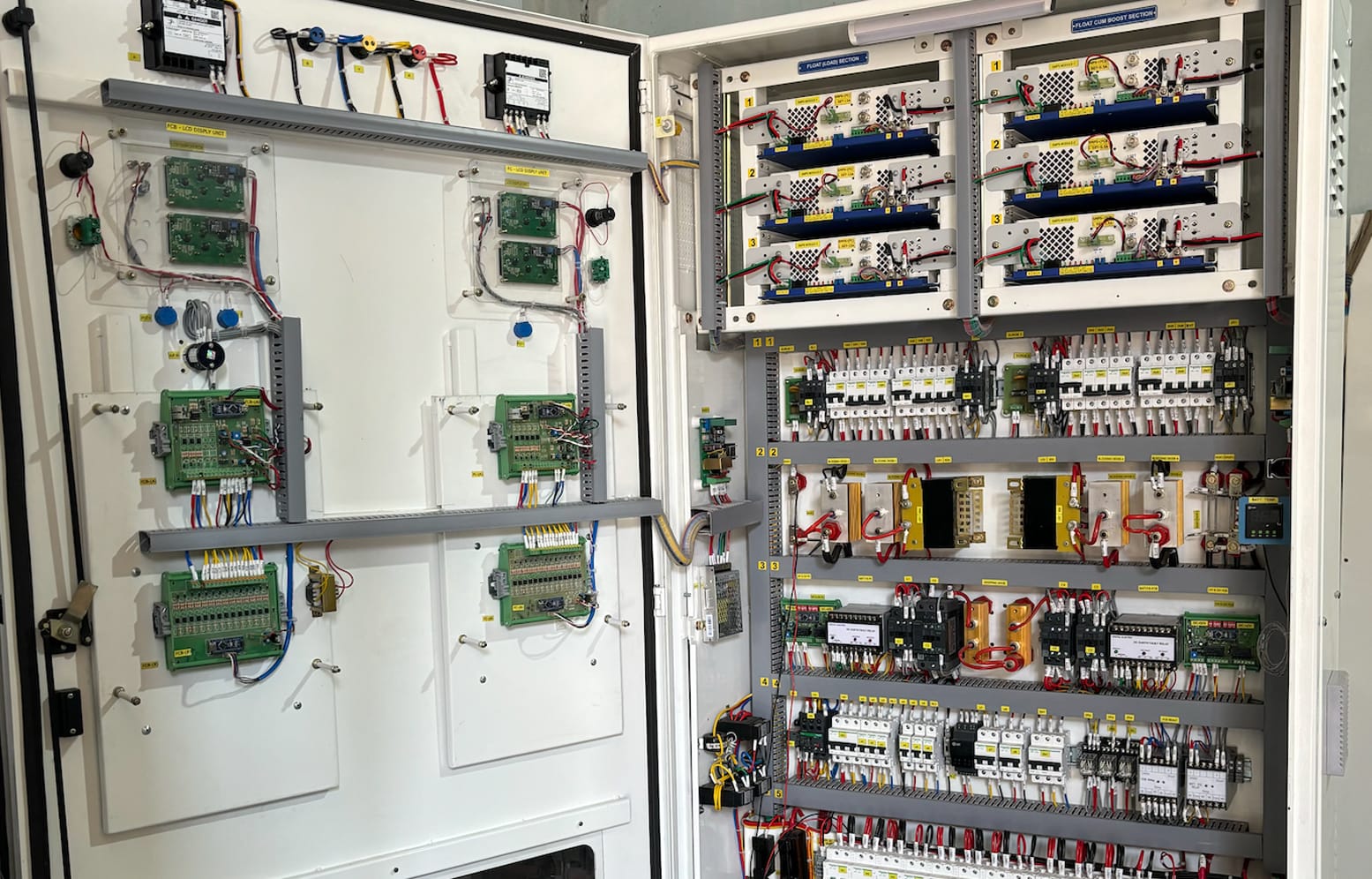
Industrial battery charging systems are critical for maintaining uninterrupted dc power continuity across substations, telecom infrastructure, power plants, industrial automation systems, battery banks, online ups systems, emergency backup infrastructure, and process industries.
Modern industrial environments depend heavily on reliable battery charging systems because improper charging infrastructure may affect:
- Battery operational life
- Backup continuity
- Charging efficiency
- Infrastructure reliability
- Emergency dc systems
- Telecom continuity
- Industrial automation operation
One of the most common technical questions asked by engineers and facility managers is:
“Which is better – SMPS battery charger or thyristor charger?”
Both charging technologies are widely used in industrial applications, but they differ significantly in:
✔ Charging efficiency
✔ Voltage regulation
✔ Ripple performance
✔ Infrastructure size
✔ Operational reliability
✔ Thermal management
✔ Maintenance requirement
✔ Energy efficiency
Understanding the operational differences between SMPS battery chargers and thyristor chargers helps industries select the right charging infrastructure for long-term operational continuity.
SMPS Battery Charger vs Thyristor Charger
SMPS battery chargers provide higher efficiency, compact design, faster response, low ripple output, and better energy optimization.
Thyristor chargers are traditionally used in heavy-duty industrial dc systems because of robust operational performance and high current handling capability.
Modern industries increasingly prefer SMPS battery chargers because of energy efficiency and intelligent operational features.
What Is an SMPS Battery Charger?
SMPS stands for Switch Mode Power Supply.
An SMPS battery charger converts ac power into regulated dc power using high-frequency switching technology.
SMPS chargers are commonly used in:
- Telecom infrastructure
- Industrial battery systems
- Online ups systems
- Data centers
- Automation systems
- Renewable energy infrastructure
These chargers are known for compact design and efficient charging performance.
What Is a Thyristor Battery Charger?
A thyristor charger uses silicon-controlled rectifier (SCR) technology for battery charging operation.
Thyristor charging systems are commonly used in:
✔ Substations
✔ Power plants
✔ Heavy industrial dc systems
✔ Process industries
✔ High-current applications
These chargers are known for robust industrial performance and high reliability in demanding operational environments.
Why Do Industries Compare SMPS and Thyristor Chargers?
Industrial environments compare these technologies because charging infrastructure directly affects:
- Battery operational life
- Backup reliability
- Energy efficiency
- Maintenance requirement
- Infrastructure scalability
Choosing the right charger technology improves long-term operational continuity significantly.
Why Are SMPS Chargers Becoming Popular?
Modern industries increasingly prefer SMPS chargers because they provide:
✔ Higher efficiency
✔ Compact infrastructure
✔ Lower heat generation
✔ Better voltage regulation
✔ Low ripple output
✔ Faster charging response
SMPS technology helps improve modern industrial power management significantly.
Why Are Thyristor Chargers Still Used in Industries?
Thyristor chargers are still widely used because they provide:
✔ Rugged industrial performance
✔ High current handling capability
✔ Proven operational reliability
✔ Stable dc infrastructure support
Heavy industrial applications often continue using thyristor-based charging systems because of operational familiarity and infrastructure compatibility.
What Is the Difference Between SMPS and Thyristor Charging Technology?
The primary difference is the charging method.
| Technology | Charging Method |
|---|---|
| SMPS Charger | High-frequency switching |
| Thyristor Charger | SCR-based phase control |
This difference affects efficiency, size, thermal behavior, and charging performance.
Why Is Efficiency Important in Battery Chargers?
Charging efficiency affects:
✔ Energy consumption
✔ Heat generation
✔ Operational cost
✔ Charging performance
SMPS chargers generally provide higher efficiency compared to conventional thyristor chargers.
Why Is Heat Generation Important?
Battery chargers generate heat during operation.
Excessive heat may affect:
- Battery charging stability
- Component operational life
- Infrastructure reliability
SMPS chargers typically generate lower heat because of higher conversion efficiency.
Why Is Voltage Regulation Important in Battery Charging?
Stable voltage regulation helps protect batteries from:
✔ Overcharging
✔ Undercharging
✔ Charging instability
Modern SMPS chargers generally provide more precise voltage regulation.
Why Is Ripple Voltage Important in Battery Systems?
Ripple voltage refers to unwanted ac fluctuation in dc output.
High ripple may affect:
- Battery operational life
- Sensitive dc equipment
- Communication systems
SMPS chargers commonly provide lower ripple output compared to traditional charging infrastructure.
Why Is Charger Size Important in Modern Industries?
Industrial facilities increasingly require compact infrastructure because of limited installation space.
SMPS chargers are usually:
✔ Smaller
✔ Lighter
✔ Easier to install
Compact infrastructure improves modern industrial flexibility significantly.
Why Is Fast Response Important in Battery Chargers?
Industrial dc systems often experience sudden load changes.
Fast response helps improve:
✔ Charging stability
✔ Battery protection
✔ Dc power continuity
SMPS chargers generally respond faster to load variation conditions.
Why Is Maintenance Important in Charger Infrastructure?
Industrial facilities prefer low-maintenance infrastructure to reduce downtime risk.
Modern SMPS chargers generally require less maintenance because of:
- Compact design
- Intelligent control systems
- Reduced mechanical stress
However, thyristor chargers are known for long-term rugged operation in harsh industrial environments.
Why Is Reliability Important in Industrial Charging Systems?
Battery chargers support critical dc infrastructure in:
- Power plants
- Substations
- Telecom systems
- Industrial automation
- Emergency systems
Reliable charger infrastructure improves operational continuity significantly.
Why Do Substations Commonly Use Thyristor Chargers?
Substations often operate in demanding environments requiring:
✔ High current capability
✔ Long-term reliability
✔ Rugged dc infrastructure
Thyristor chargers have historically been widely used in utility and substation applications.
Why Are Telecom Systems Moving Toward SMPS Chargers?
Telecom environments increasingly prefer SMPS chargers because they provide:
✔ High efficiency
✔ Compact installation
✔ Remote monitoring capability
✔ Better energy optimization
Modern telecom infrastructure increasingly uses intelligent SMPS charging systems.
Why Is Smart Monitoring Important in Battery Chargers?
Modern charging systems increasingly include smart monitoring features for:
- Remote diagnostics
- Voltage monitoring
- Charging analysis
- Alarm systems
- Predictive maintenance
Smart infrastructure improves operational reliability significantly.
Why Is Energy Efficiency Important in Modern Industries?
Industries increasingly focus on reducing:
✔ Operational energy cost
✔ Heat generation
✔ Infrastructure losses
Energy-efficient charging systems help improve long-term infrastructure optimization significantly.
Why Is Scalability Important in Charger Systems?
Industrial load demand often increases over time.
Scalable charger infrastructure helps support:
✔ Future battery expansion
✔ Additional dc load requirement
✔ Infrastructure modernization
Modern SMPS systems commonly provide modular scalability advantages.
Why Is Redundancy Important in Industrial Charging Infrastructure?
Critical industrial dc systems often use redundant charging systems to improve reliability.
Redundant infrastructure helps reduce:
✔ Operational downtime
✔ Dc system interruption
✔ Single-point failure risk
Reliable charging continuity is essential for critical industrial operation.
SMPS Charger vs Thyristor Charger Comparison Table
| Feature | SMPS Charger | Thyristor Charger |
|---|---|---|
| Efficiency | High | Moderate |
| Heat Generation | Low | Higher |
| Size | Compact | Larger |
| Ripple Output | Low | Moderate |
| Voltage Regulation | Precise | Stable |
| Maintenance | Lower | Moderate |
| Industrial Ruggedness | Good | Excellent |
| Response Speed | Fast | Moderate |
| Energy Optimization | Excellent | Moderate |
Common Charging Problems vs Recommended Solution
| Charging Problem | Recommended Solution |
|---|---|
| Battery Overheating | Improve charger efficiency |
| Voltage Instability | Use regulated charging |
| High Ripple Output | Upgrade charger technology |
| High Maintenance | Use smart charging systems |
| Charging Delay | Optimize charger capacity |
| Dc Infrastructure Failure | Use redundant charging systems |
Which Industries Use SMPS Battery Chargers?
SMPS chargers are widely used in:
- Telecom infrastructure
- Data centers
- Automation systems
- Solar battery systems
- Online ups infrastructure
- Industrial electronics
These environments require efficient and intelligent charging infrastructure.
Which Industries Use Thyristor Chargers?
Thyristor chargers are commonly used in:
✔ Substations
✔ Power plants
✔ Steel industries
✔ Heavy industrial environments
✔ Utility infrastructure
These applications require robust high-current dc systems.
Benefits of SMPS Battery Chargers
✔ High efficiency
✔ Compact design
✔ Low ripple output
✔ Intelligent monitoring
✔ Reduced energy loss
✔ Faster charging response
SMPS chargers improve modern industrial charging infrastructure significantly.
Benefits of Thyristor Chargers
✔ Rugged industrial design
✔ High current handling capability
✔ Proven operational reliability
✔ Long industrial usage history
Thyristor chargers continue supporting heavy industrial dc infrastructure globally.
Real Industrial Example
A telecom infrastructure operator managing remote communication systems experienced high energy consumption and charging instability using traditional charging infrastructure.
The telecom network later upgraded to intelligent SMPS battery charging systems integrated with smart monitoring infrastructure.
This significantly improved:
✔ Charging efficiency
✔ Backup reliability
✔ Thermal management
✔ Remote diagnostics capability
✔ Energy optimization
Meanwhile, a heavy industrial utility environment operating large dc systems continued using thyristor chargers because of high current operational requirements and rugged environmental conditions.
Both technologies remained effective when selected properly according to application requirement.
Why Is Charger Selection Important for Long-Term Infrastructure Planning?
Battery charger infrastructure directly affects:
- Battery operational life
- Backup continuity
- Infrastructure reliability
- Operational efficiency
- Maintenance planning
Proper charger selection helps industries improve long-term dc system reliability significantly.
Industrial Battery Charging Expertise
Industrial charging infrastructure planning requires understanding of:
- Dc systems
- Battery charging technology
- Ripple management
- Voltage regulation
- Thermal management
- Industrial backup continuity
- Infrastructure scalability
Substations, telecom systems, industrial automation environments, power plants, online ups infrastructure, renewable energy systems, and industrial battery environments commonly require reliable battery charger infrastructure for uninterrupted operational continuity.
Vivatek provides SMPS battery chargers, thyristor chargers, industrial dc systems, telecom charging infrastructure, online ups systems, substation battery chargers, and industrial backup continuity solutions for industrial and commercial applications across India.
Frequently Asked Questions
What is the difference between SMPS and thyristor chargers?
SMPS chargers use high-frequency switching technology, while thyristor chargers use SCR-based phase control charging technology.
Why are SMPS chargers becoming popular?
SMPS chargers provide higher efficiency, compact size, lower heat generation, and intelligent monitoring features.
Why are thyristor chargers still used in industries?
Thyristor chargers provide rugged industrial performance and high current handling capability.
Which charger is better for telecom systems?
Telecom systems increasingly prefer SMPS chargers because of high efficiency and compact infrastructure.
Why is ripple voltage important in battery charging?
High ripple voltage may reduce battery operational life and affect sensitive dc equipment.
Why is charger efficiency important?
Higher charger efficiency reduces energy loss, heat generation, and operational cost.
Talk to Our Technical Team
Substations, telecom infrastructure, power plants, industrial automation systems, online ups infrastructure, renewable energy environments, and industrial battery systems often require reliable battery charging infrastructure for uninterrupted operational continuity.
Vivatek provides SMPS battery chargers, thyristor chargers, industrial dc systems, telecom charging infrastructure, substation battery chargers, online ups systems, and backup continuity solutions for industrial and commercial applications across India.
📞 Contact: +91 9566117188 / 9841698180
📧 Email: sales@anushri.info
🌐 Website: https://anushri.info/