
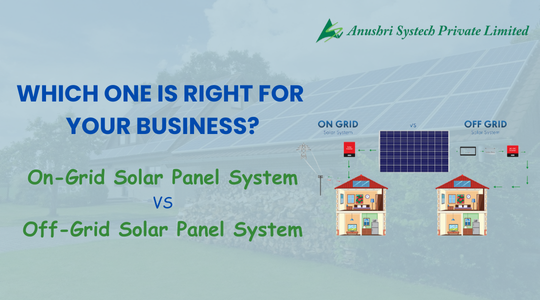
Choosing a solar system for a business is not simply a matter of selecting a certain number of panels. For an industrial plant or commercial facility, the right configuration depends on how electricity is consumed, how reliable the grid is, what equipment must remain operational during an outage, and how the business plans to use energy in the future.
A manufacturing facility with a dependable grid connection may have completely different requirements from a remote warehouse, mining site or telecom installation. Some businesses primarily want to reduce daytime electricity purchases, while others need greater energy independence or backup for critical equipment.
This is where the difference between on-grid, off-grid and hybrid solar systems becomes important.
Anushri Systech Pvt Ltd provides power solutions for industrial and commercial applications through its own ASPL solar brand and also supplies selected products from other manufacturers as a dealer, supplier and distributor. This allows customers to evaluate different technologies and brands according to their application, technical specifications and project requirements.
What Is an On-Grid Solar System?
An on-grid solar system operates in conjunction with the utility electricity network.
Solar modules generate DC electricity during daylight hours. An inverter converts this electricity into AC power, which can then be used by the facility’s electrical loads.
A simplified arrangement is:
Solar PV → Inverter → Electrical Distribution → Facility Loads
The utility remains connected to the facility and supplies electricity whenever solar generation is insufficient.
If the project and local utility arrangement permit electricity export, excess generation may also be supplied to the grid according to the applicable metering and regulatory framework.
This configuration is generally attractive for businesses that already have a usable grid connection and consume a significant amount of electricity during solar-generation hours.
How On-Grid Solar Fits Into a Business
Consider a manufacturing unit operating from morning until evening.
During working hours, the facility may operate motors, compressors, pumps, HVAC systems, lighting and production machinery. Solar generation during these hours can be used by the facility instead of purchasing the same amount of electricity from the grid.
When solar output decreases, the grid can continue supplying the remaining requirement.
This makes the system part of the facility’s normal energy infrastructure rather than a completely independent power source.
Advantages of an On-Grid Configuration
For a suitable commercial or industrial site, a grid-connected arrangement can offer several practical benefits.
The system generally does not require a large battery bank for normal operation. This can simplify the installation and reduce the amount of battery-related maintenance.
It can also be easier to expand when the facility’s electrical demand increases, provided the existing electrical infrastructure and utility requirements allow the additional capacity.
For businesses with strong daytime consumption, the alignment between generation and demand can be particularly useful.
However, the financial benefit should always be calculated using the customer’s actual electricity consumption, tariff structure, generation estimate and project cost.
Grid-Connected Solar Is Not Automatically Backup Power
This is one of the most common misunderstandings among first-time buyers.
A conventional grid-connected solar inverter normally disconnects from the utility during a grid outage.
Therefore:
On-grid solar does not automatically mean uninterrupted power during a power cut.
This happens because the system must avoid energizing a utility network that may be undergoing maintenance.
If the business needs power during an outage, additional equipment may be required.
Depending on the application, this can include:
- UPS
- Battery Energy Storage System
- Generator
- Hybrid inverter
- Critical-load distribution
- Microgrid controls
The appropriate arrangement depends on which loads need to remain operational.
What Is an Off-Grid Solar System?
An off-grid system operates without depending on the utility grid as its normal electricity source.
Solar generation supplies the facility, while battery storage is normally used to retain energy for periods when sunlight is unavailable.
A simplified arrangement is:
Solar PV → Charge/Power Management → Battery → Inverter → Loads
Because there is no utility network available to compensate for a shortfall, the system needs to be carefully designed around the facility’s complete energy requirement.
This makes off-grid design considerably different from a conventional grid-connected installation.
Where Off-Grid Systems Can Be Useful
Independent solar systems can be considered for locations where grid access is unavailable, unreliable or economically impractical.
Potential applications include:
- Remote industrial facilities
- Mining locations
- Agricultural infrastructure
- Telecom installations
- Remote warehouses
- Pumping stations
- Monitoring stations
- Rural commercial facilities
- Isolated infrastructure projects
The system should be evaluated based on actual site conditions rather than assuming that an off-grid configuration is automatically the better choice.
Why Battery Storage Becomes Important Off-Grid
Solar generation changes throughout the day.
A business may need electricity:
- Before sunrise
- During cloudy periods
- After sunset
- During periods of high demand
Battery storage bridges the gap between energy generation and energy consumption.
Battery sizing therefore needs to consider the facility’s load profile, required backup duration and expected solar production.
Battery Sizing: kW and kWh Are Not the Same
Battery specifications can be confusing if power and energy are treated as the same thing.
kW indicates how much power the battery can deliver at a given time.
kWh indicates how much energy is stored.
For example, a facility requiring a large electrical load for a short period has a different battery requirement from a facility needing a smaller load for several hours.
Battery sizing may therefore consider:
- Peak load
- Average load
- Backup duration
- Critical-load requirement
- Depth of discharge
- Charging efficiency
- Battery temperature
- Cycling frequency
- Future load growth
Selecting the Right Battery Technology
Battery selection should be based on the application.
Depending on the project, customers may evaluate technologies such as:
Lithium-Ion
Useful where compact design, high energy density and frequent cycling are important.
VRLA
Suitable for various backup applications where sealed lead-acid technology meets the operating requirements.
Ni-Cd
Often considered for demanding industrial environments where durability and temperature tolerance are important.
FIAMM Battery Solutions
FIAMM products can be evaluated for suitable industrial and commercial applications based on the required specifications.
The correct battery should be selected after reviewing the actual operating conditions rather than simply choosing a technology because it is popular.
What Is a Hybrid Solar System?
Many industrial and commercial facilities do not fit perfectly into either the on-grid or off-grid category.
A hybrid system can combine multiple power sources.
For example:
Solar + Grid + BESS + Generator
The exact configuration depends on the facility’s requirements.
Solar can provide energy during suitable conditions, the grid can supply additional demand, batteries can support selected loads or energy-management functions, and a generator can provide extended backup where required.
When Does Hybrid Solar Make Sense?
A hybrid arrangement may be worth evaluating when a business has:
- Frequent utility interruptions
- Critical production processes
- High-value electrical equipment
- Existing generator infrastructure
- Significant daytime consumption
- Energy-storage requirements
- Peak-demand concerns
- Remote or weak-grid conditions
The objective is not necessarily to make the entire facility independent.
Instead, the system can be designed around the loads that are most important to the business.
Critical Loads and Non-Critical Loads
A large industrial facility may have hundreds of electrical loads, but not all of them need backup power.
Critical loads could include:
- PLC systems
- Automation controllers
- Control rooms
- Servers
- Communication systems
- Security systems
- Emergency systems
- Selected production equipment
Other equipment may be allowed to shut down temporarily during an outage.
Separating these loads can significantly influence the required battery, UPS and backup capacity.
Solar and UPS: Two Different Functions
Solar generation and UPS systems solve different problems.
Solar primarily generates electricity.
A UPS provides immediate continuity and power protection for sensitive equipment.
A facility could therefore use solar for its general energy requirement while retaining a UPS for critical equipment such as automation, servers and control systems.
This is particularly relevant to facilities where even a short interruption can affect production or data.
Solar and Diesel Generator Integration
Industrial facilities often already have diesel generators.
Installing solar does not necessarily mean removing the generator.
The three systems can have different roles:
Solar: Renewable energy generation
Battery: Energy storage and selected backup
Generator: Extended emergency supply
Appropriate controls, protection and operating logic are required when these sources are integrated.
This should be addressed during engineering rather than after installation.
Solar and BESS Integration
A Battery Energy Storage System can provide additional flexibility to a solar project.
Depending on the application, storage can support:
- Energy shifting
- Peak-demand management
- Selected-load backup
- Renewable-energy utilization
- Microgrid operation
- Energy resilience
The storage system should be sized according to its intended function.
A large solar plant does not automatically require a similarly large battery.
Comparing On-Grid, Off-Grid and Hybrid Systems
| Requirement | On-Grid | Off-Grid | Hybrid |
|---|---|---|---|
| Utility connection | Required | Not required for normal operation | Usually available |
| Battery | Normally optional | Essential for continuous operation | Optional but commonly used |
| Grid outage backup | Not normally available | Designed into system | Can be designed |
| Energy independence | Limited | High | Flexible |
| System complexity | Lower | Higher | Higher |
| Typical application | Grid-connected businesses | Remote facilities | Critical or variable requirements |
| Battery lifecycle planning | Limited | Important | Important |
| Generator integration | Possible | Possible | Common where required |
There is no universally superior configuration. The right choice depends on the site.
Industrial Solar Requires Load Analysis
A common mistake is to calculate the plant capacity only from the available roof area.
A proper assessment should consider:
- Monthly electricity consumption
- Maximum demand
- Connected load
- Operating hours
- Shift pattern
- Daytime consumption
- Night-time consumption
- Major machinery
- Future expansion
This gives the engineering team a realistic basis for system design.
Solar for Manufacturing Plants
Manufacturing facilities often have complex electrical requirements.
Typical loads may include:
- Motors
- Compressors
- Pumps
- Chillers
- HVAC
- Furnaces
- Welding systems
- CNC machines
- Automation
- Production lines
The load profile can change considerably between shifts.
For this reason, a factory should not be treated like a standard commercial rooftop.
The solar system should be designed around the production environment.
Solar for Warehouses and Logistics Facilities
Warehouses can have significant roof areas suitable for solar installation.
Electricity consumption may come from:
- Lighting
- HVAC
- Refrigeration
- Conveyors
- Material-handling systems
- Office areas
- Battery charging
Future requirements such as electric-vehicle charging can also influence the electrical design.
Solar for Offices and Commercial Buildings
Commercial buildings typically have substantial daytime consumption from:
- Air conditioning
- Lighting
- Elevators
- IT equipment
- Networking
- Ventilation
- Pumps
A grid-connected configuration can be useful where daytime consumption aligns with solar production.
Critical IT or communication equipment may still require separate UPS or battery support.
Solar for Hospitals and Critical Facilities
Hospitals have different priorities from ordinary commercial buildings.
Critical medical equipment cannot simply depend on solar generation alone.
A facility may require an integrated architecture involving:
Grid + Solar + UPS + BESS + Generator
Solar can contribute to energy generation while UPS and backup systems maintain continuity for critical loads.
Solar for Remote Industrial Sites
Remote sites can face several challenges:
- Limited grid access
- Difficult maintenance access
- High temperatures
- Dust
- Long cable distances
- Fuel logistics
An off-grid or hybrid configuration may be considered depending on the energy requirement.
Battery autonomy, generator backup and remote monitoring can become particularly important in these applications.
Site Assessment Before Installation
A solar feasibility study should evaluate more than the electricity bill.
The physical site may be assessed for:
- Roof condition
- Structural suitability
- Shading
- Solar exposure
- Available area
- Access
- Drainage
- Cable routes
- Equipment location
- Maintenance space
For ground-mounted projects, additional civil and land conditions need to be considered.
Roof Condition and Solar Project Life
A solar installation is a long-term asset.
If an industrial roof is already approaching the end of its useful life, installing solar without addressing the roof condition can create future problems.
The customer may eventually have to remove the solar equipment to repair or replace the roof.
This is why roof assessment should form part of the initial feasibility process.
Electrical Infrastructure Assessment
The existing electrical system should be reviewed before connecting a larger solar installation.
This may include:
- Transformer rating
- HT/LT panels
- Busbars
- Cables
- Protection devices
- Metering
- Interconnection point
- Existing generator
- Existing UPS
The solar system should be integrated into the facility without compromising safe operation.
HT and LT Integration
Industrial customers may operate through HT or LT electrical arrangements.
The appropriate interconnection method depends on the facility’s electrical architecture and applicable requirements.
For larger installations, the engineering team may need to evaluate:
- Transformer loading
- Switchgear
- Protection
- Metering
- Cable capacity
- Interconnection point
This is one reason professional engineering is important for larger projects.
DC and AC Capacity
The solar array’s DC capacity and inverter’s AC capacity are separate parameters.
They do not necessarily need to be identical.
The selected configuration can influence:
- Energy production
- Inverter utilization
- Clipping
- Equipment sizing
- Project economics
Procurement teams should therefore compare the complete system design instead of looking only at the advertised kW figure.
Solar Inverter Selection
The inverter should be selected according to both the solar array and the facility’s electrical requirements.
Important considerations can include:
- DC voltage
- MPPT range
- AC output
- Efficiency
- Protection
- Communication
- Monitoring
- Environmental conditions
- Service availability
For larger plants, multiple inverters may provide operational flexibility.
Power Quality Considerations
Industrial equipment can be sensitive to electrical conditions.
Facilities may operate:
- Variable-frequency drives
- Motors
- PLCs
- Automation
- Welding equipment
- Sensitive electronic systems
Depending on the project, engineers may review:
- Voltage
- Frequency
- Power factor
- Harmonics
- Protection coordination
Solar should therefore be integrated as part of the complete electrical system.
Solar Generation Is Not Constant
A plant’s rated capacity does not mean it will generate that amount continuously.
Actual production varies with:
- Solar irradiation
- Temperature
- Cloud cover
- Shading
- Soiling
- Module characteristics
- Inverter efficiency
- Electrical losses
- Equipment availability
Generation estimates should therefore be based on the project location and proposed system design.
Performance Ratio and Plant Availability
Performance Ratio can be used as one indicator of how effectively the plant is operating relative to the available solar resource.
Plant availability is another important consideration.
A system that is frequently unavailable cannot deliver its expected energy output.
Monitoring can help identify:
- Inverter faults
- Communication problems
- Reduced generation
- Equipment downtime
- Performance changes
Solar Monitoring
A suitable monitoring platform can provide information such as:
- Daily generation
- Monthly generation
- Inverter status
- Alarms
- Faults
- Historical performance
- Plant availability
For larger industrial facilities, this information can help the operations team identify problems without relying only on physical inspection.
Protection and Safety
Safety should be incorporated from the design stage.
The system may require:
- DC isolation
- AC isolation
- Surge protection
- Earthing
- Lightning protection
- Overcurrent protection
- Equipment labelling
- Safe maintenance access
The exact requirements depend on the system design and applicable standards.
Environmental Conditions
The installation environment can influence equipment selection.
Industrial and commercial sites may experience:
- High temperature
- Dust
- Humidity
- Coastal salt exposure
- Chemical atmosphere
- Vibration
Equipment and structures should therefore be selected according to actual site conditions.
Solar Project Cost
The project price depends on the complete scope.
Cost can be influenced by:
- Solar capacity
- Module selection
- Inverter selection
- Structure
- Electrical equipment
- Transformer requirements
- BESS
- Civil works
- Installation
- Monitoring
- Commissioning
- Site conditions
There is no single price per kW that accurately represents every project.
Evaluating ROI and Payback
A realistic financial evaluation should consider:
- Project investment
- Expected annual generation
- Electricity tariff
- Self-consumption
- Export arrangements
- Maintenance
- Financing
- Equipment degradation
- Replacement requirements
A generic payback period should not be presented as a guarantee.
The actual result depends on the project.
Total Cost of Ownership
The initial purchase price is only one part of the financial decision.
Businesses should also consider:
CAPEX + Maintenance + Spare Parts + Replacement + Service + Downtime Risk
For systems containing batteries, battery replacement and lifecycle performance can have a significant impact on long-term economics.
Financing and Commercial Models
Depending on eligibility and applicable regulations, businesses may consider different project models, including:
- Direct purchase
- Bank-financed projects
- EPC procurement
- Captive arrangements
- Open-access projects
- Other third-party structures
The right model depends on the customer’s financial strategy and project circumstances.
Utility and Regulatory Considerations
Grid-connected projects can involve utility-specific requirements related to:
- Interconnection
- Metering
- Protection
- Approvals
- Export arrangements
These requirements vary by location and can change over time.
Customers should therefore verify the current requirements applicable to their facility before finalizing financial projections.
Existing Solar System Upgrades
A business that already has solar may not need a complete replacement.
Depending on the system’s condition, options may include:
- Additional PV capacity
- Inverter replacement
- BESS integration
- Monitoring upgrade
- Protection upgrade
- Electrical infrastructure modification
- Replacement of damaged modules
A technical assessment should determine whether the existing system can be expanded or modernized.
Adding BESS to an Existing Solar Plant
Some businesses initially install grid-connected solar and later identify a requirement for storage.
A retrofit can be considered if the existing electrical architecture and equipment are compatible.
The purpose of the storage should first be established.
It could be:
- Critical-load backup
- Energy shifting
- Peak management
- Renewable-energy utilization
The BESS should then be sized around that purpose.
Maintenance and Service
A solar installation is designed for long-term operation, but it still requires appropriate maintenance.
Depending on the environment, maintenance may include:
- Module cleaning
- Visual inspection
- Inverter checks
- Cable inspection
- Structure inspection
- Earthing checks
- Protection checks
- Monitoring review
Dusty industrial locations may require a different maintenance schedule from clean commercial environments.
Warranty vs AMC
These two services should not be confused.
A product warranty generally covers specified manufacturing or product-related issues under the manufacturer’s terms.
An AMC provides ongoing service such as inspection, preventive maintenance and technical support.
Before purchasing, customers should understand:
- Warranty duration
- Warranty exclusions
- Claim process
- Service response
- AMC scope
- Preventive maintenance frequency
Spare Parts and Long-Term Support
The availability of replacement components can become important several years after installation.
Customers should consider:
- Inverter service
- Spare components
- Monitoring equipment
- Protection devices
- Technical support
- Warranty handling
- Replacement timelines
A reliable supply and service network can reduce downtime when equipment requires attention.
Common Mistakes to Avoid
Choosing only by price
A lower quotation may have a narrower scope or different equipment.
Sizing from roof area alone
The electricity requirement should also be considered.
Assuming on-grid solar provides backup
A conventional grid-connected system normally disconnects during a grid outage.
Oversizing storage
Battery capacity should be calculated from the actual requirement.
Ignoring the existing electrical system
Transformer and panel capacity can affect project design.
Ignoring future expansion
A growing business may need a different electrical architecture later.
Choosing equipment without service support
Long-term availability matters for industrial assets.
Using unrealistic financial assumptions
ROI should be calculated using actual project data.
Decision Guide
On-Grid
Consider this when:
- Grid supply is available
- Daytime consumption is significant
- Primary objective is energy-cost management
- Backup is not required from the solar plant itself
Off-Grid
Consider this when:
- Grid supply is unavailable
- Grid extension is impractical
- Energy independence is important
- Battery storage can support the required load
Hybrid
Consider this when:
- Grid reliability is a concern
- Critical loads require backup
- Energy storage is required
- Generator integration is needed
- The business wants greater energy flexibility
Frequently Asked Questions
Which system is suitable for an industrial factory?
It depends on grid availability, consumption pattern, operating hours, critical loads, site conditions and future requirements.
Is on-grid solar suitable for commercial buildings?
It can be suitable for buildings with a usable grid connection and sufficient daytime electricity consumption.
Does off-grid solar work without batteries?
A fully independent system generally requires energy storage or another source of power to cover periods when solar generation is unavailable.
Can a factory use solar with a diesel generator?
Yes. Solar, battery storage and generators can be integrated when the system is properly engineered.
Can BESS be added later?
In many projects, storage can be added later, but compatibility and electrical integration should be assessed before selecting the equipment.
Is ASPL Anushri Systech’s own brand?
Yes. ASPL is Anushri Systech’s own solar brand.
Does Anushri Systech supply other brands?
Yes. The company also works with selected manufacturers as a dealer, supplier and distributor.
Can Anushri support EPC projects?
Yes. Depending on the project scope, support can include product selection, technical documentation, supply, installation, testing and commissioning.
What information is required before selecting a system?
Electricity bills, maximum demand, operating hours, site details, roof or land information and existing electrical-system details are useful starting information.
Does solar completely eliminate grid electricity?
Not necessarily. The result depends on system capacity, consumption pattern, operating hours, generation and the chosen system architecture.
Conclusion
Choosing between on-grid and off-grid solar should begin with the business requirement, not with the equipment.
A factory with dependable grid power and significant daytime consumption may find a grid-connected installation practical.
A remote facility may require an independent system with battery storage.
A business concerned about both energy costs and power continuity may benefit from a hybrid architecture combining solar with batteries, UPS systems or generators.
The most important step is understanding how the facility consumes electricity and what the business expects the power system to achieve.
Anushri Systech Pvt Ltd supports industrial and commercial requirements through ASPL, its own solar brand, while also supplying selected products from other manufacturers through its dealer, supplier and distributor network.
This approach allows customers, EPC contractors, consultants and procurement teams to evaluate different equipment options while keeping the focus on application, engineering, reliability and long-term value.
📞 +91 9566117188 // +91 9841698180
📧 sales@anushri.info
📍2/27, Luz Ave 3rd St, East Abiramapuram, Mylapore, Chennai, Tamil Nadu 600004