
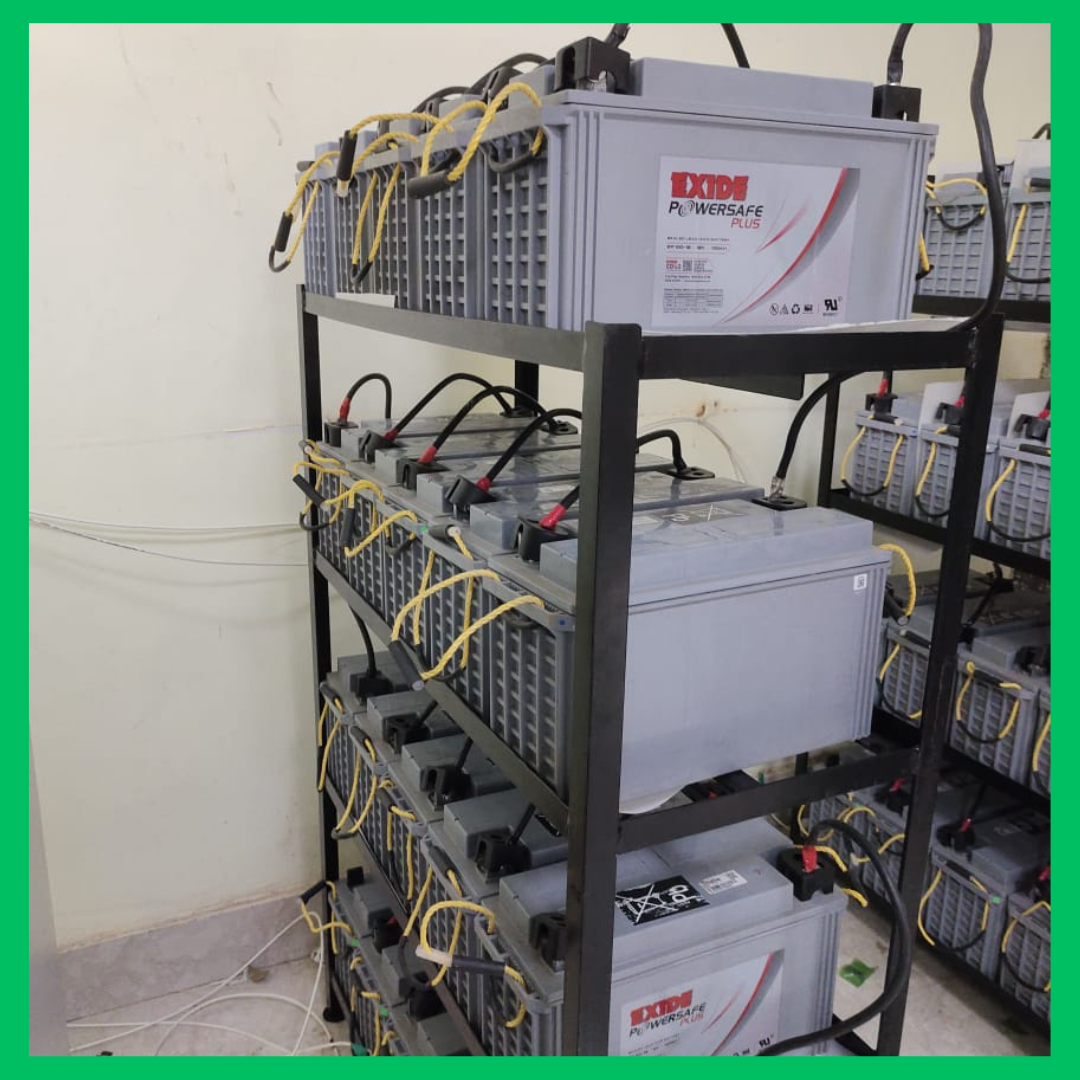
Industrial battery selection is not a simple competition between technologies.
Lithium, lead-acid and nickel-cadmium batteries have different characteristics and can be appropriate for different applications.
For a business planning a new installation or replacing an existing battery bank, the right decision should consider the complete operating environment, not just the purchase price.
Lithium Batteries
Lithium technology has become increasingly relevant to modern commercial and industrial energy-storage applications.
For suitable systems, lithium can offer:
- Compact installation
- Efficient charging
- High cycle capability
- Reduced routine maintenance
- Battery monitoring through BMS
- Flexible rack and cabinet configurations
Anushri Systech manufactures lithium solutions under the Vivatek brand and also supplies selected lithium battery brands.
Lithium can be considered for UPS systems, solar storage, telecom, ESS, BESS and industrial applications where the system requirements are compatible.
Lead-Acid Batteries
Lead-acid batteries remain widely used in backup power.
Their established technology, availability and familiarity make them suitable for many UPS and stationary applications.
Different lead-acid constructions are designed for different operating requirements.
Businesses should evaluate:
- Expected backup duration
- Discharge profile
- Maintenance requirements
- Installation environment
- Available space
- Expected service period
Nickel-Cadmium Batteries
Ni-Cd batteries are used in specialised industrial and infrastructure applications.
They can be considered where robust operation, long service life and tolerance to demanding environmental conditions are important.
Applications may include:
- Railways
- Telecom
- Utilities
- Industrial facilities
- Infrastructure
- Emergency systems
The environmental and regulatory considerations associated with Ni-Cd should also be taken into account when evaluating the technology.
Simple Comparison
| Factor | Lithium | Lead-Acid | Ni-Cd |
|---|---|---|---|
| Space efficiency | Generally high | Generally lower | Application dependent |
| Routine maintenance | Low for suitable systems | Depends on type | Depends on system |
| Cycle capability | Generally high | Depends on type | Generally robust |
| Charging characteristics | Efficient within specified limits | Established | Robust |
| Monitoring | BMS commonly integrated | Depends on system | Depends on system |
| Typical use | UPS, solar, ESS, BESS | UPS, backup | Industrial/infrastructure |
| Initial cost | Usually higher | Often lower | Often higher |
| Selection priority | System compatibility | Application and maintenance | Environment and duty |
This comparison is general. Actual performance depends on the battery model, chemistry, configuration and operating conditions.
Space Requirements
Space can become an important factor in commercial and industrial facilities.
A battery installation occupies more than just the physical battery dimensions.
The project may also require:
- Battery racks
- Cabinets
- Cable space
- Service access
- Protection equipment
- Ventilation or environmental control
Lithium systems can provide a compact solution in suitable applications, but the actual installation should always be evaluated using the manufacturer’s specifications.
Maintenance Considerations
Maintenance requirements vary significantly between technologies and battery types.
Some lead-acid systems require more regular inspection and maintenance than sealed or lithium systems.
Lithium batteries generally rely on electronic monitoring through the BMS and require appropriate system-level inspection and servicing.
The maintenance plan should therefore be considered during the initial technology selection.
Charging and Discharging
The battery should be selected according to the application’s charging and discharge profile.
A battery used mainly for occasional UPS backup may have a different operating pattern from a battery used every day for solar energy shifting.
For renewable-energy applications, the number of daily cycles can become an important selection factor.
Temperature and Site Conditions
Temperature affects battery performance and service life.
The installation environment should therefore be reviewed before selecting the technology.
Consider:
Ambient temperature → Battery-room conditions → Ventilation → Installation location → Cooling requirements
For demanding industrial environments, these factors can be as important as the battery’s electrical specifications.
Total Cost Matters More Than Purchase Price
A battery’s initial price does not represent its complete cost.
Businesses should consider:
Purchase → Installation → Maintenance → Energy efficiency → Replacement frequency → Space → Monitoring → Disposal
A higher initial investment can sometimes make sense if the technology provides benefits that match the application’s long-term requirements.
The opposite can also be true: a lower-cost technology may be more practical when the application does not require advanced features.
Which Technology Should You Choose?
Lithium may be worth evaluating when:
- Space is limited
- Reduced routine maintenance is important
- Frequent cycling is expected
- Solar storage is required
- Advanced battery monitoring is useful
- The UPS or energy-storage system supports lithium
Lead-acid may be appropriate when:
- Established backup technology is preferred
- The application has a suitable operating profile
- Initial investment is a major consideration
- The installation environment supports the battery type
Ni-Cd may be considered when:
- The application is demanding
- Robust industrial operation is important
- Long service life is required
- The project environment suits Ni-Cd technology
Anushri Systech’s Multi-Brand Approach
Anushri Systech does not restrict customers to a single battery manufacturer.
We manufacture Vivatek lithium battery solutions and also act as a dealer, supplier and distributor of selected battery brands.
This approach allows B2B customers to discuss solutions according to their:
- Technical specification
- Application
- Existing equipment
- Approved vendor requirements
- Project budget
- Procurement requirements
FAQs
Is lithium always better than lead-acid?
No. The appropriate technology depends on the application, operating profile, budget, space and system compatibility.
Which battery is suitable for industrial UPS systems?
Lithium, lead-acid and Ni-Cd can all be used in suitable applications. The UPS and project requirements determine the appropriate choice.
Is lithium suitable for solar storage?
Yes, suitable lithium systems are widely used for solar energy storage applications.
Are Ni-Cd batteries still used in industry?
Yes. They continue to be used for certain industrial and infrastructure applications where their characteristics are appropriate.
Does Anushri Systech supply different battery brands?
Yes. Anushri Systech manufactures Vivatek lithium solutions and also supplies selected brands through its dealer, supplier and distributor network.
Can you compare battery options for my project?
Yes. Share your application, load, backup requirement and existing equipment details for an initial technical discussion.
Need Help Selecting a Battery Technology?
Don’t select a battery only from a price comparison.
Send your project details to Anushri Systech and let our team understand the application before moving toward product selection and quotation.
📞 +91 9841698180 // 6379486766
📍 No.2/27, Luz Avenue 3rd Street, Mylapore, Chennai – 600004, Tamil Nadu, India
Vivatek lithium solutions and selected battery technologies for commercial and industrial power applications.