
For many industrial and commercial facilities, the electricity requirement is becoming more complex. A factory may have production equipment running in multiple shifts, a warehouse may have refrigeration and automated handling systems, while an office or commercial building can have substantial HVAC and IT loads.
At the same time, businesses are adopting solar generation, reviewing electricity costs and looking for better ways to manage power during interruptions or high-demand periods.
A Lithium-Ion Battery Energy Storage System (BESS) can connect these requirements into a more flexible energy strategy. Instead of using stored energy only as emergency backup, a properly engineered system can also support renewable-energy utilization, peak-demand management, energy shifting and selected critical loads.
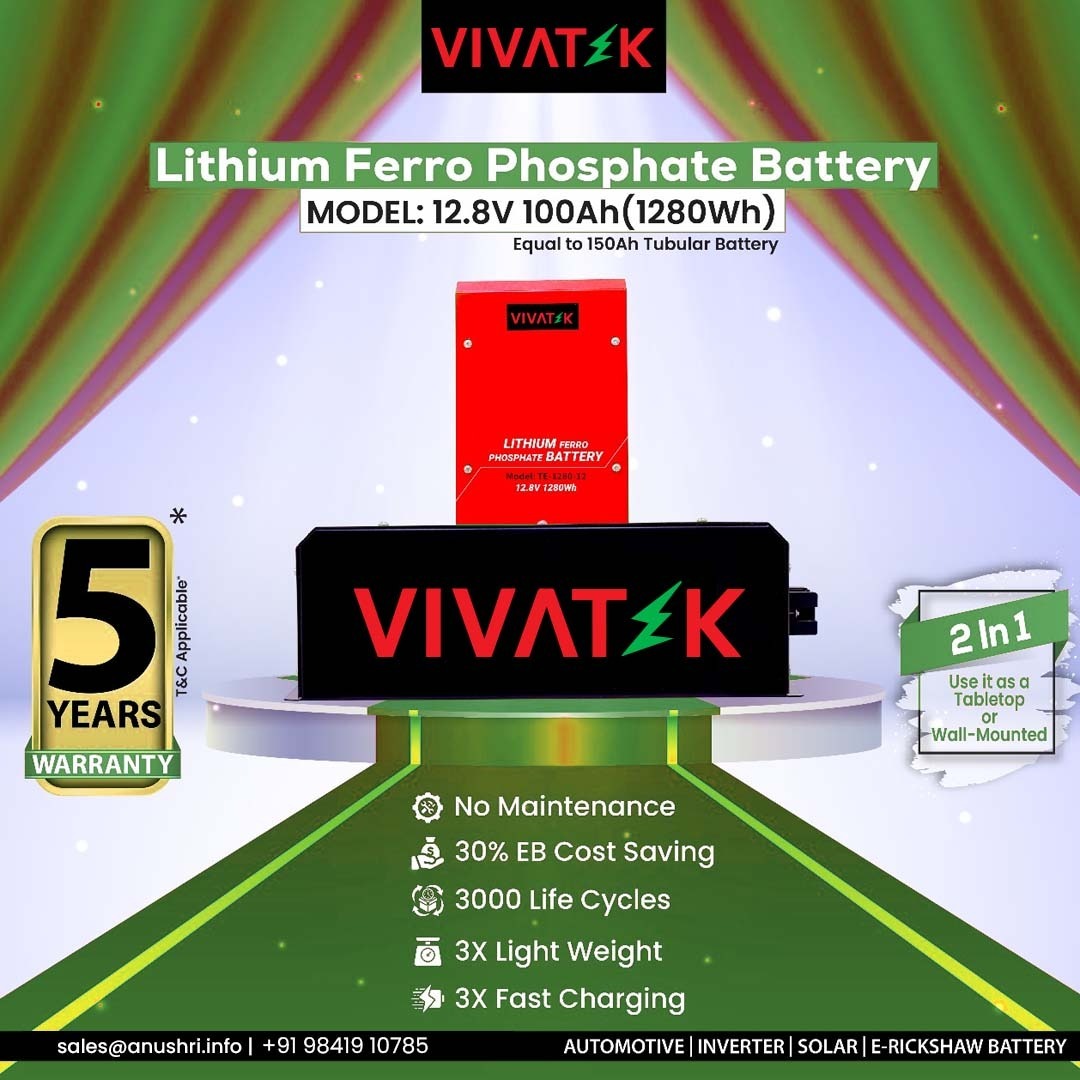
Anushri Systech Pvt Ltd supports industrial and commercial power requirements through its own Vivatek brand as well as products from other manufacturers available through its dealer, supplier and distributor network. This allows project teams to evaluate equipment according to their technical requirements instead of being restricted to a single product range.
What Is a Lithium Ion BESS?
A Lithium Ion BESS stores electrical energy in rechargeable lithium-based battery modules and makes that energy available when required.
However, an industrial storage installation is considerably more than a battery bank.
A complete system can contain the battery modules, battery management system, power conversion system, energy management controls, thermal management, protection equipment, monitoring, communication systems and safety infrastructure.
The battery stores the energy, while the other components control how that energy is charged, discharged, protected and delivered to the facility.
This distinction is important when comparing quotations. Two systems with the same battery capacity may have very different capabilities because their control systems, power-conversion equipment, cooling arrangements and integration scope can differ.
Why Industrial Businesses Are Looking at Energy Storage
The business case for storage usually begins with a specific operational problem.
A facility may want to reduce short-duration demand peaks. Another may want to use more of its solar generation after sunset. A remote site may need to coordinate solar, batteries and a generator. A critical facility may require additional support for selected loads.
In each case, the battery is being used for a particular purpose.
This is why the right starting point is not the battery size. The first question should be:
What does the business need the storage system to accomplish?
Once that objective is clear, the required power, energy capacity, operating strategy and equipment can be determined more accurately.
BESS Is Not Simply a Large Backup Battery
Traditional backup systems are generally designed around maintaining supply when the normal source fails.
A BESS can perform that role, but its capabilities can extend beyond emergency operation.
For example, a storage system may charge during periods of available solar generation and discharge later when the facility needs electricity. It may also be programmed to reduce a short demand spike or support selected loads during a grid event.
This makes storage an energy-management asset as well as a backup resource.
The actual operating modes depend on the system architecture, utility conditions, tariff structure and project objectives.
Understanding Power Capacity and Energy Capacity
Two numbers are particularly important when evaluating a storage system.
Power capacity, normally expressed in kW or MW, indicates how much electrical power the system can deliver at a particular moment.
Energy capacity, expressed in kWh or MWh, indicates how much energy can be stored.
Consider a simplified example.
A facility requires 500 kW of critical load and wants two hours of battery support. The basic energy requirement would be approximately 1,000 kWh.
However, the actual installed battery capacity may need to be higher because the design also has to consider usable state-of-charge limits, conversion losses, reserve capacity, temperature and battery ageing.
This is why simply multiplying load by backup time should not be treated as the final battery-sizing calculation.
State of Charge and Usable Energy
A battery is not normally operated by continuously using every available unit of stored energy.
State of Charge (SOC) indicates how much energy remains in the battery relative to its usable operating range.
For example, a system may be controlled so that it does not routinely operate at the absolute upper and lower limits.
This operating window helps the system maintain predictable performance.
For a buyer, this means the advertised battery capacity and the energy actually available for a particular application may not always be identical.
A technical proposal should clearly state the usable energy available under the specified operating conditions.
Depth of Discharge and Battery Life
Depth of Discharge (DoD) describes how much of the battery’s available energy is used during a cycle.
Frequent operation at very deep discharge levels can affect battery ageing depending on the chemistry, operating conditions and battery design.
Therefore, the storage system should be sized around the intended duty cycle rather than only around the largest possible discharge.
This becomes especially important when a customer expects the battery to cycle every day for several years.
Understanding C-Rate
Battery performance is also influenced by the rate at which energy is charged or discharged.
A high-power application may require the battery to deliver a substantial amount of energy in a relatively short period.
A long-duration application may place greater emphasis on storing energy for several hours.
The appropriate battery configuration therefore depends on the relationship between power and capacity.
This is one reason why a 1 MWh battery does not automatically mean that every 1 MWh system will perform in the same way.
What Happens Inside a BESS?
A lithium-ion storage installation generally operates through several layers of control.
The battery cells and modules store the electrical energy.
The Battery Management System monitors battery conditions and manages operation within defined limits.
The Power Conversion System manages the conversion between battery DC power and the facility’s AC electrical system.
The Energy Management System can determine how the storage system should interact with solar, the grid, generators and facility loads.
Together, these systems create an energy-storage platform rather than simply a collection of batteries.
The Battery Management System
The BMS is one of the key control systems in a lithium-ion installation.
Depending on the system design, it can monitor conditions such as cell voltage, temperature, state of charge and fault status.
It can also communicate with higher-level controls and protection systems.
For an industrial buyer, it is useful to understand what information is available through the BMS and how the system responds when abnormal conditions are detected.
The Power Conversion System
The battery stores DC energy, while industrial and commercial facilities normally use AC electricity.
The PCS manages this conversion.
It can control the flow of energy between the battery and the electrical network according to the selected operating mode.
The PCS rating therefore needs to match the required charge and discharge power.
Its compatibility with the site’s electrical system is also an important part of the engineering process.
Energy Management System
The EMS provides higher-level control of the energy-storage system.
For example, it can be configured around an operating strategy in which:
- Solar power supplies the facility first.
- Surplus generation charges the battery.
- Stored energy is used during a selected later period.
- Grid electricity supplies the remaining requirement.
- The generator is started when defined backup conditions occur.
The actual sequence varies from project to project.
The important point is that storage should operate according to a defined energy strategy rather than simply charging and discharging without considering the facility’s needs.
Lithium Ion BESS With Solar
Solar generation and energy storage are often considered together because their operating patterns can complement each other.
Solar generation is strongest during daylight hours, while a facility may continue consuming electricity after solar production declines.
Storage can allow some of the generated energy to be shifted to a later period.
For a commercial building, this could mean using stored solar energy during evening operations.
For an industrial facility, it may mean supporting selected loads after the production of solar power has reduced.
The economic value depends on the site’s load pattern and applicable electricity arrangements.
Peak Demand Management
Some commercial and industrial electricity bills are influenced not only by total energy consumption but also by maximum demand.
A short period of unusually high demand can affect the overall electricity cost structure.
A BESS can potentially discharge during selected demand peaks to reduce the amount of power drawn from the grid.
For this application, the battery needs sufficient power capability rather than simply a large energy capacity.
A facility with a 15-minute demand peak may have a different storage requirement from a site attempting to reduce a sustained three-hour load.
Therefore, actual demand data should be reviewed before making a financial calculation.
Energy Shifting
Energy shifting means storing electricity at one time and using it later.
The source could be solar generation or grid electricity, depending on the project and applicable tariff structure.
For example, a business may have excess solar generation during the afternoon but continue operating after sunset.
Storage can shift part of that available energy into a later operating period.
The benefit should be evaluated using real electricity prices, operating schedules, battery efficiency and expected cycling.
Round-Trip Efficiency
Energy storage is not perfectly lossless.
Some energy is consumed during charging, conversion and discharge.
Round-trip efficiency describes how much of the energy put into the system can subsequently be recovered.
For example, if a system receives a certain amount of energy during charging, the usable energy returned later will be somewhat lower.
This matters when calculating operating savings because the cost of charging the battery and the amount of energy recovered must both be considered.
Battery Degradation
Battery capacity changes over time.
Two common contributors are cycle ageing and calendar ageing.
Cycle ageing is associated with charging and discharging activity.
Calendar ageing occurs simply as the battery remains in service over time.
Temperature, operating conditions, charging strategy, discharge depth and cycling frequency can influence the rate of degradation.
For this reason, a serious BESS proposal should consider expected performance over the project lifecycle rather than presenting only the first-year capacity.
High-Temperature Operating Conditions
Industrial installations can operate in demanding environments.
Outdoor projects may experience high ambient temperatures, while indoor installations can also require careful thermal management if the battery room has limited ventilation.
Battery systems therefore need appropriate environmental controls.
Depending on the equipment, this may involve cooling, ventilation, temperature monitoring or dedicated thermal-management systems.
The design should be based on the actual installation environment rather than assuming standard indoor conditions.
BESS Safety and Protection
Safety needs to be considered from the beginning of the project.
A complete installation can involve electrical protection, isolation, temperature monitoring, battery controls, emergency shutdown and fire-safety provisions.
The exact requirements depend on the battery technology, system capacity, installation location and applicable regulations and standards.
The enclosure, access arrangement, ventilation or cooling, detection systems and emergency procedures should all be considered as part of the overall engineering design.
Containerized Energy Storage
Large-scale installations may use containerized BESS solutions.
A container can house battery modules and associated equipment within a dedicated environment.
This approach can be useful where a project requires substantial storage capacity and modular deployment.
However, the container still requires proper site preparation, electrical connection, thermal management, safety provisions, access and maintenance planning.
Indoor BESS Installation
Indoor systems can be appropriate for certain commercial and industrial applications where a suitable dedicated space is available.
The room design should account for equipment dimensions, access, thermal conditions, electrical distribution, maintenance and safety.
Existing buildings may require modifications before installation.
A site survey can identify these requirements early and help prevent problems during execution.
BESS for Manufacturing Plants
Manufacturing facilities can be strong candidates for storage assessment because their electricity consumption is often closely linked to production.
A factory may have substantial loads from motors, compressors, pumps, HVAC, automation and process equipment.
The BESS strategy can be evaluated alongside production schedules and maximum-demand data.
In some cases, the system may focus on peak management. In others, it may be integrated with solar and backup infrastructure.
BESS for Commercial Buildings
Commercial buildings can have predictable daytime loads but may continue consuming electricity into the evening.
Offices, hotels, hospitals, shopping centres and business campuses can therefore evaluate storage in combination with solar and existing electrical infrastructure.
The best configuration depends on building occupancy, HVAC demand, operating hours and tariff structure.
BESS for Warehouses and Logistics Centres
Warehouses are increasingly dependent on electrical infrastructure.
Lighting, refrigeration, automated handling systems, conveyors, charging equipment and IT systems can contribute to the load.
Where rooftop solar is available, storage can be evaluated as part of a broader energy-management strategy.
Future requirements such as electric-vehicle charging can also be considered during planning.
BESS for Data Centres
Data centres require a different approach because continuity is critical.
UPS systems normally provide immediate protection for sensitive loads, while generators can provide longer-duration emergency power.
BESS can potentially form another layer within the facility’s power architecture.
The design must consider the relationship between the battery system, UPS, generator, distribution system and critical loads.
BESS for Hospitals
Hospitals contain both critical and non-critical electrical loads.
Medical systems, communications, IT infrastructure and emergency equipment may require high levels of power continuity.
Storage can be evaluated alongside UPS systems, generators and renewable generation.
The purpose should be clearly defined before selecting the battery capacity.
BESS for Telecom and Remote Infrastructure
Remote telecom and infrastructure sites may face unreliable grid availability or high logistics costs for fuel and maintenance.
A hybrid configuration involving solar, battery storage and a generator can be considered where appropriate.
The storage system may help coordinate renewable generation and backup resources while reducing unnecessary generator operation.
BESS for Renewable Energy Projects
As solar and other renewable-energy installations grow, storage can help manage the difference between generation and consumption.
For renewable projects, the battery may be used for:
- Energy shifting
- Output management
- Backup
- Grid support
- Microgrid operation
The correct application depends on the project’s electrical and commercial objectives.
BESS With Diesel Generators
A generator can remain an important component of an industrial backup system even after storage is installed.
A coordinated system can use the battery for short-duration requirements and the generator for longer interruptions.
The control system must determine when the generator starts, how the battery is charged and how loads are transferred.
Proper integration can make the combined system more flexible than relying on either technology alone.
BESS and UPS Integration
A BESS should not automatically be presented as a replacement for every UPS installation.
UPS systems are designed for highly controlled power continuity for sensitive equipment.
BESS generally focuses more broadly on energy storage and management.
A facility can use both technologies where the applications justify it.
For example, a data facility might retain UPS protection for sensitive IT equipment while using larger storage infrastructure for broader energy-management requirements.
Microgrid Applications
A microgrid can combine multiple energy sources and loads under a coordinated control architecture.
A possible industrial configuration could include:
Utility Grid + Solar + BESS + Generator + Critical Loads
During normal operation, the grid and solar can serve the facility.
The BESS can manage selected energy requirements.
During an outage, the system can transition according to its designed operating strategy.
The final configuration depends on the facility’s electrical architecture and continuity requirements.
Modular BESS Architecture
Large projects do not always need to be built as one enormous battery block.
Modular designs can provide flexibility when capacity requirements are expected to grow.
A business might initially install storage for a particular load and later expand as electricity demand or renewable generation increases.
Modularity can also simplify certain maintenance and replacement strategies.
Redundancy for Critical Applications
Critical facilities may require additional resilience.
Instead of relying on one single system, the architecture can be designed with appropriate redundancy or multiple battery and conversion units.
The exact configuration depends on the required availability level.
This should be established during engineering rather than added after equipment selection.
How BESS Is Sized for a Business
A useful sizing study normally starts with the operating objective.
If the purpose is backup, the calculation may focus on critical load and required duration.
If the purpose is peak management, maximum-demand data becomes particularly important.
If the purpose is solar shifting, the study needs to understand solar generation and the facility’s consumption profile.
If several objectives are required, the system must be sized around the combined operating strategy.
This is why there is no universal battery capacity that can be recommended for every factory or commercial building.
Site Assessment for BESS
Before installation, the physical location should be reviewed.
Important considerations can include:
- Available floor or outdoor area
- Equipment access
- Cable routes
- Electrical connection point
- Cooling requirements
- Environmental exposure
- Fire-safety provisions
- Drainage
- Security
- Maintenance access
For larger systems, civil and structural requirements may also need to be evaluated.
Electrical Integration
BESS becomes part of the facility’s electrical network.
Engineers may need to examine:
- Transformer capacity
- Switchgear
- Distribution panels
- Cable sizing
- Protection coordination
- Earthing
- Metering
- Existing generators
- Existing UPS systems
- Solar inverters
This review helps determine where the storage system can be safely connected.
Grid Synchronization and Protection
A grid-connected BESS must operate in coordination with the electrical network.
The system may need to manage synchronization, protection and controlled import or export according to the project’s operating requirements.
Protection settings should be coordinated with the existing facility equipment.
These details are particularly important for industrial sites with complex electrical distribution.
BESS Monitoring
A modern storage system can provide substantial operational data.
Depending on the equipment, operators may be able to monitor:
- State of charge
- Battery condition
- Temperature
- Charge/discharge power
- PCS status
- System alarms
- Energy throughput
- Historical performance
Remote visibility can help facility teams identify unusual operating conditions and arrange technical intervention when necessary.
Preventive Maintenance
A BESS should have an appropriate maintenance plan.
Maintenance requirements can vary according to the equipment and installation.
Activities may include inspection of electrical connections, cooling systems, monitoring equipment, protection systems and enclosure conditions.
Regular review of system alarms and performance data can also help identify issues before they become major operational problems.
Battery Replacement Planning
Battery systems have a finite operating life.
Replacement should therefore be considered during the initial project planning stage.
A good lifecycle strategy can include:
- Expected capacity retention
- Operating cycle assumptions
- Warranty conditions
- Replacement methodology
- Spare-part availability
- Future technology changes
This helps businesses avoid treating battery replacement as an unexpected expense.
End-of-Life Considerations
A responsible storage strategy should also consider what happens when battery modules reach the end of their useful service period.
Depending on local requirements and the battery technology, businesses may need appropriate procedures for removal, transportation, recycling or other end-of-life handling.
This is another reason to select suppliers that can support the project beyond initial installation.
BESS Project Economics
A storage project should be evaluated using more than its purchase price.
The financial model can consider:
Initial investment + installation + maintenance + replacement + operating losses
against potential benefits such as:
Energy savings + demand reduction + renewable-energy utilization + backup value
The actual financial result depends heavily on electricity tariffs, operating schedules, battery cycling and system performance.
Therefore, generic claims about guaranteed payback should be avoided.
When Does BESS Make Commercial Sense?
A storage project can become more attractive when a facility has one or more of the following characteristics:
A significant demand peak.
A large solar installation with useful surplus generation.
A requirement for selected backup capacity.
High-value critical loads.
A need to coordinate several power sources.
A suitable tariff structure that rewards energy shifting.
However, each project still needs an individual assessment.
Vivatek BESS Solutions
Vivatek is Anushri Systech Pvt Ltd’s own brand.
The brand forms part of the company’s wider power-solutions portfolio for industrial and commercial requirements.
Where technically appropriate, customers can evaluate Vivatek solutions for energy-storage projects based on their application, capacity and system requirements.
At the same time, Anushri Systech is not restricted to its own brand.
The company also works as a dealer, supplier and distributor for other manufacturers, allowing customers to consider alternative products when a project has approved-brand requirements, consultant specifications or existing-system compatibility needs.
This is particularly useful for EPC contractors and industrial procurement teams that need flexibility in equipment sourcing.
Why Multi-Brand Supply Is Useful for Industrial Projects
Industrial projects can have strict procurement specifications.
For one project, the consultant may approve a particular manufacturer.
Another facility may already use a specific inverter or battery platform.
A third customer may be looking for a cost-effective solution that meets defined technical requirements.
Having access to multiple manufacturers allows the project team to compare suitable options instead of forcing every application into the same product.
The final selection should always be based on the technical requirements of the project.
BESS for New Facilities
Storage can be considered during the initial electrical design of a new factory, warehouse, hospital or commercial building.
Early planning makes it easier to allocate:
- Equipment space
- Electrical connection points
- Cable routes
- Cooling provisions
- Safety systems
- Future expansion space
This can be more efficient than attempting to retrofit every requirement after the building is already operational.
BESS Retrofit for Existing Facilities
Existing businesses can also investigate storage.
A retrofit assessment can review the current solar plant, transformer, distribution system, generator, UPS and facility load profile.
The goal is to determine whether storage can be integrated without creating unnecessary changes to the existing infrastructure.
BESS Commissioning
Commissioning is an important stage of the project.
It can involve verification of:
- Battery communication
- BMS operation
- PCS operation
- EMS controls
- Protection
- Charging
- Discharging
- Emergency shutdown
- Monitoring
- Grid interaction
Testing should confirm that the system behaves according to the approved operating strategy before final handover.
BESS for Different Industrial Applications
A manufacturing plant may prioritize peak-demand management.
A data centre may prioritize continuity and integration with UPS systems.
A warehouse may focus on solar utilization and future EV charging.
A remote facility may need solar, storage and generator coordination.
A commercial building may evaluate demand management and renewable-energy consumption.
These applications demonstrate why BESS cannot be treated as a standard product with one fixed configuration.
A Practical Project Workflow
A successful project generally starts with an understanding of the customer’s objective.
The engineering team then reviews electricity data and the site environment.
After that, the required power and energy capacity can be determined, followed by selection of suitable battery, PCS, BMS, EMS and supporting equipment.
The next stage covers electrical design, protection, installation and commissioning.
Once operational, the system should be monitored and maintained according to the manufacturer’s recommendations and project requirements.
This approach connects the technology to the business objective instead of treating the battery as an isolated purchase.
Common Mistakes When Buying BESS
Selecting Based Only on MWh
Energy capacity alone does not tell you how quickly the system can deliver power.
Ignoring the Load Profile
A battery sized without understanding the facility’s operating pattern may not deliver the expected value.
Treating Backup and Energy Management as the Same Requirement
A system designed for peak shaving may not automatically provide the required backup performance.
Ignoring Degradation
The financial model should account for changes in battery capacity over time.
Forgetting Thermal Conditions
High temperatures can influence battery performance and lifecycle.
Comparing Only Equipment Prices
Installation, controls, safety systems, commissioning and service can represent a significant portion of a complete project.
Not Planning Future Expansion
If the facility is expected to grow, expansion should be considered during the initial design.
The Future of Industrial Energy Storage
The role of energy storage is moving beyond emergency backup.
As businesses install more solar generation and electricity-management strategies become more sophisticated, batteries can become part of a coordinated energy infrastructure.
A future industrial facility may use solar during the day, storage during selected peak periods, the grid when economically appropriate and a generator during extended emergencies.
The energy-management system can coordinate these resources according to the operating requirements of the facility.
This makes storage an important component of modern power planning.
Frequently Asked Questions
What is a Lithium Ion BESS?
A Lithium Ion BESS is an engineered battery-storage system that stores electrical energy and supplies it when required.
Can BESS work with solar panels?
Yes. A BESS can be integrated with solar generation to store selected surplus energy and make it available later, subject to the system design.
Can a BESS replace a UPS?
Not automatically. BESS and UPS systems can have different purposes and operating characteristics. Some facilities may use both.
Can BESS work with a diesel generator?
Yes. Properly engineered systems can coordinate battery storage and generator operation.
How long can a BESS provide backup?
It depends on the usable energy capacity and the load being supplied. A 1 MWh system, for example, will provide different durations at different load levels.
Does battery capacity remain the same throughout its life?
No. Battery capacity can decline over time due to ageing and operating conditions.
Is lithium ion BESS suitable for factories?
It can be suitable for selected industrial applications involving peak management, solar integration, backup or other energy-management objectives.
Does Anushri Systech provide only Vivatek products?
No. Vivatek is Anushri Systech’s own brand, while the company also supplies suitable products from other manufacturers through its dealer, supplier and distributor network.
Can an existing solar plant be upgraded with storage?
In many cases, yes. The existing solar, inverter, electrical distribution and control infrastructure should first be assessed.
What information is required for BESS sizing?
Useful information includes load profile, maximum demand, critical loads, required backup duration, solar capacity, operating schedule, site conditions and the intended operating strategy.
Conclusion
Lithium ion BESS is becoming an important part of modern industrial and commercial energy planning, but its value depends on how well the system is matched to the facility.
For one business, storage may be primarily about reducing demand peaks. For another, it may be about using more solar energy. A critical facility may need storage to support selected loads, while a remote site may require a coordinated solar, battery and generator system.
The technology should therefore be selected after understanding the site’s electricity consumption, operating conditions, electrical infrastructure and business objectives.
Anushri Systech Pvt Ltd supports these requirements through Vivatek, its own brand, along with suitable products from other manufacturers supplied through its dealer, supplier and distributor network. This provides industrial customers, commercial businesses, EPC contractors, consultants and procurement teams with flexibility when evaluating energy-storage equipment.
The most effective BESS project is not necessarily the largest one or the least expensive one.
It is the system that delivers the right power, usable energy, operating strategy, safety, reliability and lifecycle value for the facility it serves.
Planning a Lithium Ion BESS Project?
If your business is evaluating energy storage for a factory, manufacturing unit, warehouse, hospital, commercial building, data centre, telecom facility, renewable-energy project or other industrial application, start with the actual electrical requirement.
Share your load profile, maximum demand, required backup duration, existing s9oolar capacity, operating hours and site details with Anushri Systech to evaluate a suitable BESS configuration.
📞 +91 9566117188 // +91 9841698180
📧 sales@anushri.info
📍2/27, Luz Ave 3rd St, East Abiramapuram, Mylapore, Chennai, Tamil Nadu 600004