
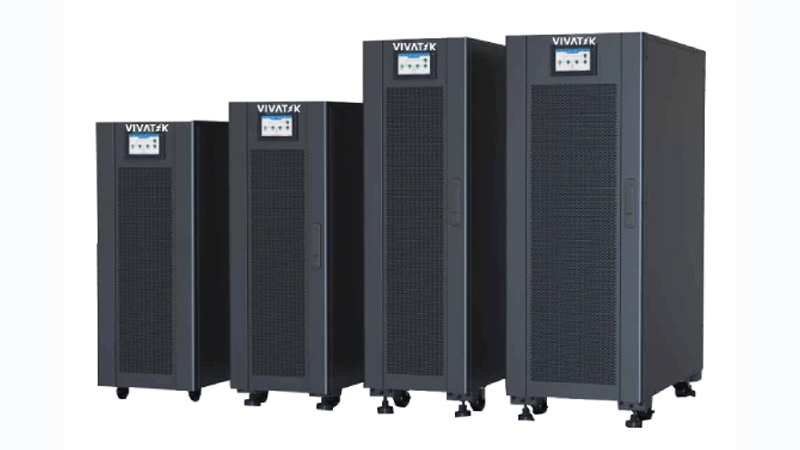
In industrial environments, power interruptions are not just technical issues—they directly affect production continuity, equipment safety, data integrity, and operational cost. Unstable grid conditions, voltage fluctuations, and unexpected outages make an industrial UPS with battery backup a foundational requirement for factories, data centers, hospitals, and infrastructure facilities.
At VIVATEK, industrial UPS systems with battery backup are engineered for B2B and mission-critical applications, where uptime, reliability, and long-term performance are non-negotiable. This blog is written for factory owners, plant heads, EPC contractors, consultants, and procurement teams looking to implement dependable industrial power backup solutions.
What Is an Industrial UPS with Battery Backup?
An industrial UPS with battery backup combines:
Online UPS technology for continuous power conditioning
Battery banks that supply instant power during mains failure
The UPS isolates critical loads from grid disturbances and seamlessly supplies battery power during outages—without transfer delay.
Unlike residential or office UPS units, industrial UPS systems are designed for:
Continuous, heavy-duty operation
High-capacity and three-phase loads
Industrial electrical environments
Custom backup durations and scalable battery banks
Why Battery Backup Is Critical in Industrial UPS Systems
Battery backup determines how long operations can continue safely during a power failure.
Key benefits include:
Instant power availability during outages
Protection against voltage dips, surges, and transients
Safe shutdown or continued operation of critical processes
Reduced stress on sensitive equipment
Improved uptime and operational stability
For industries with continuous or safety-critical processes, battery-backed UPS systems act as a risk control mechanism, not just a backup device.
Typical Applications of Industrial UPS with Battery Backup
Industrial UPS systems with battery backup are widely deployed in:
Manufacturing Plants – CNC machines, robotics, PLC panels
Data Centers & IT Infrastructure – servers, networking, storage
Hospitals & Healthcare Facilities – diagnostic and life-support systems
Textile, Pharma & Food Processing Units – process control and instrumentation
Utilities & Infrastructure Projects – control rooms, telecom, substations
Each application requires tailored planning for UPS capacity, battery runtime, and redundancy.
Battery Technologies Used in Industrial UPS Systems
Selecting the right battery technology is essential for performance and lifecycle cost.
🔹 SMF / VRLA Batteries
Maintenance-free
Suitable for controlled indoor environments
Ideal for short to medium backup durations
🔹 Tubular Batteries (Long Backup)
Designed for extended runtime
Suitable for frequent and long power cuts
Common in manufacturing and process industries
🔹 Lithium-Ion Batteries
High energy density
Longer lifecycle and faster recharge
Suitable for space-constrained and high-availability environments
Battery choice depends on runtime needs, discharge cycles, space, and total cost of ownership.
Backup Time Planning: How Much Battery Backup Is Required?
Backup time varies by application:
IT & data centers: Typically 10–30 minutes for generator takeover
Manufacturing plants: 30 minutes to several hours
Hospitals & utilities: Extended backup for safety and continuity
Backup planning considers:
Power cut frequency and duration
Generator integration strategy
Safe shutdown vs. continuous operation
Space, ventilation, and budget constraints
Balanced planning avoids unnecessary oversizing while ensuring reliability.
🔹 Battery Lifecycle Management
Battery performance degrades over time if not monitored correctly. Industrial UPS systems benefit from a structured battery lifecycle strategy that includes:
Periodic battery health checks
Capacity testing and trend analysis
Temperature and charging optimization
Planned replacement cycles
Proactive lifecycle management helps prevent unexpected downtime and premature battery failure.
🔹Generator & Battery Coordination
In many industrial facilities, the UPS battery backup works in coordination with a diesel generator or alternate power source.
The typical sequence is:
Mains power fails
UPS batteries instantly support the load
Generator starts and stabilizes
UPS transfers load back to supported supply
Proper coordination ensures zero interruption, smooth transition, and equipment safety.
Installation, Commissioning & Battery Safety
Industrial UPS battery systems require careful installation planning:
Dedicated battery rooms or racks
Proper ventilation and thermal management
Correct cable sizing and protection devices
Commissioning tests including charge–discharge validation
Correct installation directly impacts battery life, safety, and system reliability.
Compliance & Industrial Standards Consideration
Industrial UPS systems with battery backup are typically evaluated against applicable electrical safety, power quality, and performance standards. Battery systems are reviewed for isolation, protection, and operational safety to align with industrial audits, EPC documentation, and internal approval processes.
This supports long-term reliability and regulatory alignment.
How Industrial Buyers Evaluate UPS with Battery Backup
Procurement and technical teams typically assess:
Connected load (kW / kVA)
Criticality of operations
Required battery backup duration
Battery technology preference
Space and environmental conditions
Maintenance and lifecycle expectations
A structured evaluation ensures alignment with both operational and business goals.
Designed for B2B & Project-Based Procurement
Industrial UPS systems with battery backup are commonly deployed through:
EPC-led industrial projects
Factory and infrastructure upgrades
Institutional and utility installations
Long-term operational facilities
This makes them suitable for organizations that value reliability, documentation, and lifecycle support.
📞 Start with a Technical Discussion
If you are evaluating an industrial UPS with battery backup for a factory, data center, hospital, or infrastructure project, the most effective first step is a technical discussion.
VIVATEK works with organizations to:
Assess load and backup requirements
Recommend suitable UPS and battery configurations
Plan redundancy and future expansion
Support installation, commissioning, and long-term service
You can engage at any stage of your project. The focus is technical clarity before commercial decisions.
FAQ
Q1. How long can an industrial UPS operate on battery backup?
Backup time depends on load, battery type, and configuration, ranging from minutes to several hours.
Q2. Can battery backup be expanded later?
Yes. With proper planning, many systems allow future battery expansion.
Q3. Is lithium battery backup suitable for industrial UPS systems?
Lithium batteries offer longer life and compact design, but selection depends on application and operating environment.
Q4. How often should industrial UPS batteries be replaced?
Battery replacement intervals depend on battery type, usage, and temperature. Periodic health checks help plan replacements proactively.
Final Perspective
An industrial UPS with battery backup is not just a power backup solution—it is a safeguard for productivity, safety, and operational continuity. The right combination of UPS architecture, battery technology, and lifecycle planning directly impacts uptime and long-term cost.