
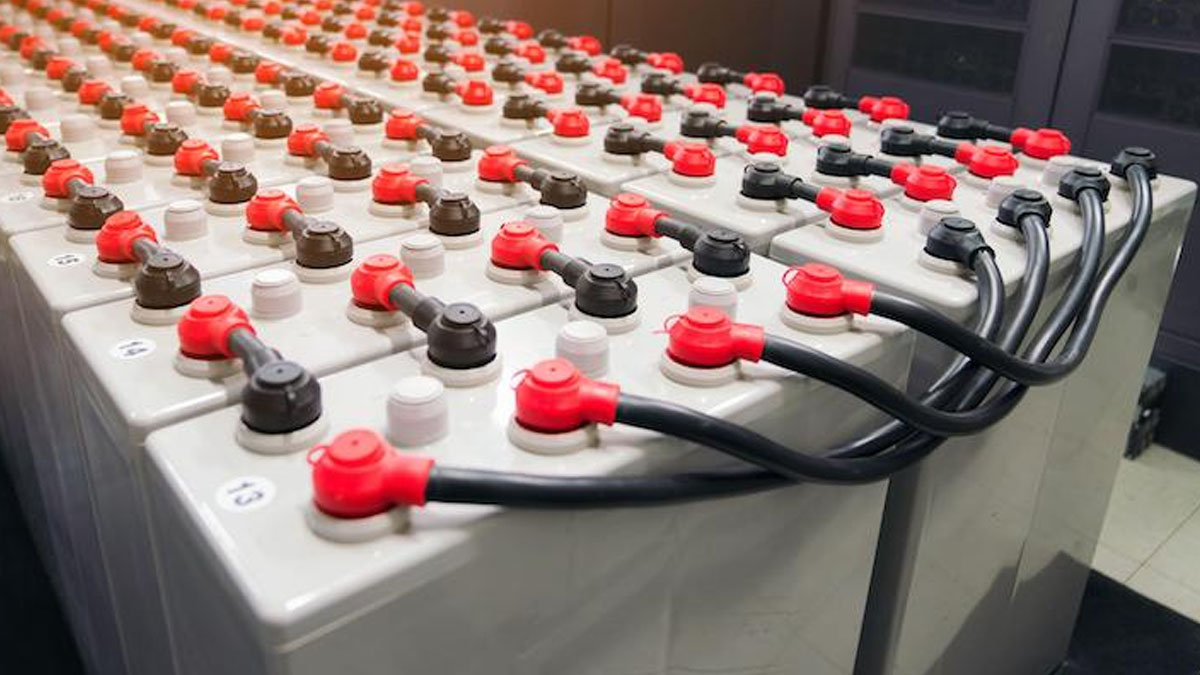
Reliable backup power is no longer limited to large factories or utility facilities. Offices, data centers, telecom sites, healthcare facilities, warehouses, transport infrastructure and manufacturing plants all depend on electrical systems that must remain available when the main supply is interrupted.
Battery storage provides an important layer of protection in these environments. It can support a UPS during a grid outage, maintain DC control systems, provide telecom backup or store energy for selected renewable-power applications.
Lead-acid technology remains widely considered for stationary applications because it is a mature technology with established maintenance practices and a broad range of configurations.
However, selecting the right battery requires more than comparing prices or ampere-hour ratings. The application, load, autonomy, discharge rate, temperature, charging method, installation conditions and expected service life all need to be considered.
This guide explains how stationary lead-acid batteries are used across European commercial and industrial applications and what buyers should evaluate before choosing a battery system.
What Is an Industrial Lead-Acid Battery?
An industrial lead-acid battery is a rechargeable stationary energy-storage system designed to provide electrical power when the primary supply is unavailable or unsuitable.
Unlike automotive batteries, stationary systems are selected around a specific application and operating profile.
They can be integrated with:
- Online UPS systems
- Telecom infrastructure
- Electrical substations
- Emergency power systems
- Industrial control equipment
- Renewable-energy systems
- Commercial buildings
- Critical infrastructure
A battery does not operate independently. Its performance depends on the complete system, including the charger, UPS or DC equipment, protection devices, cabling, monitoring and installation environment.
Why Lead-Acid Technology Remains Relevant
Lithium-based storage has expanded rapidly, but lead-acid technology continues to have a place in stationary backup applications.
Its long history means that many electrical engineers and maintenance teams are familiar with its installation, charging and maintenance requirements. Existing UPS installations may also already be designed around lead-acid battery banks.
The technology can be practical when:
- The application is primarily standby
- Existing equipment is designed for lead-acid
- Suitable installation space is available
- The expected discharge profile matches the battery
- Maintenance procedures are available
- Lifecycle economics are appropriate
This does not mean lead-acid is automatically the best choice. Applications involving frequent cycling, restricted space or particular energy-density requirements may justify evaluating lithium-based alternatives.
European Commercial and Industrial Power Requirements
Power infrastructure requirements vary considerably across Europe.
A small office may need battery support for IT and communications equipment, while a manufacturing facility may require backup for automation and control systems. A telecom installation may require longer autonomy, while a data center may require highly structured UPS redundancy.
Factors that can influence battery selection include:
- Site operating conditions
- Critical-load requirements
- Required autonomy
- Available installation space
- Temperature
- Maintenance access
- UPS architecture
- Local project requirements
- Future expansion
For projects across different European countries, buyers should also confirm the applicable technical, safety, environmental and installation requirements for the specific location.
Types of Lead-Acid Batteries
Lead-acid is not a single battery configuration. Different constructions are designed for different operating conditions.
Flooded Lead-Acid Batteries
Flooded batteries contain a liquid electrolyte and are generally associated with larger stationary installations where dedicated infrastructure and maintenance procedures are available.
They may be considered for applications where:
- Space is available
- Battery-room infrastructure is provided
- Maintenance can be performed regularly
- The operating profile suits the technology
The installation must follow the manufacturer’s requirements for ventilation, charging and safety.
VRLA Batteries
Valve Regulated Lead Acid batteries are widely used for stationary backup applications.
They are commonly considered for:
- UPS systems
- Telecom infrastructure
- Security systems
- Commercial buildings
- IT equipment
VRLA batteries can reduce routine maintenance compared with conventional flooded designs, but they still require appropriate temperature control, inspection and health monitoring.
AGM Batteries
Absorbent Glass Mat is a type of VRLA construction in which the electrolyte is held within a glass-mat separator.
AGM batteries can be suitable for applications requiring compact stationary backup systems.
Their suitability should be assessed based on:
- Required discharge
- Runtime
- Charging conditions
- Temperature
- Installation arrangement
Gel Batteries
Gel batteries use a gelled electrolyte and are available for selected stationary applications.
They may be considered where the application’s charging and discharge requirements are compatible with the technology.
The manufacturer’s technical data should be used for final selection.
Commercial Applications
Battery backup is not limited to heavy industry.
Commercial facilities also depend on systems that must remain available during power interruptions.
Offices
Battery-backed UPS systems can support:
- Servers
- Networking
- Communication systems
- Security
- Access-control equipment
Retail Facilities
Backup power may be required for:
- POS systems
- Networking
- Security systems
- Communication infrastructure
Hotels
Critical IT, communication, security and selected building systems may require backup power.
Banks and Financial Facilities
Financial infrastructure depends on continuous operation of:
- Servers
- Networking
- Communication systems
- Security infrastructure
- Transaction-support equipment
Warehouses and Logistics Centers
Modern logistics facilities rely on digital warehouse systems, communication networks, scanners, automation and control equipment.
Educational Institutions
Universities and other educational facilities may use battery-backed systems for:
- Servers
- Networking
- Security
- Digital infrastructure
- Examination systems
Commercial Data Rooms
Smaller data rooms may require dedicated UPS battery systems to protect IT and communication equipment.
Industrial Applications
Manufacturing Plants
Production facilities may use battery-backed systems for PLCs, automation, control panels, CNC systems and critical process equipment.
Telecom Infrastructure
Communication equipment requires dependable backup to maintain network availability during utility interruptions.
Electrical Substations
Stationary battery banks can support protection, switching, control and communication equipment.
Utilities
Power-generation and distribution facilities may require reliable DC systems for essential electrical functions.
Railway Infrastructure
Battery systems may support selected signaling, communication and control applications.
Healthcare Facilities
Hospitals and healthcare facilities depend on reliable electrical infrastructure for IT systems, monitoring and other critical loads.
Renewable Energy Projects
Battery systems can support selected solar and hybrid installations where the technology and duty cycle are appropriate.
Commercial vs Industrial Battery Selection
The distinction between commercial and industrial applications is useful, but it is not absolute.
A commercial data center can have much more demanding power requirements than a small industrial workshop.
| Consideration | Commercial | Industrial |
|---|---|---|
| Typical loads | IT, security, communications | Automation, controls, machinery |
| Environment | Often controlled | Can be demanding |
| Backup profile | Often critical-load focused | Application dependent |
| Space | May be restricted | May allow dedicated battery areas |
| Maintenance | Facility-based | Often engineering-led |
| Selection | Load and autonomy focused | Load, duty and environment focused |
The application should always determine the final battery configuration.
How to Select the Right Battery
A practical selection process starts with the system rather than the battery catalogue.
1. Identify the Critical Load
Determine which equipment actually requires backup.
Not every connected load necessarily needs to remain powered.
2. Establish Required Autonomy
Determine whether the system needs:
- A few minutes
- Tens of minutes
- Several hours
- A longer-duration energy-storage function
3. Confirm DC Voltage
The battery-bank voltage must be compatible with the UPS or DC system.
4. Understand the Duty Cycle
Determine whether the battery will primarily remain on standby or undergo regular charge-discharge cycles.
5. Assess the Environment
Consider temperature, humidity, dust, ventilation and installation location.
6. Check Available Space
Battery dimensions, cabinet requirements, rack arrangement and access space should be reviewed before purchase.
7. Confirm Charger Compatibility
Charging voltage and current must be appropriate for the selected battery technology.
8. Consider Future Expansion
If the facility is expected to grow, the battery architecture should be evaluated accordingly.
Battery Capacity and Sizing
Battery sizing should not be based solely on the nominal Ah rating.
A simplified starting point may consider:
Load × Runtime ÷ DC Voltage
However, actual engineering also needs to account for:
- UPS efficiency
- Battery discharge characteristics
- End-of-discharge voltage
- Temperature
- Battery ageing
- Design margin
- Manufacturer discharge curves
For critical applications, the manufacturer’s published discharge data should be used to determine the appropriate configuration.
Why Discharge Rate Matters
Battery performance depends partly on how quickly energy is drawn.
A battery delivering a relatively high current for a short period does not necessarily provide the same usable energy characteristics as one operating over a longer discharge period.
Therefore, engineers should evaluate:
- Required current
- Discharge duration
- End voltage
- Temperature
- Required autonomy
This is one reason why comparing batteries only by Ah can produce misleading results.
Battery Bank Configuration
Large systems generally require multiple cells or batteries connected together.
Series Connection
Series-connected batteries increase the total DC voltage.
Parallel Connection
Parallel strings increase available capacity and current capability.
Series-Parallel Configuration
Large installations can combine both arrangements to achieve the required voltage and capacity.
The configuration must be compatible with the UPS or DC system and should be designed by qualified personnel.
Battery Charging
Charging is a major part of battery performance.
The charger must be matched to the battery technology and system voltage.
Depending on the application and manufacturer’s instructions, charging may involve:
- Float charging
- Boost charging
- Controlled recharge
- Temperature compensation
Incorrect charging conditions can shorten battery life or affect system reliability.
Recharge Time
Backup performance should not be evaluated only by discharge duration.
The battery also needs to recover after an outage.
Recharge planning should consider:
- Battery capacity
- Depth of discharge
- Charger rating
- Required recovery time
- Frequency of power interruptions
- Facility operating schedule
For sites experiencing repeated outages, recharge performance becomes particularly important.
Battery Temperature and Operating Environment
Temperature can have a significant effect on stationary battery performance and ageing.
European sites may experience substantial seasonal differences, while industrial environments may introduce additional heat from machinery and electrical equipment.
The site assessment should consider:
- Minimum temperature
- Maximum temperature
- Seasonal variation
- Ventilation
- Heating
- Cooling
- Indoor/outdoor installation
The selected battery should operate within the manufacturer’s specified environmental conditions.
Battery Installation
A suitable battery can still underperform if the installation is poorly designed.
Installation planning should address:
- Battery rack or cabinet
- Ventilation
- Floor loading
- Cable routing
- DC protection
- Earthing
- Maintenance clearance
- Temperature
- Accessibility
Requirements depend on the battery technology and project configuration.
Battery Cabinet vs Battery Rack
Battery Cabinet
A cabinet provides an enclosed arrangement and can be suitable where protected installation is preferred.
Battery Rack
A rack can provide easier access to individual cells and is often considered for larger stationary battery systems.
The appropriate arrangement depends on battery type, capacity, site layout, safety requirements and maintenance strategy.
Battery Cable and Connection Design
Industrial battery banks can carry substantial DC current.
The electrical design should therefore consider:
- Cable cross-section
- Current rating
- Cable length
- Voltage drop
- Terminal arrangement
- Polarity
- Connection quality
- Protection
Poor connections can create resistance and heat, affecting reliability.
Battery Safety
Battery systems should be installed and maintained according to appropriate technical and site-safety procedures.
Important considerations include:
- Correct polarity
- Short-circuit protection
- DC isolation
- Correct cable sizing
- Safe handling
- Appropriate PPE
- Ventilation where required
- Maintenance procedures
The safety requirements depend on the battery technology and installation environment.
Battery Monitoring
Battery monitoring can provide maintenance teams with information that is difficult to obtain from visual inspection alone.
Depending on the system, monitoring may include:
- Battery voltage
- Individual cell voltage
- Temperature
- Charging status
- State of charge
- Battery health
- Alarm conditions
Monitoring can support earlier identification of abnormal conditions.
Battery Testing
Testing helps establish whether a battery is actually capable of meeting the required backup performance.
Possible testing methods include:
Voltage Testing
Checks the electrical condition of the cells or battery.
Internal Resistance Testing
Can help identify changes in battery condition.
Capacity Testing
Provides information about usable battery capacity.
Discharge Testing
Can be used for critical systems where actual backup capability needs to be verified.
The test method and frequency should follow the battery manufacturer’s recommendations and the site’s maintenance plan.
Battery Maintenance
A maintenance program can include:
- Visual inspection
- Terminal inspection
- Connection checks
- Voltage measurement
- Temperature monitoring
- Charger checks
- Battery health assessment
- Periodic testing
Maintenance records should be retained so that changes in battery condition can be tracked over time.
Battery Design Life vs Actual Service Life
A published design-life figure should not automatically be interpreted as a guaranteed service life.
Actual performance can be influenced by:
- Ambient temperature
- Charging conditions
- Discharge depth
- Cycle frequency
- Maintenance
- Installation quality
- Storage conditions
Lifecycle expectations should therefore be discussed with reference to the manufacturer’s specifications and the actual operating environment.
Battery Replacement Planning
Battery replacement should be planned before the existing system becomes unreliable.
Possible warning signs include:
- Reduced backup duration
- Repeated battery alarms
- Failed capacity tests
- Increased internal resistance
- Physical deterioration
- Age approaching the expected service period
Planned replacement is generally easier to manage than emergency replacement after a failure.
Existing Battery Replacement vs New Installation
New Installation
A new system allows engineers to design the battery, charger, UPS, protection and installation together.
Replacement Project
An existing installation requires additional checks:
- Existing DC voltage
- UPS model
- Charger capability
- Number of cells
- Existing battery capacity
- Cabinet or rack dimensions
- Cable configuration
- Protection system
This prevents compatibility problems during replacement.
Can Lead-Acid Be Replaced With Lithium?
In some applications, lithium technology can be considered as an alternative to lead-acid.
Potential reasons may include:
- Smaller footprint
- Higher energy density
- Faster charging
- Frequent cycling
- Reduced routine maintenance
However, replacement is not simply a matter of removing one battery and installing another.
The complete system should be checked for:
UPS compatibility + charger + BMS + DC voltage + protection + communication + installation requirements
Lead-Acid vs Lithium-Ion
| Factor | Lead-Acid | Lithium-Ion |
|---|---|---|
| Technology maturity | Very high | High |
| Energy density | Lower | Higher |
| Footprint | Generally larger | Generally smaller |
| Standby use | Well established | Suitable |
| Frequent cycling | Application dependent | Often advantageous |
| Initial cost | Often lower | Often higher |
| Maintenance | Technology dependent | Generally low routine maintenance |
| BMS | Depends on system | Required |
Neither technology should automatically be considered superior. The operating profile should determine the selection.
Lead-Acid vs Ni-Cd
Ni-Cd technology may be considered for applications requiring particular durability and environmental characteristics.
Lead-acid may be attractive where:
- Standby operation is required
- Existing infrastructure supports it
- Cost and availability are important
Ni-Cd may be evaluated for:
- Certain utility systems
- Railway applications
- Challenging industrial environments
- Selected critical DC applications
The final decision should be based on the actual project requirements.
UPS Integration
A battery should always be evaluated with its UPS system.
Important compatibility factors include:
- DC bus voltage
- Battery capacity
- Number of cells
- Charging voltage
- Charging current
- End-of-discharge voltage
- Protection
- Monitoring
This is particularly important when replacing an existing battery bank.
Integration With DG Sets
Many industrial and commercial facilities combine batteries, UPS systems and diesel generators.
A typical sequence may be:
Utility failure → Battery supports critical load → DG starts → UPS accepts generator supply → Battery recharges
The exact sequence depends on the UPS, generator and electrical distribution architecture.
Solar and BESS Integration
Battery systems are increasingly being considered alongside renewable-energy infrastructure.
A facility may combine:
Grid + Solar + Battery + UPS + DG
Such systems can provide greater flexibility for backup and energy management.
Engineering should define:
- Charging source
- Power-source priority
- Battery operating window
- Backup requirement
- Energy-management strategy
- Protection coordination
Battery Storage and Transportation
Battery condition can be affected before installation if storage and transportation are not properly managed.
The supplier’s instructions should be followed for:
- Storage temperature
- State of charge
- Storage duration
- Packaging
- Terminal protection
- Handling
- Transportation
Long-term storage requirements vary by battery technology.
Battery Recycling and End-of-Life
A battery lifecycle does not end when the battery is removed from service.
Used batteries should be handled through appropriate collection, recycling or disposal channels in accordance with applicable local requirements.
For European projects, customers should verify the specific waste-management requirements applicable in the country where the battery is installed.
Total Cost of Ownership
Purchase price is only one part of the financial decision.
A realistic comparison can include:
Purchase + Installation + Maintenance + Energy Losses + Monitoring + Replacement + End-of-Life Management
A higher initial investment may provide better lifecycle value in some applications, while a lower-cost solution may be appropriate in others.
The decision should be based on the complete operating period.
Common Buyer Mistakes
Buying Only by Price
The cheapest quotation does not necessarily provide the lowest lifecycle cost.
Comparing Only Ah
Nominal capacity does not describe complete discharge performance.
Ignoring Temperature
Operating conditions influence battery ageing.
Selecting Without Checking the UPS
The battery and charger must be compatible.
Ignoring Future Expansion
Future load increases should be considered during system planning.
No Replacement Strategy
Critical sites should plan battery replacement before reliability becomes a concern.
Assuming Every Lead-Acid Battery Is Equivalent
Different constructions and models can have very different discharge and operating characteristics.
Vivatek Industrial & Commercial Battery Solutions
Vivatek provides battery solutions for industrial and commercial power applications.
Depending on the project requirement, available technologies may include:
- Lead-acid batteries
- VRLA batteries
- 2V battery systems
- Lithium-based batteries
- LiFePO4 solutions
- Ni-Cd batteries
- FIAMM battery solutions
The appropriate configuration should be determined from the actual load, autonomy, DC voltage, operating environment and duty cycle.
For project requirements, customers can share their existing system information so that the battery configuration can be evaluated before procurement.
Industrial Battery Project Workflow
A structured project can follow:
Requirement identification → Load assessment → Runtime requirement → Battery technology evaluation → Sizing → Technical proposal → Commercial evaluation → Testing → Delivery → Installation → Commissioning → Maintenance → Replacement planning
This provides a more reliable procurement process than selecting a battery purely from a catalogue.
Frequently Asked Questions
What is an industrial lead-acid battery?
It is a stationary rechargeable battery designed for applications such as UPS backup, telecom, substations and other critical-power systems.
Are lead-acid batteries still suitable for Europe?
Yes. They remain relevant for many stationary standby applications when their characteristics match the project requirement.
Which lead-acid battery is suitable for UPS systems?
VRLA, AGM and other lead-acid configurations can be considered depending on the UPS, runtime, discharge requirement and installation environment.
Are AGM and VRLA the same?
AGM is one type of VRLA battery construction.
How is battery capacity calculated?
Capacity is determined using load, required autonomy, DC voltage, discharge characteristics, temperature and design factors.
Does Ah determine backup time?
No. Discharge rate, temperature, end voltage, battery condition and UPS efficiency also affect runtime.
What is battery autonomy?
It is the period for which the battery can support the required load during a power interruption.
Can lead-acid batteries be used with solar?
Yes, where the battery and charging system are properly designed for the application.
Can lead-acid batteries be replaced with lithium?
Potentially, but the UPS, charger, BMS, DC voltage, protection and complete system compatibility must be evaluated.
How long do industrial batteries last?
Service life depends on technology, temperature, charging, discharge conditions, cycling and maintenance.
Does temperature affect battery life?
Yes. Operating temperature is an important factor in battery performance and ageing.
What is a battery bank?
A battery bank is a group of cells or batteries connected to achieve the required system voltage and capacity.
Why is battery monitoring useful?
It provides visibility into parameters such as voltage, temperature, alarms and battery condition.
How often should industrial batteries be tested?
The appropriate interval depends on the technology, application criticality and manufacturer’s recommendations.
What is the difference between standby and cycling?
A standby battery is mainly discharged during an outage, while a cycling application repeatedly charges and discharges the battery.
Can industrial batteries work with generators?
Yes. Battery-backed UPS systems can be integrated with generator systems when properly engineered.
Can batteries be used with BESS?
Yes. Suitable battery technologies can form part of Battery Energy Storage Systems.
What should I check before replacing a UPS battery?
Check the UPS DC voltage, battery configuration, charger capability, capacity, physical dimensions and protection requirements.
Is a higher Ah battery always better?
No. The battery must match the required discharge profile, voltage and application.
What information should I provide for a quotation?
UPS rating, load, required runtime, DC voltage, existing battery details and site conditions are useful starting points.
What is total cost of ownership?
It includes the purchase, installation, maintenance, energy-related costs, replacement and end-of-life expenses.
Why should I evaluate the supplier?
Technical selection, documentation, testing, installation support, replacement availability and service can all affect long-term reliability.
Can Vivatek support commercial applications?
Yes. Battery requirements can be evaluated for commercial facilities as well as industrial and critical-power applications.
Can Vivatek support battery replacement?
Battery replacement requirements can be evaluated based on the existing UPS, battery configuration, load and required runtime.
Conclusion
Industrial and commercial facilities need battery systems that match the way their electrical infrastructure actually operates.
Lead-acid technology remains a practical option for many stationary backup applications, but the correct choice depends on load, autonomy, discharge characteristics, temperature, charging, installation, maintenance, compatibility and lifecycle cost.
For some applications, lead-acid may be the most practical option. For others, lithium-ion, LiFePO4 or Ni-Cd technology may deserve consideration.
The best approach is therefore not to start with a battery brand or chemistry. Start with the application, understand the electrical requirement, and then select the technology and configuration that meet it.
For European commercial and industrial projects, this application-first approach can help buyers make more informed decisions and build a more reliable long-term power strategy.
Need an Industrial Battery Solution?
Whether you are planning:
- A new UPS installation
- Industrial battery replacement
- Telecom backup
- Substation DC backup
- Commercial power backup
- Solar energy storage
- BESS integration
- Lithium battery migration
share the basic project information with the Vivatek team.
Required information:
UPS Rating:
Critical Load:
Required Backup:
DC Voltage:
Existing Battery:
Application:
Site Conditions:
Contact Vivatek
Email: sales@anushri.info
Phone: +91 9841698180
Address: No. 2/27, Luz Avenue 3rd Street, Mylapore, Chennai – 600004, Tamil Nadu, India