
Heavy Duty Industrial UPS Systems for High-Load Applications
Industrial operations need dependable power to avoid production delays, equipment issues and unexpected shutdowns. Anushri Systech provides heavy-duty UPS systems from 10 kVA to 500 kVA+ for factories, manufacturing plants, process industries and critical infrastructure. We assess your load, backup time, battery requirements and site conditions to recommend a practical solution.
Heavy-Duty UPS Solutions for Demanding Electrical Loads
A large UPS installation is not simply a matter of selecting a higher kVA rating. Industrial equipment can have different starting currents, power factors and operating patterns.
Our approach is to understand the equipment being protected and then develop a suitable configuration.
Solutions can be considered for:
- Production and manufacturing equipment
- CNC and precision machinery
- PLC and automation systems
- Process control systems
- Industrial computers
- Data and communication infrastructure
- Critical instrumentation
- Infrastructure and EPC projects
The final configuration depends on the application and electrical design of the site.

Industrial UPS Capacity Range
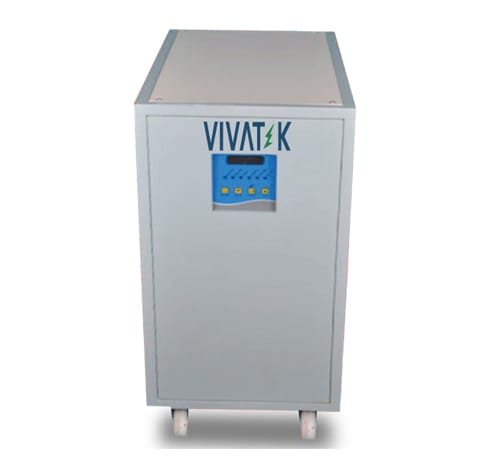
10 kVA–50 kVA
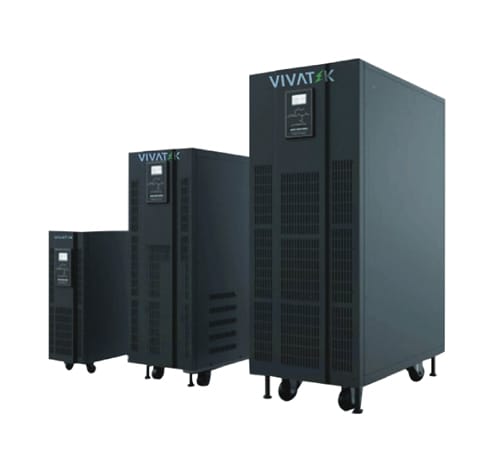
50 kVA–200 kVA
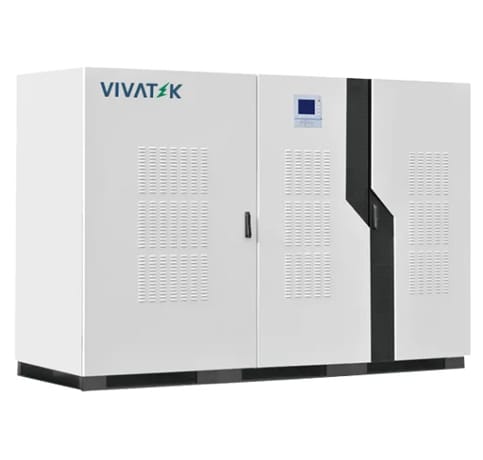
200 kVA–500 kVA+
Reliable Power Backup Solutions for Industrial, Commercial & Critical Applications
3 Phase Input – 3 Phase Output
Suitable where the protected distribution or equipment requires three-phase power.
3 Phase Input – Single Phase Output
Useful where the facility has a three-phase incoming supply but the critical load requires single-phase output.
Parallel UPS Systems
Multiple compatible UPS units can be configured for additional capacity or redundancy where the project requires higher availability.
Modular UPS Systems
A modular architecture can be considered when future capacity expansion is expected or when flexible system configuration is important.
Online Double-Conversion Technology
For critical industrial applications, online double-conversion UPS technology can provide a controlled power supply to the protected equipment.
The incoming AC power is converted to DC and then regenerated through the inverter before reaching the load.
This arrangement can help isolate connected equipment from many disturbances in the incoming electrical supply.
Depending on the selected model, available functions may include voltage regulation, frequency control, bypass operation, battery monitoring, overload protection and communication interfaces.
Battery Backup Designed Around Your Runtime
The UPS and battery bank should be treated as one system.
A requirement for a few minutes of backup is very different from a requirement for one or two hours.
Battery sizing depends on factors such as:
- UPS capacity
- Actual load
- Required autonomy
- DC bus voltage
- Battery technology
- Discharge characteristics
- Ambient temperature
- Battery ageing
- Charging capability
We can help determine an appropriate battery arrangement instead of simply supplying batteries based on nominal Ah capacity.
Battery Backup Designed Around Your Runtime

VRLA Battery Systems
VRLA batteries can be suitable where a compact and practical backup solution is required.

Tubular Battery Systems
Tubular batteries may be considered for applications where the operating requirement and installation environment suit this technology.

Lithium-Ion Battery Systems
Lithium-ion solutions can be evaluated where footprint, weight, maintenance, charging performance and lifecycle are important considerations.

Industrial Battery Banks
For demanding installations, the battery system can be designed according to the required DC voltage, autonomy and operating conditions.


When Your Existing UPS Needs Replacement
Replacing an existing UPS does not always mean simply purchasing another unit with the same rating.
An old installation should be reviewed for:
- Current operating load
- Battery condition
- UPS efficiency
- Available spare parts
- Maintenance history
- Existing bypass arrangement
- Future load growth
- Communication requirements
- Physical installation constraints
If the existing system is becoming difficult to maintain or spare parts are no longer practical to obtain, a replacement assessment can help determine the most suitable upgrade path.
Have an old UPS that needs replacement? Send us the existing UPS details for evaluation.
Emergency UPS Replacement
A failed UPS can create an immediate operational problem.
For urgent requirements, the first priority is to understand the existing system and identify what must remain operational.
Useful information includes the UPS model, capacity, battery voltage, application, fault condition and required backup time.
Where suitable equipment is available, supply and deployment can be planned around the urgency of the application.
For an urgent UPS requirement, contact our team with the existing UPS nameplate details.
Generator and UPS Integration
Many industrial facilities use generators for extended power outages.
The UPS provides immediate continuity, while the generator can take over the longer-duration supply once it starts and stabilizes.
Integration should consider generator capacity, UPS input characteristics, frequency behaviour, transfer arrangements and the connected load.
A coordinated UPS-generator design can provide a more dependable continuity strategy than treating the two systems separately.
Industrial UPS for CNC Machines
CNC machines combine electronic controls, drives and precision equipment.
A power interruption can interrupt machining operations and create restart or production issues.
The UPS requirement should be evaluated based on the machine’s electrical configuration and the specific components that need protection.
In some applications, protecting the CNC control and associated electronics may be more practical than backing up the complete machine.
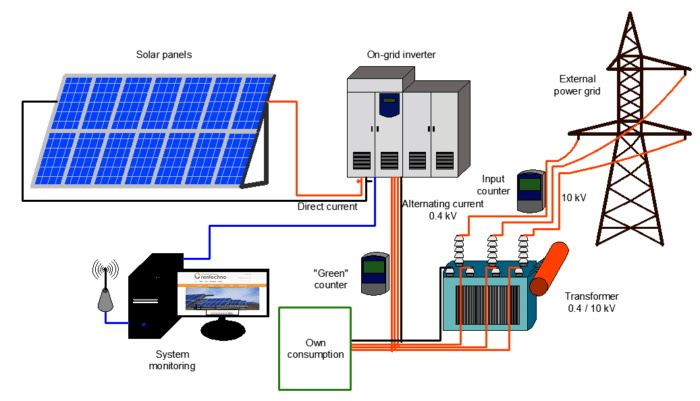
Industrial UPS for Automation and PLC Systems
Modern factories depend on PLCs, HMIs, controllers, communication equipment and instrumentation.
Unexpected power loss can cause several control devices to restart simultaneously.
A suitably designed UPS can support critical control and communication equipment during short interruptions and help maintain operational continuity.
The protected load should be identified according to the actual automation architecture.
UPS for Manufacturing and Process Plants
Large plants often contain both essential and non-essential loads.
Putting the entire facility on a UPS may not always be the most practical approach.
Instead, the electrical design can identify equipment where continuity has the greatest operational value.
This may include production controls, instrumentation, industrial computers, automation systems and selected machinery.
This approach can help control system cost while protecting the loads that matter most.
UPS for Data and IT Infrastructure
Servers, network equipment, storage systems and communication infrastructure require dependable electrical power.
Larger facilities may require additional features such as parallel operation, redundancy, battery monitoring, remote communication and scalable capacity.
The UPS design should also consider the supporting electrical and cooling infrastructure.
UPS for EPC and Infrastructure Projects
EPC contractors and project engineers often require more than equipment supply.
Project requirements may include technical selection, capacity calculation, battery sizing, documentation, delivery coordination, installation support, testing and commissioning.
We can work with project teams to understand the required specifications and develop a solution that fits the project electrical design.
Installation and Commissioning Support
Correct installation is essential for dependable UPS operation.
The installation may involve verification of incoming supply, phase sequence, earthing, protection devices, battery connections, bypass arrangement, output distribution and communication interfaces.
Commissioning can include operational checks, alarm verification, battery charging checks, bypass operation and load testing where required.
The exact commissioning scope depends on the selected system and project requirements.
AMC and Preventive Maintenance
A UPS should be periodically inspected rather than waiting for a failure.
Maintenance can include UPS health checks, battery assessment, electrical measurements, alarm review, ventilation inspection and functional testing.
Preventive maintenance is particularly important for industrial facilities where an unexpected UPS failure could affect production or critical infrastructure.
We can also support customers with battery replacement and service requirements.
Need a Heavy-Duty Industrial UPS?
Don’t select a high-capacity UPS only by looking at the kVA number.
Tell us what equipment you need to protect, how much load it carries and how long you need backup. We can help evaluate the appropriate UPS capacity, phase configuration and battery arrangement for your application.
Request an Industrial UPS Quote
Share your requirement → Technical assessment → Suitable configuration → Commercial quotation → Supply & project support
FAQ
Industrial UPS requirements can be supported across a broad range, including systems from approximately 10 kVA through 500 kVA and above, depending on the application and selected product range.
Yes. Existing UPS replacement requirements can be evaluated based on the current model, capacity, battery arrangement, load and site conditions.
Yes. Battery configuration can be planned according to the required autonomy, UPS DC voltage, battery technology and application.
Installation and commissioning support can be arranged according to the project scope and selected equipment.
Yes. Project and bulk requirements can be evaluated based on technical specifications, quantity, application and delivery requirements.
The required capacity depends on the actual load, power factor, equipment characteristics, operating margin and future expansion. A technical assessment is preferable to selecting a UPS based only on the nameplate rating.
Some UPS architectures support parallel or modular expansion. This depends on the selected equipment and should ideally be considered during the initial design.
Yes. UPS-generator integration is common, but the electrical characteristics of both systems should be reviewed during design.
Yes. Maintenance, technical support and battery replacement requirements can be supported for suitable installations.
Send your required UPS capacity, approximate load, backup time, application and location. If you have an existing UPS, send its model and rating as well. Our team can then review the requirement and recommend a suitable configuration.