
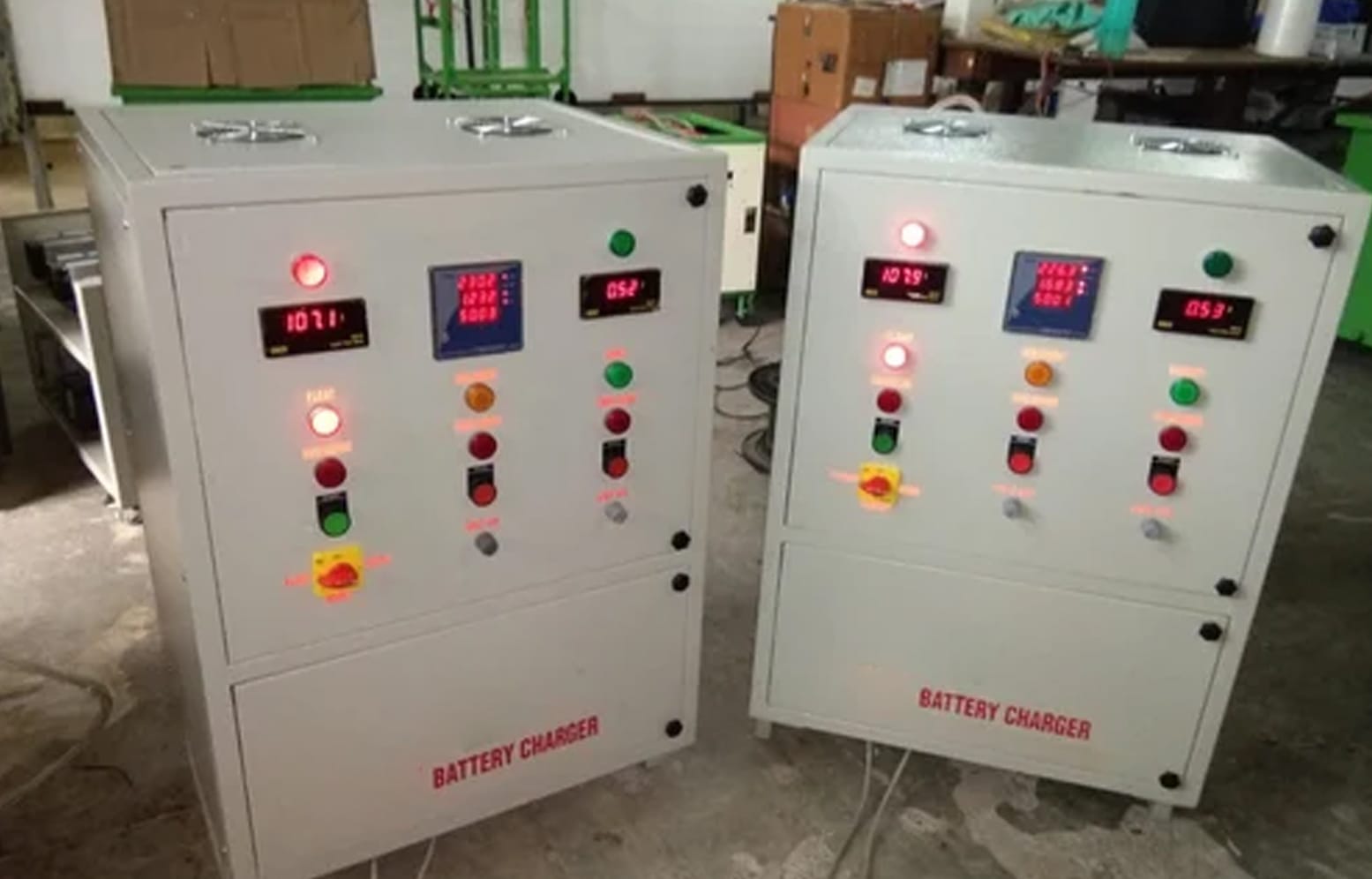
Industrial battery systems must be ready to supply power when the normal AC supply fails or an interruption occurs. In substations, telecom installations, power plants and industrial facilities, the battery charger plays an important role in maintaining battery charge and supporting the connected DC system.
However, maintaining a battery during normal operation is different from recharging it after a discharge. This is where float charging and boost charging come into the picture.
If you are selecting an industrial battery charger, understanding these two charging modes can help you discuss the right requirements with your engineering team or equipment supplier.
This guide explains how float and boost charging work, the differences between them, what to check before selecting a charger, and the information to prepare when requesting a quotation.
What Is the Difference Between a Float Charger and a Boost Charger?
A float charger maintains a battery at its recommended charge level during standby operation. A boost charger operates at a higher charging setting when the battery requires additional charging, subject to the battery manufacturer’s recommendations.
The key difference is their purpose: float charging maintains readiness, while boost charging supports battery recovery when required.
A charger may provide one charging mode or combine float and boost functions in the same system. The appropriate arrangement depends on the battery, DC load, operating conditions and system design.
What Is Float Charging?
Float charging is a method of maintaining a battery at its specified float voltage after it has been charged.
In many industrial DC systems, the battery remains connected to the charger for long periods. The charger helps maintain the battery’s charge while also supporting the connected DC load, where the system is designed for that arrangement.
Float charging is commonly considered for applications such as:
- Substation control and protection DC systems
- Telecom backup battery installations
- Industrial control and automation systems
- Emergency and standby power applications
- Power plant DC supply systems
The correct float setting depends on the battery chemistry, construction, temperature and manufacturer’s instructions. A setting suitable for one battery should not automatically be applied to another.
What should be checked in float charging?
When evaluating a float charging system, consider:
- Whether the charger output matches the battery bank’s nominal DC voltage
- Whether the float voltage can be adjusted to the battery manufacturer’s specification
- Whether the charger can support the continuous DC load and battery maintenance requirements
- Whether voltage regulation and output ripple meet the project’s requirements
- Whether battery temperature and charging conditions are monitored where necessary
These checks help establish whether the charger is suitable for the intended installation.
What Is Boost Charging?
Boost charging is a higher-rate charging mode used when a battery requires additional charging after discharge or under other conditions specified by the battery manufacturer.
For example, a battery bank may supply DC power during an AC supply interruption. When the normal supply returns, the charging system may need to restore the battery’s charge while continuing to support essential equipment.
A boost-capable charger can help perform this task when its output settings and operating sequence are designed for the application.
Boost charging may be relevant to:
- Substation battery banks
- Industrial DC backup systems
- Telecom power installations
- Power plant control systems
- Other critical standby battery applications
Boost charging should not be treated as an instruction to apply the highest possible voltage or current. The permitted charging settings and duration must follow the battery manufacturer’s recommendations and the system design.
What should be checked in boost charging?
Before selecting a boost-capable charger, review:
- The battery manufacturer’s permitted boost charging settings
- Required charging current and recovery time
- The charger’s current-limiting and voltage-control functions
- Whether the DC load remains connected during boost charging
- Whether the charging system has the required interlocks and changeover arrangements
- Whether temperature monitoring and boost-duration controls are required
The answers depend on the installation. A charger designed for one battery bank may not be suitable for another.
Float Charger vs Boost Charger: Key Differences
| Comparison factor | Float charging | Boost charging |
|---|---|---|
| Main purpose | Maintain battery charge | Restore charge when additional charging is needed |
| Typical operating condition | Normal standby operation | After discharge or when specified by the charging strategy |
| Charging setting | Manufacturer-specified float setting | Manufacturer-specified boost setting |
| Charging current | Depends on the battery and connected load | Controlled according to the charger and battery requirements |
| Duration | May continue during normal standby operation | Usually controlled according to the battery and system requirements |
| Main selection concern | Long-term maintenance and load support | Recovery requirements and safe charging limits |
These are general distinctions. Actual charger operation depends on its design, the battery technology and the application.
Why Do Industrial Systems Need Float and Boost Charging?
The charging requirements of an industrial battery change according to its condition and the operating state of the installation.
During normal operation, float charging helps maintain battery readiness. After a discharge, the system may need a different charging setting to recover the battery within the required time.
A properly designed charging arrangement considers both requirements rather than focusing only on charging speed.
For example, a substation DC system may need to support protection and control equipment while maintaining its battery bank. The charger selection must therefore account for the continuous DC load, the battery’s charging requirements and the arrangement used to maintain DC supply during charging or equipment failure.
What Is a Float Cum Boost Charger?
A float cum boost charger combines float and boost charging functions in one charging system.
Depending on its design, the system may offer manual selection, automatic mode changeover or other control features. The available functions must be confirmed from the specific charger’s technical documentation.
A combined charger may be suitable when the installation requires both battery maintenance and recovery charging without separate equipment for each function.
When evaluating this arrangement, check:
- Available operating modes
- Automatic and manual control options
- Output voltage and current ranges
- Battery compatibility
- DC load requirements
- Alarms, protections and monitoring functions
- Changeover and redundancy requirements, if applicable
Do not assume that every float cum boost charger includes automatic changeover or the same protection features.
How to Select the Right Industrial Battery Charger
Choosing a charger starts with understanding the complete battery and DC system. Selecting equipment based only on the battery’s nominal voltage or a desired charging time may overlook important operating requirements.
1. Confirm the battery type
Identify the battery chemistry and construction, such as lead-acid, VRLA or nickel-cadmium, where applicable. Check the battery manufacturer’s charging instructions before deciding on the required charging modes.
2. Confirm the battery bank voltage
Record the nominal DC voltage of the battery bank and its configuration. The charger’s output range must be suitable for the required operating and charging voltages.
3. Calculate the charging requirement
The charger rating must account for the required battery charging current and the DC load that it is expected to supply.
For systems where the charger supplies the load and charges the battery simultaneously, both requirements must be considered in the sizing calculation. The final design should also account for the required recovery time and project-specific operating conditions.
4. Define the required recovery time
Tell the supplier how quickly the battery must recover after a discharge. The achievable charging time depends on battery capacity, depth of discharge, temperature, battery condition, charger capability and permitted charging current.
A specified recovery time should be verified through engineering calculations rather than assumed from the charger’s current rating alone.
5. Review voltage regulation and ripple
Voltage regulation and output ripple are important when the charger supplies a battery bank and sensitive DC equipment.
Review the limits specified by the project and the equipment connected to the DC bus. Confirm the proposed charger’s documented performance against those requirements.
6. Check protection and monitoring features
Depending on the application, required features may include current limiting, overvoltage protection, alarms, temperature monitoring, fault indication and automatic mode control.
Prepare a list of mandatory features before requesting a quotation so suppliers can propose equipment against the same requirements.
7. Check the installation environment
Consider ambient temperature, ventilation, available floor or panel space, cable entry, maintenance access and the site’s electrical supply.
These details can affect equipment selection and installation planning.
Why Are Battery Voltage and Temperature Important?
Charging voltage and battery temperature influence charging behaviour and battery service life.
A charging setting that is too high or too low for the battery can contribute to undercharging, overcharging or premature degradation. Temperature can also affect the appropriate charging voltage.
For this reason, float and boost settings should be based on the battery manufacturer’s instructions. Where temperature compensation is required, the charger and battery arrangement must support the specified method.
There is no single float voltage or boost voltage that should be used for every industrial battery system.
What Problems Can Occur with an Incorrect Charger?
A charger that does not match the battery and DC system can create operating problems.
| Possible problem | What to investigate |
|---|---|
| Battery does not recover as expected | Charging current, discharge depth, battery condition and recovery-time requirement |
| Battery overheats during charging | Charging settings, battery temperature and ventilation |
| Battery repeatedly remains undercharged | Float settings, charger capacity, DC load and battery condition |
| DC voltage is outside the required range | Charger regulation, settings, load conditions and system configuration |
| Excessive ripple is reported | Charger specifications, filtering and measurement conditions |
| Unexpected changeover or charging alarms | Control settings, interlocks, sensors and charger faults |
These are starting points for troubleshooting, not universal diagnoses. Qualified personnel should investigate faults using the manufacturer’s procedures and the site’s safety requirements.
Which Industries Use Industrial Float and Boost Charging Systems?
Electrical substations
Substations may use DC battery systems for protection, control, switchgear operation and other essential functions. Charger sizing and changeover design must reflect the required DC load and battery duty.
Telecommunications
Telecom installations may use battery backup to support communication equipment during supply interruptions. The charging arrangement must match the battery technology, DC bus requirements and site operating conditions.
Power plants
Power plant DC systems can support control, protection and other essential equipment. Charger selection should follow the plant’s technical specification and required redundancy arrangements.
Industrial facilities
Manufacturing and process facilities may use batteries for control systems, emergency functions and other standby applications. The appropriate charger depends on the equipment being supported and the consequences of losing DC supply.
The actual application and required equipment should be confirmed for each project rather than assumed from the industry name alone.
What Information Should You Share When Requesting a Charger Quotation?
Providing complete technical information helps the supplier evaluate the application and recommend a suitable configuration.
Before contacting a supplier, prepare the following details where available:
- Required DC system voltage
- Battery chemistry, model and capacity in ampere-hours
- Battery bank configuration
- Continuous DC load and any relevant peak load
- Required battery recovery time
- Required float and boost charging functions
- AC input supply details
- Voltage regulation and ripple limits
- Required protection, alarms and monitoring
- Site location and installation conditions
- Project quantity and expected procurement timeline
- Technical specification or equipment datasheet, if available
If some information is not available, share the details you have and ask the technical team which additional information is needed.
Industrial Battery Charger Solutions from Vivatek
An industrial battery charging system should be selected according to the battery bank, connected DC load, charging requirements and operating environment.
Vivatek provides industrial battery charger and power solution offerings for industrial and commercial applications. If you are evaluating a float charger, boost charger or float cum boost charging arrangement, discuss your system requirements with the technical team before finalising the equipment.
You can also explore the battery energy storage systems page and the power backup and solar solutions page to review related offerings. Confirm the availability and suitability of the specific charger model with the company.
Request an Industrial Battery Charger Quotation
Planning a new installation, replacing an existing charger or reviewing your battery charging requirements?
Contact the Vivatek team with your battery details, DC load, charging requirements and project specification. This will help the team understand your application and assess the next steps.
Phone: +91 9566117188 / 9841698180
Email: sales@anushri.info
Website: https://anushri.info/
Frequently Asked Questions
Is a float charger different from a boost charger?
Yes. Float charging maintains a battery at its recommended charge level during standby operation, while boost charging provides an additional charging mode when required by the battery and system design.
Can one charger provide both float and boost charging?
Yes. A float cum boost charger can provide both functions when designed for the application. Available operating modes and automatic controls vary by model.
Does boost charging always charge a battery faster?
Boost charging is intended to support additional charging, but the actual recovery time depends on the battery, its condition, permitted charging current, charger rating and operating conditions.
Can every battery use boost charging?
No. Charging modes and settings depend on the battery’s chemistry, construction and manufacturer’s instructions. Confirm compatibility before using boost charging.
How do I calculate the required industrial battery charger rating?
The calculation depends on the DC load, battery capacity, required charging current, recovery time, system voltage and operating arrangement. A qualified engineer should calculate and verify the rating against the project specification.
What is the difference between a float charger and a float cum boost charger?
A float charger may be designed primarily for maintenance charging. A float cum boost charger provides both float and boost functions, subject to its specified operating capabilities.
What details are needed to request an industrial battery charger quotation?
Provide the DC system voltage, battery chemistry and capacity, DC load, recovery-time requirement, AC input supply, required charging modes and relevant project specifications. The supplier can then identify any missing information needed for selection.
Where are float and boost chargers used?
They may be used in substations, telecom installations, power plants and industrial facilities that require battery-backed DC systems. Suitability depends on the specific application and technical requirements.