
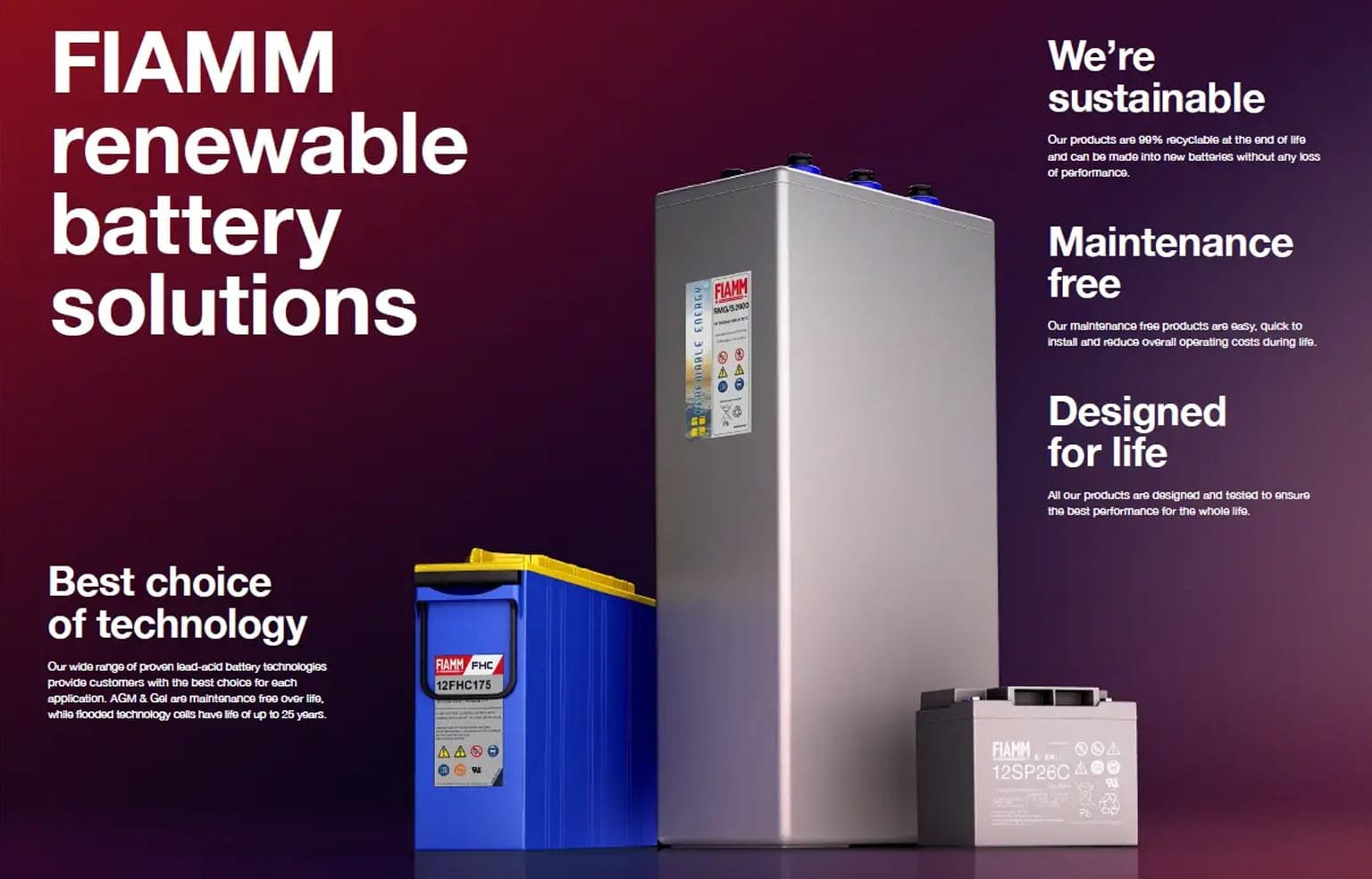
Reliable stored energy becomes important at the exact moment normal power is no longer available. A UPS may be operating correctly, a generator may be ready to start, and the electrical infrastructure may be well maintained—but during a utility failure, the battery becomes the immediate source of energy for the critical load.
That makes battery selection an engineering decision, not simply a purchasing decision.
For UPS installations, telecom networks, data centers, industrial facilities, utilities and selected renewable-energy systems, FIAMM battery solutions can be evaluated according to the application’s discharge profile, required autonomy, environmental conditions and system configuration.
For international buyers, the same principle applies whether the project is in India, the Middle East, Africa, Europe, Southeast Asia or another market. The correct solution depends on the actual operating conditions of the site.
This guide explains the important considerations for selecting, sizing, installing and maintaining FIAMM stationary battery solutions for commercial and industrial applications.
Understanding the Role of a Stationary Battery
A stationary battery is designed to remain installed at a fixed location and provide stored electrical energy when required.
Unlike an automotive starting battery, which is primarily designed for short-duration engine starting, stationary batteries are selected according to specific backup or energy-storage duties.
A typical UPS arrangement works as follows:
Utility Supply → UPS → Critical Load
with:
Battery Bank → UPS DC Bus
When utility power fails, the battery provides DC energy to the UPS, allowing the inverter to continue supplying the connected load.
The battery therefore forms an important part of the overall power-continuity system.
FIAMM Battery Product Selection
FIAMM offers battery products for different applications and operating requirements. The exact characteristics vary by product family and model.
When evaluating a FIAMM solution, the buyer should identify:
- Exact product series
- Battery construction
- Nominal voltage
- Capacity
- Discharge characteristics
- Design application
- Charging requirements
- Operating temperature
- Installation conditions
A product should not be selected simply because it has the required voltage and Ah rating.
The specific model’s technical documentation should be checked against the project requirements.
Standby and Cyclic Applications
One of the first questions in battery selection is:
How will the battery actually be used?
Standby Operation
In a standby application, the battery normally remains charged and is called upon when the main supply fails.
Typical examples include:
- UPS systems
- Emergency systems
- Telecom backup
- Control systems
- Security infrastructure
Cyclic Operation
In a cyclic application, the battery is regularly charged and discharged.
Examples can include selected:
- Renewable-energy systems
- Hybrid power systems
- Energy-storage installations
- Remote power systems
A battery designed primarily for standby service should not automatically be assumed to be the best option for frequent deep cycling.
Choosing a Battery for UPS Applications
UPS battery selection begins with the UPS itself.
The engineering team should establish:
UPS capacity + actual load + DC voltage + required autonomy + discharge profile
The UPS manufacturer’s requirements should also be checked for:
- DC bus voltage
- Number of cells
- Charger voltage
- Maximum charging current
- Battery compatibility
- Recommended battery configuration
The battery should work as part of the complete UPS system rather than being selected independently.
Short-Runtime UPS Applications
Many UPS installations require battery support for a relatively short period.
The purpose may be to:
- Maintain critical loads temporarily
- Allow a generator to start
- Complete a controlled shutdown
- Protect data during a power interruption
The battery’s high-rate discharge characteristics can therefore be more important than its nominal Ah rating alone.
Long-Runtime Applications
Some facilities require extended autonomy.
This may be relevant to:
- Telecom sites
- Remote infrastructure
- Certain industrial systems
- Renewable-energy installations
- Facilities without immediate generator support
Long-duration applications should be evaluated using the manufacturer’s appropriate discharge data.
Telecom Battery Selection
Telecom infrastructure often operates continuously and may include sites where maintenance access is limited.
Battery selection should consider:
- DC system voltage
- Network load
- Required autonomy
- Site temperature
- Cabinet arrangement
- Maintenance access
- Monitoring capability
- Expected operating pattern
For remote sites, battery condition monitoring can reduce the need for unnecessary physical inspections and help maintenance teams identify developing issues.
Data Center Battery Requirements
Data centers place a high priority on availability.
A typical power architecture may include:
Utility → UPS → Critical IT Load
with battery backup and generator support forming part of the wider continuity strategy.
Battery planning should consider:
- Required ride-through time
- UPS topology
- Redundancy
- Battery-room conditions
- Cooling
- Monitoring
- Maintenance access
- Replacement strategy
The battery configuration should be coordinated with the UPS and overall electrical design.
Industrial DC Power Applications
Industrial facilities may use stationary batteries for DC control and protection systems in addition to UPS applications.
Potential uses include:
- Electrical substations
- Control systems
- Protection systems
- Industrial automation
- Emergency systems
- Infrastructure projects
In these installations, reliability of the DC supply can be important for maintaining control and protection functions during an AC supply interruption.
Renewable Energy and Hybrid Systems
Battery storage can also form part of a hybrid power architecture.
A project may combine:
Solar + Grid + Battery + UPS/Inverter + Generator
The correct battery depends on how frequently the system cycles and how deeply the battery is discharged.
For a renewable-energy project, the engineering team should therefore examine the expected:
- Daily cycling
- Depth of discharge
- Charge profile
- Discharge duration
- Temperature
- Seasonal operating pattern
The technology should match the actual duty cycle.
2V Cells vs 12V Battery Blocks
Stationary systems may use individual cells or multi-cell battery blocks.
2V Cells
2V cells can be arranged in series to create the required DC voltage.
For example:
60 × 2V = 120V
The actual cell count depends on the system voltage.
12V Blocks
12V battery blocks contain multiple cells internally and can simplify certain installations.
The decision between individual cells and blocks depends on:
- System design
- Required capacity
- Maintenance approach
- Physical arrangement
- Available space
- Replacement strategy
AGM vs GEL
AGM and GEL are different lead-acid constructions.
AGM
The electrolyte is held within an absorbent glass-mat separator.
AGM technology is widely considered for standby applications where the product’s discharge and environmental characteristics are appropriate.
GEL
The electrolyte is immobilized in gel form.
GEL technology can be considered for applications where its specific charging and cycling characteristics match the system.
The choice should be based on the actual manufacturer’s specification rather than assuming one technology is universally better.
Battery Bank Sizing
Battery sizing should be performed from the actual load requirement.
The basic energy relationship is:
Energy = Power × Time
However, real battery sizing also considers:
- DC voltage
- UPS efficiency
- Discharge rate
- End voltage
- Temperature
- Battery ageing
- Design margin
Illustrative Example
Suppose a system requires:
20 kW load
for:
30 minutes
The theoretical energy requirement would be:
20 kW × 0.5 hour = 10 kWh
This is only an initial energy calculation.
The actual battery capacity must be determined using the system efficiency, DC voltage and manufacturer’s discharge data.
Therefore, this example should not be used as a final product-sizing calculation.
Understanding C-Rate
Battery documentation may use terms such as:
C1, C5, C8 or C10
These relate to the discharge period associated with a particular capacity rating.
The same nominal battery capacity can behave differently under different discharge conditions.
This is why procurement teams should compare batteries using equivalent discharge conditions rather than comparing Ah figures alone.
Float Charging
In many standby applications, batteries remain connected to a charging system that maintains them in a ready state.
The charging system must provide the appropriate:
- Float voltage
- Charging current
- Temperature compensation
- Battery configuration
The charging parameters must match the battery manufacturer’s recommendations.
Incorrect charging can affect battery life and reliability.
Recharge After Power Failure
A backup system should not only survive one outage.
If a facility experiences repeated interruptions, the battery may need to recharge within a defined period before another event occurs.
Recharge planning should consider:
Depth of discharge → Charger capability → Battery capacity → Required recovery time
This is particularly important for sites with unstable utility power.
Temperature Compensation
Temperature can significantly influence lead-acid battery performance and ageing.
High temperatures can accelerate degradation, while low temperatures can influence available capacity.
A properly engineered installation should therefore consider:
- Ambient temperature
- Battery temperature
- Charger settings
- Ventilation
- Cooling
- Seasonal variations
Temperature compensation should follow the battery and charger manufacturer’s requirements.
Battery Room and Cabinet Design
The physical installation is as important as the battery selection.
Consider:
- Available floor space
- Rack arrangement
- Weight
- Ventilation
- Temperature
- Maintenance clearance
- Cable routing
- DC protection
- Accessibility
The selected cabinet or rack should support the battery dimensions and weight and allow safe maintenance access.
Ventilation and Environmental Conditions
The installation environment should be assessed before commissioning.
Important factors include:
- Temperature
- Humidity
- Dust
- Ventilation
- Corrosive atmosphere
- Vibration
- Water exposure
- Physical access
For industrial and outdoor installations, these factors can have a significant effect on long-term battery performance.
Battery Monitoring
Battery monitoring provides useful visibility into system condition.
Depending on the monitoring system, parameters can include:
- Individual cell voltage
- String voltage
- Temperature
- Internal resistance
- Charge status
- Alarm status
For critical infrastructure, remote monitoring can help maintenance teams identify abnormal conditions before they develop into a complete backup failure.
Battery Commissioning
A proper commissioning process establishes a baseline for future maintenance.
A typical sequence may include:
Receiving inspection → Physical inspection → Installation → Polarity verification → Connection checks → Voltage verification → Charger verification → Functional testing → Documentation
The actual commissioning procedure should follow the manufacturer’s instructions and project requirements.
Acceptance Testing
Large industrial and infrastructure projects may require formal acceptance testing.
Depending on the project, this can include:
- Visual inspection
- Voltage verification
- Charger checks
- Alarm verification
- Functional testing
- Discharge testing where specified
- Documentation review
The acceptance criteria should be agreed during project planning.
Preventive Maintenance
Battery maintenance should be planned rather than performed only after an alarm occurs.
Typical maintenance activities include:
Visual Inspection
Check for physical damage, abnormal swelling, leakage or other visible conditions.
Connection Inspection
Check terminals and connections for looseness, corrosion or abnormal heating.
Voltage Monitoring
Compare individual cells or strings to identify unusual variations.
Temperature Monitoring
Check whether the operating environment remains within the recommended range.
Performance Testing
Periodic testing can provide information about the battery’s remaining capability.
The frequency should be determined by the manufacturer, application criticality and site maintenance program.
Battery Health Assessment
Battery condition can be evaluated using multiple indicators.
Useful measurements may include:
Voltage + Temperature + Internal Resistance + Capacity + Trend Data
Looking at the trend over time can be more useful than considering one measurement in isolation.
A battery that gradually shows increasing resistance or declining capacity may require further investigation before failure occurs.
Common Reasons for Reduced Backup Time
A reduction in autonomy does not always mean that the entire battery bank has failed.
Possible causes include:
- Increased connected load
- Battery ageing
- High operating temperature
- Incorrect charging
- Weak cells
- Poor connections
- Incorrect original sizing
- Changes in discharge requirements
The cause should be established before replacing the complete system.
Battery Replacement Planning
Replacement should be treated as part of the lifecycle plan.
A practical process is:
Condition assessment → Replacement decision → Procurement → Installation → Testing → Commissioning
For critical infrastructure, procurement lead times should be considered well before the battery reaches the end of its useful service.
Battery Storage Before Installation
Batteries may sometimes remain in storage before being installed.
Storage conditions and maximum storage periods should follow the manufacturer’s instructions.
Before commissioning stored batteries, verify:
- Storage duration
- Physical condition
- Voltage
- Charging requirements
- Manufacturer’s recommendations
Long-term storage should never be treated as equivalent to normal operation.
EPC Technical Submittals
EPC contractors and system integrators often require technical documentation before approving a battery.
A project submission may include:
- Product datasheet
- Discharge curves
- Battery sizing calculation
- General arrangement
- Battery dimensions
- Weight
- Terminal details
- Charging requirements
- Installation instructions
- Warranty information
- Applicable compliance documentation
The required document package varies by project.
OEM and System Integrator Considerations
OEMs and system integrators may need batteries that fit an existing electrical architecture.
Before integration, verify:
- DC voltage
- Capacity
- Physical dimensions
- Terminal arrangement
- Charging characteristics
- Discharge profile
- Operating temperature
- Monitoring requirements
A battery that physically fits an installation is not necessarily electrically compatible with it.
Warranty Evaluation
Warranty terms should be reviewed before procurement.
Ask the supplier to clarify:
- Warranty duration
- Covered conditions
- Installation requirements
- Maintenance requirements
- Replacement procedure
- Exclusions
- Transportation responsibilities
A warranty should complement a maintenance program rather than replace it.
Total Cost of Ownership
The lowest purchase price does not necessarily represent the lowest overall cost.
A lifecycle assessment can include:
Purchase → Installation → Energy consumption → Maintenance → Testing → Replacement → End-of-life management
For mission-critical applications, potential downtime costs should also be considered.
A slightly higher initial investment may be justified when it provides better compatibility, serviceability or lifecycle performance.
Responsible End-of-Life Management
Stationary batteries should be managed responsibly after reaching the end of their useful service.
For lead-acid products, appropriate collection and recycling channels should be used in accordance with applicable local regulations.
International projects should clearly establish who is responsible for end-of-life handling.
Frequently Asked Questions
What are FIAMM batteries used for?
Depending on the specific product, FIAMM stationary batteries can be considered for UPS, telecom, industrial, emergency and other backup applications.
Can FIAMM batteries be used internationally?
The suitability depends on the specific product, application and destination requirements. International projects should also confirm applicable logistics and regulatory requirements.
Which battery is suitable for an Online UPS?
The correct selection depends on the UPS DC voltage, load, required autonomy, discharge profile and manufacturer’s battery requirements.
Is a higher Ah battery always better?
No. The battery must be evaluated against the required discharge conditions, physical configuration and system requirements.
What is the difference between 2V and 12V batteries?
A 2V cell is an individual cell, while a 12V block contains multiple cells internally. The appropriate arrangement depends on the system design.
Can the same battery be used for UPS and solar?
Not necessarily. The expected duty cycle and charging/discharging pattern must be evaluated for each application.
How does temperature affect lead-acid batteries?
High temperatures can accelerate ageing, while low temperatures can affect available capacity.
What information is needed for battery sizing?
Load, DC voltage, backup duration, discharge conditions, temperature and UPS specifications are among the key inputs.
How can battery health be monitored?
Depending on the monitoring system, voltage, temperature, internal resistance and capacity-related information can be tracked.
When should a battery be replaced?
Replacement should be considered based on condition, test results, ageing, reduced autonomy and the criticality of the installation.
Can an existing battery be replaced with another brand?
Compatibility must be evaluated before making a substitution. Voltage, capacity, discharge characteristics, charging requirements and physical configuration should all be checked.
What is a battery discharge curve?
It shows how battery voltage and available capacity change under specified discharge conditions.
What does C10 mean?
C10 generally refers to a capacity/discharge condition associated with a ten-hour discharge period. The manufacturer’s test conditions should always be reviewed.
Do batteries need temperature control?
The requirement depends on the battery, environment and manufacturer’s specified operating range. High-temperature locations may require additional cooling or environmental control.
Can batteries be installed outdoors?
Some systems can be designed for outdoor use, but the battery and enclosure must be appropriate for the environmental conditions.
Can batteries work with diesel generators?
Yes, batteries can form part of UPS systems that also use generators. The UPS-generator arrangement should be engineered for compatibility.
Can FIAMM batteries be used in telecom sites?
Suitable products can be evaluated for telecom applications based on the site’s DC voltage, load, autonomy and environmental conditions.
Can FIAMM batteries be used in data centers?
Suitable stationary products can be considered as part of a data-center UPS architecture.
What should an EPC contractor request?
Technical datasheets, discharge information, dimensions, weight, charging requirements, drawings, warranty and applicable compliance documentation may be required.
What should distributors verify?
They should verify product identification, documentation, supply availability, warranty support and technical assistance.
How should batteries be transported internationally?
Transportation requirements depend on the specific product and destination. Packaging, handling, documentation and applicable regulations should be confirmed before shipment.
What is total cost of ownership?
It is the overall lifecycle cost, including purchase, installation, operation, maintenance, replacement and end-of-life handling.
Are FIAMM batteries suitable for the Middle East?
They can be evaluated for projects in the region, but temperature, installation conditions and application duty must be considered.
Are they suitable for African projects?
They can be considered for appropriate industrial, telecom and infrastructure applications after evaluating the site’s electrical and environmental conditions.
Are they suitable for European projects?
The appropriate product can be evaluated against the project’s technical requirements and applicable European regulatory and environmental requirements.
Can Anushri Systech help with battery selection?
You can provide the UPS/DC voltage, load, autonomy, application and project location for an initial technical discussion.
Conclusion
Choosing a stationary battery is ultimately about matching the energy-storage system to the way the equipment will operate.
For UPS, telecom, industrial DC systems, data centers and selected renewable-energy projects, the important factors go well beyond nominal capacity. Discharge behaviour, autonomy, charging, temperature, installation, monitoring, maintenance and lifecycle planning all influence the final result.
FIAMM products can be evaluated for different stationary applications, but the exact model should always be selected using current manufacturer documentation and the requirements of the project.
For buyers in India and international markets across the Middle East, Africa, Europe and Asia-Pacific, a technically structured procurement process can help reduce compatibility problems and improve long-term reliability.
The right question is therefore not simply:
“Which battery has the lowest price?”
A better question is:
“Which battery configuration matches our load, runtime, environment and operating profile?”
Global FIAMM Battery Enquiries
Whether you are:
- Planning a new UPS installation
- Replacing an existing battery bank
- Working on an EPC project
- Supporting telecom infrastructure
- Developing a data-center project
- Integrating renewable energy
- Procuring batteries for industrial facilities
- Looking for international supply
you can share the project requirements with Anushri Systech for an initial technical evaluation.
Email: sales@anushri.info
Phone: +91 9841698180 // +91 9566117188
Location: 2/27, Luz Ave 3rd St, East Abiramapuram, Mylapore, Chennai, Tamil Nadu 600004.