
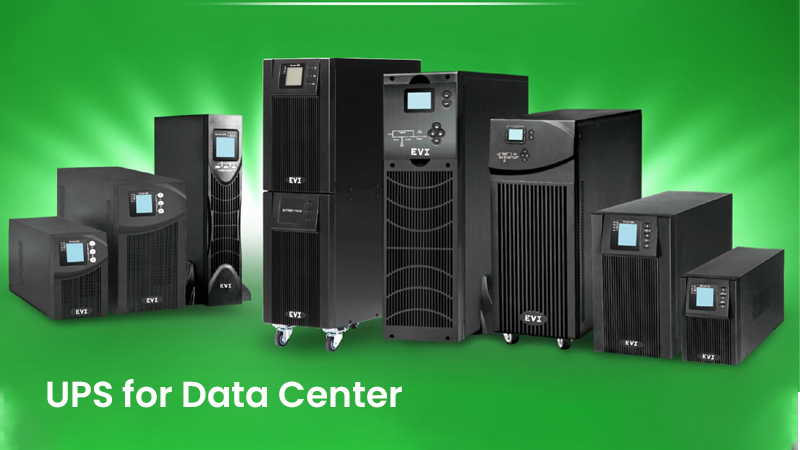
Data centers are built on one non-negotiable requirement: continuous, clean, and reliable power. Even a momentary interruption can lead to service outages, data risk, SLA penalties, and reputational impact. A UPS for data center environments is therefore a core reliability system—not just a backup device.
At VIVATEK, UPS solutions for data centers are engineered for high availability, scalability, and operational resilience, supporting enterprise, colocation, and mission-critical facilities.
Why UPS Systems Are Critical in Data Centers
Data centers operate with:
Zero tolerance for downtime
Continuous 24/7 loads
Highly sensitive IT and networking equipment
A data center UPS ensures:
Uninterrupted power during grid failures
Stable voltage and frequency for IT equipment
Protection from surges, sags, and transients
Seamless transition to generator power
This directly safeguards uptime, data integrity, and business continuity.
Typical Applications of UPS in Data Centers
UPS systems support multiple critical layers, including:
Server racks and blade servers
Network switches, routers, and firewalls
Storage systems and backup infrastructure
Cooling controls and BMS interfaces
Security, access control, and monitoring systems
Each layer has different criticality, shaping UPS sizing, redundancy, and battery strategy.
Online UPS Architecture for Data Centers
Online double-conversion UPS is the preferred architecture because it:
Provides zero transfer time
Electrically isolates IT loads from the grid
Delivers consistent output quality
This architecture underpins predictable performance and high availability.
Modular UPS for Scalable Growth
Modern facilities adopt modular UPS to enable:
Incremental capacity expansion
N+1 redundancy and fault tolerance
Faster serviceability with lower MTTR
Optimized space and energy utilization
Modular design avoids over-provisioning while keeping the facility future-ready.
Battery Backup Strategy
Battery backup is typically designed to:
Bridge power until generators stabilize
Maintain uptime during short-duration outages
Enable safe shutdown in smaller sites
Planning considers load size, redundancy, generator start time, thermal limits, and room layout—ensuring seamless continuity without risk.
UPS Monitoring & Visibility
Data centers benefit from real-time visibility into UPS health and performance:
Status dashboards and alarms
Event logs for audit and troubleshooting
Proactive alerts to reduce incident response time
Monitoring supports predictive maintenance and operational confidence.
Energy Efficiency & Operating Cost
UPS efficiency impacts OPEX and sustainability goals. Efficient operation:
Reduces heat losses and cooling demand
Lowers energy consumption at scale
Supports greener data center design
Efficiency awareness helps balance availability with long-term cost control.
Thermal Management & Battery Room Design
Thermal conditions directly affect UPS and battery life. Best practices include:
Controlled ambient temperature
Proper airflow and ventilation
Segregated battery rooms or racks
Good thermal design improves battery longevity and system reliability.
Reliability, Redundancy & High Availability
Data center UPS designs often include:
N+1 or higher redundancy
Parallel architectures
Maintenance bypass paths for zero-downtime servicing
These principles help meet availability targets and SLA commitments.
Installation, Commissioning & Readiness
A robust deployment includes:
Load analysis and redundancy planning
Structured cabling and protection coordination
Factory/onsite testing and commissioning
Integration with monitoring systems
Commissioning validates performance under real operating conditions.
Compliance, Documentation & Audits
For enterprise and institutional projects, UPS deployments are commonly supported by:
Commissioning records and test reports
As-built documentation
Maintenance and safety procedures
This documentation aligns with internal audits, RFPs, and governance needs.
How Data Center Teams Evaluate a UPS
Decision-makers typically assess:
Power capacity and growth path
Redundancy and fault tolerance
Battery runtime and recharge behavior
Efficiency and serviceability
Lifecycle support and spares strategy
A structured evaluation aligns technical, operational, and business objectives.
Designed for B2B & Mission-Critical Deployments
UPS systems are deployed across:
Enterprise and colocation data centers
Cloud and edge facilities
Financial, telecom, and government infrastructure
These environments require engineering-driven solutions, not off-the-shelf products.
Data Center UPS RFP & Pre-Design Readiness Checklist
Before initiating a formal procurement or RFP, data center teams typically align on a few technical fundamentals. This helps avoid redesign, delays, and scope changes later in the project lifecycle.
Key aspects usually defined at this stage include:
Total IT load and expected growth over time
Redundancy strategy (N, N+1, or parallel architecture)
Required battery autonomy for generator takeover or controlled shutdown
Space availability for UPS and battery systems
Monitoring, alerting, and integration expectations
Commissioning, testing, and documentation requirements
Establishing these parameters early enables smoother coordination between design consultants, EPC partners, and power solution providers.
UPS Integration Within the Data Center Power Chain
In a data center, the UPS functions as part of a larger power ecosystem rather than a standalone system. It typically operates between:
Utility / grid supply
Generator systems
Power distribution units (PDUs)
IT and cooling loads
Correct integration ensures:
Seamless transition during power events
No disturbance to sensitive IT equipment
Predictable behavior during maintenance or fault conditions
A well-integrated UPS architecture strengthens overall power chain resilience.
Long-Term Availability & Lifecycle Planning
Data center infrastructure is designed for long operational life. UPS systems therefore need to support:
Component-level serviceability
Planned battery replacement cycles
Firmware and monitoring upgrades
Minimal disruption during maintenance
Lifecycle-aware planning helps data centers maintain consistent availability levels while controlling long-term operational risk.
When to Engage a UPS Manufacturer
Engaging a UPS manufacturer early—during the concept or design stage—helps:
Validate power architecture assumptions
Align redundancy and scalability with real load behavior
Reduce late-stage design changes
Improve coordination across stakeholders
This approach supports engineering-led decision-making, rather than reactive procurement.
Technical Engagement for Data Center UPS Planning
For data center projects where availability, scalability, and reliability are critical, early technical discussions provide clarity before commercial decisions.
VIVATEK works with data center owners, consultants, and EPC teams to support:
Power architecture planning
Redundancy and battery strategy definition
Integration with monitoring and facility systems
Commissioning and lifecycle readiness
FAQ
1. Why is a UPS mandatory for data center operations?
A UPS is essential in data centers to ensure uninterrupted power to servers, networking equipment, and control systems. Even short power interruptions can cause service outages, data corruption, and SLA violations.
2. What type of UPS is best suited for data centers?
Data centers typically use online double-conversion UPS systems because they provide zero transfer time and continuous power conditioning, protecting sensitive IT equipment from grid disturbances.
3. How is UPS capacity calculated for a data center?
UPS capacity is determined based on total IT load, future expansion plans, redundancy requirements, and efficiency considerations. Proper load assessment ensures reliable performance without over- or under-sizing.
4. What is the role of battery backup in a data center UPS?
Battery backup bridges the gap between utility power failure and generator availability. It ensures continuous operation during short outages and provides time for controlled shutdown if required.
5. Why is redundancy important in data center UPS design?
Redundancy (such as N+1 or parallel configurations) ensures that the data center remains operational even if one UPS module or component fails, supporting high availability and uptime targets.
6. Can a UPS system be expanded as the data center grows?
Yes. Modular UPS architectures allow data centers to scale power capacity incrementally, making it easier to support future IT load growth without redesigning the entire power infrastructure.
7. How does a UPS integrate with generators in a data center?
During a power outage, the UPS instantly supports the load using batteries while the generator starts and stabilizes. Once stable, the load is transferred seamlessly, ensuring uninterrupted operation.
8. What maintenance is required for data center UPS systems?
UPS maintenance typically includes periodic inspections, battery health checks, functional testing, and monitoring of alarms and performance indicators to ensure long-term reliability.
9. How does UPS efficiency impact data center operating costs?
Higher UPS efficiency reduces energy losses and heat generation, lowering cooling requirements and overall operating expenses while supporting sustainable data center design.
10. When should a data center engage a UPS manufacturer or solution provider?
Engaging early during the design or planning stage helps align UPS architecture, redundancy, and scalability with real load requirements, reducing redesign risks and improving long-term reliability.
📞 Start with a Technical Discussion
Selecting the right UPS for a data center begins with understanding load profiles, redundancy targets, and growth plans.
VIVATEK supports projects by:
Assessing power and availability requirements
Recommending suitable UPS architecture
Planning redundancy, batteries, and monitoring
Supporting installation, commissioning, and lifecycle service
Early technical engagement ensures long-term reliability and scalability.
Final Perspective
A UPS for data center environments is a strategic investment in uptime, reliability, and trust. With the right architecture, monitoring, efficiency planning, and documentation, data centers can operate confidently even under challenging power conditions