
Modern factories do not stop only during power cuts — they stop during power disturbances.
A small voltage dip, phase imbalance, or frequency fluctuation is enough to halt PLC logic, trip drives, corrupt automation signals, and reject an entire production batch. Machines appear powered, but the process fails.
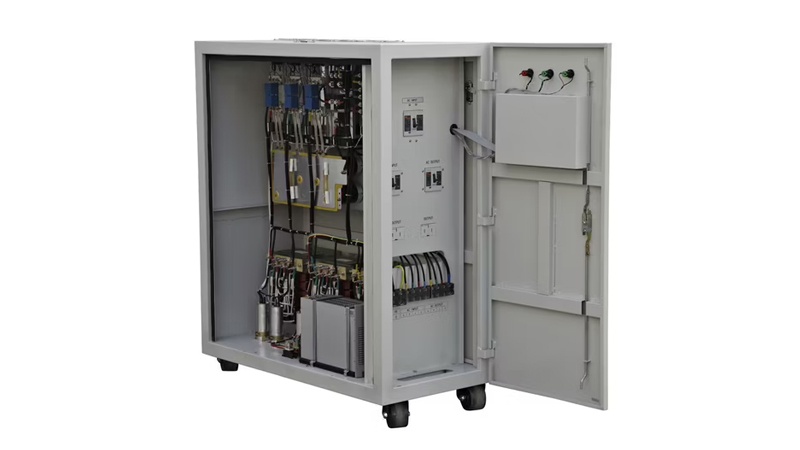
A three phase online UPS for factory power backup ensures continuous, stable electricity for industrial equipment. Instead of only restoring power, it protects production continuity.
For manufacturing industries, stable power quality is more critical than power availability.
Why Factories Need Industrial Online UPS Systems
Many industries still rely only on generators.
Generators supply electricity — but they do not condition electricity.
Before generator stabilizes:
PLC panels restart
CNC machines lose coordinates
Sensors misread signals
SCADA communication drops
Production material becomes scrap
An industrial online UPS system removes these disturbances completely.
It provides zero-transfer-time power and maintains voltage and frequency within safe limits.
This is why automation plants, textile units, pharmaceutical production, and process industries use heavy duty online UPS solutions.
Generator vs Online UPS Protection
| Protection Type | Generator | Industrial Online UPS |
|---|---|---|
| Supplies power after outage | Yes | Yes |
| Instant backup | No | Yes |
| Voltage stabilization | No | Yes |
| Frequency regulation | No | Yes |
| PLC protection | No | Yes |
| CNC machine safety | No | Yes |
| Automation continuity | No | Yes |
A generator restores electricity.
A UPS protects the process.
Both must work together for a reliable factory power backup solution.
Where Three-Phase UPS Is Used in Industry
A three phase industrial UPS is designed for operational systems, not lighting loads.
Manufacturing Applications
CNC machines and servo drives
Injection moulding machines
Printing and packaging lines
Textile processing equipment
Chemical processing plants
Pharmaceutical production units
Food processing industries
Automation PLC panels
SCADA control systems
Data logging equipment
These loads require a continuous waveform — not battery backup alone.
What Happens During a 1-Second Power Disturbance
Without UPS:
Batch rejected
Machine reset required
Calibration lost
Restart delay 30–90 minutes
With UPS:
Process continues normally
No operator intervention
No material loss
The cost of one rejected production cycle often exceeds the cost of installing an industrial power backup system.
Choosing the Right UPS Capacity
Most factories make a mistake: selecting kVA based on total load.
Correct selection depends on:
kW load
Motor starting current
Harmonics
Expansion plans
Process sensitivity
Generator availability
Proper sizing prevents overload trips and overspending.
A technical evaluation ensures the right online UPS for manufacturing industry instead of trial-and-error purchase.
How Much Battery Backup Is Needed?
Industrial UPS is not meant for long inverter-type backup.
Purpose:
Prevent interruption
Allow generator startup
Maintain automation continuity
Provide controlled shutdown
The goal is process continuity — not long runtime.
Installation in Running Factory
Industrial UPS installation does not require production shutdown.
Typical method:
Panel preparation
Parallel integration
Testing during maintenance window
Controlled switchover
Operations continue with minimal interruption.
Problems Prevented by Heavy Duty Online UPS
A reliable industrial UPS protects against:
Voltage fluctuation
Phase failure
Harmonics disturbance
Drive tripping
PLC reset
Encoder position loss
Instrument calibration failure
Data corruption
Automation breakdown
These invisible problems cause more downtime than total outages.
Long-Term Reliability and Maintenance
An industrial UPS works as infrastructure equipment, not a consumable device.
Stable operation requires:
Periodic inspection
Battery health monitoring
Load balancing
Preventive service
Correct engineering ensures years of dependable performance.
Who Should Consider Installing One
This applies to:
Factory owners
Maintenance engineers
Electrical consultants
Automation integrators
EPC contractors
Purchase departments
Project managers
Any operation where production stoppage costs money requires a stable industrial UPS solution.
What You Should Do Next
Instead of guessing UPS capacity, prepare these details:
Machine list
Critical panels
Required backup duration
Generator availability
Installation location
With this information, a technical recommendation can match your exact requirement and avoid unnecessary cost.
Final Note
In manufacturing, electricity availability keeps machines ON.
Power quality keeps production RUNNING.
A three-phase online UPS protects the process, not just the equipment.