
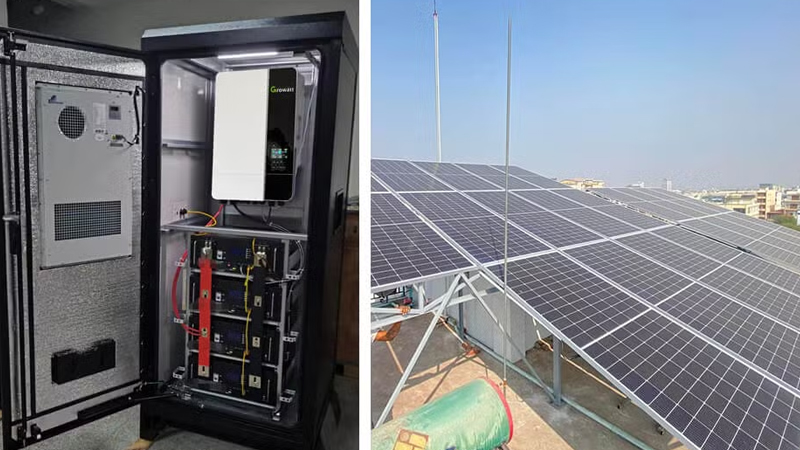
Rising electricity tariffs, peak demand charges, grid outages, and diesel dependency are forcing businesses to rethink how they manage power. A lithium battery solar hybrid system offers a smart, future-ready solution by combining solar power, lithium battery energy storage, and grid supply into one intelligent system.
If you are searching for a lithium battery solar hybrid system, you are not just exploring solar—you are looking for reliability, control, and long-term cost savings.
ASPL designs and executes lithium battery solar hybrid systems exclusively for commercial and industrial facilities, where performance, safety, and ROI are critical.
Executive Summary (For Decision Makers)
A lithium battery solar hybrid system enables businesses to:
Use solar power during the day
Store excess energy in lithium batteries
Reduce peak demand charges
Ensure uninterrupted power during outages
Minimize diesel generator usage
ASPL delivers engineering-driven hybrid solar systems that balance solar generation, battery storage, and grid interaction for maximum savings and reliability.
👉 Share your electricity bill to get a FREE hybrid solar feasibility & ROI assessment from ASPL.
Is a Lithium Battery Solar Hybrid System Right for Your Business?
This solution is ideal if:
Your monthly electricity bill is ₹75,000+
You face frequent power cuts or voltage fluctuations
Peak demand charges increase your bills
Diesel generator costs are high
Power reliability impacts production or operations
👉 If these apply to your facility, ASPL can design a high-ROI hybrid system for you.
What Is a Lithium Battery Solar Hybrid System?
A lithium battery solar hybrid system integrates:
Solar power plant
Lithium-ion battery energy storage
Hybrid inverter / power conversion system
Intelligent energy management
How it works:
Solar supplies power to your load during the day
Excess solar energy charges lithium batteries
Batteries discharge during peak tariff hours or outages
Grid power supports the system when required
The entire system operates automatically, without manual switching.
Why Lithium Batteries Are Preferred in Solar Hybrid Systems
Lithium batteries are the preferred choice for modern hybrid systems due to:
High energy density
Faster charge & discharge capability
Long cycle life
Low maintenance
Compact footprint
High round-trip efficiency
Compared to conventional batteries, lithium technology delivers better lifecycle value and operational stability.
Why Businesses Are Adopting Lithium Battery Solar Hybrid Systems
Commercial and industrial users adopt hybrid systems to:
Control peak demand and tariff impact
Improve power reliability
Maximize solar self-consumption
Reduce diesel generator runtime
Build energy resilience
A lithium battery solar hybrid system converts solar into a 24×7 energy asset, not just a daytime source.
Who Should Install a Lithium Battery Solar Hybrid System?
This solution is well suited for:
Manufacturing plants & factories
IT parks & data centers
Hospitals & healthcare facilities
Warehouses & logistics hubs
Commercial buildings & campuses
If uninterrupted power and predictable energy costs matter, a hybrid system delivers strong business value.
Key Benefits for Commercial & Industrial Users
✔ Peak Load & Tariff Optimization
Batteries discharge during high-tariff periods, reducing demand charges.
✔ Reliable Backup Power
Lithium batteries provide silent, clean backup without diesel dependence.
✔ Higher Solar Utilization
Store surplus solar energy instead of exporting it at low value.
✔ Improved ROI
Savings from peak shaving and diesel reduction accelerate payback.
✔ Future-Ready Infrastructure
Hybrid systems are scalable and grid-ready.
Lithium Battery Solar Hybrid System vs On-Grid Solar
| Feature | Hybrid System | On-Grid Solar |
|---|---|---|
| Battery storage | Yes (Lithium) | No |
| Power during outages | Yes | No |
| Peak tariff control | Yes | Limited |
| Capital cost | Higher | Lower |
| Energy flexibility | High | Medium |
Hybrid systems are chosen when reliability and control are more important than lowest upfront cost.
What Happens If a Hybrid System Is Poorly Designed?
Many businesses face:
Undersized batteries that don’t last through outages
Oversized systems with poor ROI
Inverter–battery mismatch
Safety risks from poor thermal management
Low savings due to incorrect energy logic
ASPL eliminates these risks through engineering-led hybrid system design.
How ASPL Designs Lithium Battery Solar Hybrid Systems
ASPL follows an engineering-first approach:
Detailed load and tariff analysis
Optimal solar–battery–grid sizing
Intelligent energy management logic
Safety and protection coordination
Approval-ready system design
We design systems to maximize savings, reliability, and long-term performance.
Safety, Compliance & Reliability
Every ASPL hybrid system includes:
Battery safety architecture
Thermal management planning
Electrical protection and isolation
Grid compliance and synchronization
Fire-safe cabling and practices
This ensures safe, insurable, and reliable operation.
Expected Performance & ROI
For commercial hybrid systems:
Significant reduction in peak demand charges
Sharp drop in diesel generator usage
Higher solar utilization
Typical ROI: 4–6 years (project-specific)
Asset life: 20–25 years
Savings continue well beyond payback.
Typical Project Timeline
Feasibility & system design: 1–2 weeks
Engineering & approvals: 2–3 weeks
Installation & commissioning: 4–8 weeks
⏱️ Timelines depend on system size and complexity.
What ASPL Supports in Hybrid Solar Projects
ASPL supports:
Commercial & industrial hybrid systems
Solar + lithium battery integration
Engineering, EPC & commissioning
Long-term performance optimization
ASPL does not support:
Residential hybrid systems
Component-only supply
Price-only projects without performance accountability
This ensures qualified, serious project execution.
Frequently Asked Questions – Lithium Battery Solar Hybrid System
Q1. Will the system work during grid outages?
Yes. Batteries supply power automatically during outages.
Q2. Can battery usage be limited to peak hours only?
Yes. Energy logic can be customized for peak shaving.
Q3. Can the system be expanded later?
Yes. Both solar and battery capacity can be scaled.
Q4. Is the system safe for industrial use?
Yes. ASPL designs with safety and compliance as priorities.
Free Hybrid Solar Feasibility & ROI Assessment
👉 Share your electricity bill and load details, and ASPL will provide:
Solar + battery capacity recommendation
Backup duration estimate
Savings & ROI projection
Execution roadmap
✔ Free
✔ Confidential
✔ No obligation
Final Call to Action
Ready to Deploy a Lithium Battery Solar Hybrid System?
ASPL helps businesses:
Reduce electricity and diesel costs
Improve power reliability
Control peak demand
Build future-ready energy infrastructure
👉 Request a FREE Hybrid System Feasibility & ROI Report
📞 Contact ASPL today and turn solar into a reliable power asset