
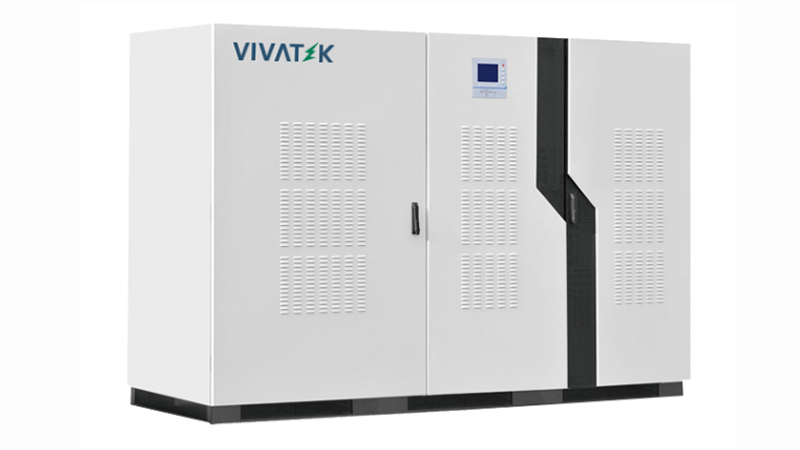
In industrial environments, power continuity is not a convenience—it is a business requirement. Manufacturing lines, automation systems, data centers, hospitals, and infrastructure facilities depend on stable three-phase power to operate safely and efficiently. Even a short power disturbance can result in production loss, equipment damage, or safety risks. This makes 3 phase industrial UPS systems a critical part of modern industrial operations.
At VIVATEK, 3 phase industrial UPS systems are engineered specifically for B2B and industrial applications, where reliability, scalability, and long-term performance matter more than headline specifications. This blog is written for factory owners, plant heads, EPC contractors, consultants, and procurement teams evaluating three-phase UPS solutions for mission-critical power backup.
What Is a 3 Phase Industrial UPS System?
A 3 phase industrial UPS system is designed to provide uninterrupted, regulated power to high-capacity loads that operate on three-phase supply. Unlike residential or office UPS systems, industrial UPS units are built to handle:
Continuous and heavy load operation
Unbalanced and non-linear industrial loads
Voltage fluctuations and grid instability
Integration with generators and hybrid power sources
The UPS acts as a protective layer between the grid and critical equipment, ensuring stable output even during power disturbances.
Why 3 Phase UPS Systems Are Essential for Industry
Most industrial machinery and infrastructure operate on three-phase power due to its efficiency and load-handling capability. However, three-phase systems are also sensitive to power quality issues.
A 3 phase industrial UPS system helps by:
Maintaining uninterrupted power during outages
Stabilizing voltage across all three phases
Protecting equipment from surges, sags, and harmonics
Supporting continuous operation of automation and control systems
Reducing downtime, scrap, and unplanned shutdowns
For industries with continuous or batch processes, a three-phase UPS is a risk-management and productivity tool.
Industries That Commonly Use 3 Phase Industrial UPS Systems
3 phase industrial UPS systems are widely deployed across:
Manufacturing Plants – production lines, CNC machines, robotics
Textile, Pharma & Food Processing – process control and instrumentation
Data Centers & IT Infrastructure – servers, networking, storage
Hospitals & Healthcare Facilities – diagnostic and life-support systems
Utilities & Infrastructure Projects – control rooms, substations, telecom
Each industry has different load profiles and uptime expectations, making proper UPS selection essential.
VIVATEK’s Engineering-Driven Approach
At VIVATEK, 3 phase industrial UPS systems are designed with a focus on real operating conditions, not just laboratory ratings.
The engineering approach includes:
Design for continuous industrial duty cycles
Stable performance under unbalanced loads
Compatibility with Indian grid conditions
Provision for future load expansion
Service-friendly architecture for long-term maintenance
Every system is configured based on actual load behavior, site conditions, backup requirements, and growth plans, ensuring reliable performance throughout its lifecycle.
Types of 3 Phase Industrial UPS Configurations
🔹 3 Phase In – 3 Phase Out UPS
Used for:
Manufacturing plants
Process industries
Large automation systems
Hospitals and infrastructure facilities
These systems support high-capacity loads and continuous operation.
🔹 3 Phase In – 1 Phase Out UPS
Suitable for:
CNC machines
Automation panels
Control and instrumentation systems
This configuration provides stable single-phase output from a three-phase supply.
🔹 Modular 3 Phase UPS Systems
Ideal for:
Data centers and IT facilities
Applications requiring redundancy (N+1 / N+X)
Sites with phased or uncertain load growth
Modular architecture allows capacity expansion without replacing the entire system, reducing downtime and long-term cost.
Battery Options & Backup Planning
3 phase industrial UPS systems support multiple battery technologies depending on operational needs:
SMF / VRLA batteries
Tubular batteries for long backup requirements
Lithium-ion battery integration
Custom backup durations from minutes to several hours
Battery selection is based on outage patterns, load criticality, space availability, and lifecycle cost, not just initial price.
Manufacturing Quality & System Testing
Before deployment, each 3 phase industrial UPS system undergoes structured testing, including:
Functional and safety checks
Full-load and overload testing
Phase balance and performance verification
Battery charge and discharge validation
Support for Factory Acceptance Testing (FAT)
This ensures dependable performance under real industrial operating conditions.
Installation, Commissioning & Lifecycle Support
For industrial buyers, the UPS lifecycle is as important as the product itself. After installation, support typically includes:
On-site commissioning and validation
Preventive maintenance planning
Battery health monitoring
Support during load expansion or process changes
Structured AMC and service coordination
This approach helps maintain uptime and predictable performance year after year.
Compliance & Industrial Standards Consideration
3 phase industrial UPS systems are generally evaluated against applicable electrical safety, power quality, and performance standards. During project evaluation, aspects such as voltage stability, protection mechanisms, and operational safety are reviewed to align with industrial audits, EPC documentation, and internal approval processes.
This supports long-term reliability and compliance across industrial environments.
How Industrial Buyers Choose the Right 3 Phase UPS
Most organizations follow a structured evaluation process:
Identify critical loads and downtime impact
Analyze existing power quality issues
Define backup duration and redundancy needs
Select the appropriate UPS architecture
Plan installation, commissioning, and lifecycle support
A methodical approach helps avoid under-sizing, over-sizing, and future constraints.
Common Mistakes to Avoid
When selecting a 3 phase industrial UPS system, common mistakes include:
Choosing capacity based only on connected load
Ignoring future expansion plans
Underestimating battery lifecycle requirements
Not planning for maintenance bypass and service access
Avoiding these mistakes reduces operational risk and long-term cost.
Designed for B2B & Project-Based Procurement
3 phase industrial UPS systems are commonly supplied for:
Industrial and infrastructure projects
EPC-led installations
Institutional and utility requirements
Long-term operational facilities
This makes them suitable for organizations that value reliability, documentation, and lifecycle planning.
📞 Start with a Technical Discussion
If you are evaluating 3 phase industrial UPS systems for a factory, data center, hospital, or infrastructure project, the most effective first step is a technical discussion.
VIVATEK works with organizations to:
Understand real operating conditions
Recommend the right UPS configuration
Plan backup, redundancy, and future growth
Support long-term reliability and service
You can share your requirement at any stage. The focus is technical clarity before commercial commitment.
FAQ
Q1. When should a 3 phase UPS be used instead of a single-phase UPS?
A 3 phase UPS is recommended for high-capacity, continuous, or industrial loads such as motors, automation systems, and large IT infrastructure.
Q2. Can a 3 phase UPS handle unbalanced loads?
Yes, when properly designed and sized, industrial 3 phase UPS systems can manage unbalanced and non-linear loads.
Q3. Is a modular 3 phase UPS suitable for factories?
Modular systems are suitable where scalability or redundancy is required. Fixed systems are often used where the load is stable and predictable.
Q4. How long does installation and commissioning take?
Timelines depend on system size and site readiness, but installations are typically planned to minimize operational disruption.
Final Perspective
A 3 phase industrial UPS system is not just a backup device—it is a core part of an organization’s power reliability strategy. Choosing the right system and the right manufacturing partner directly impacts uptime, safety, and long-term performance.