
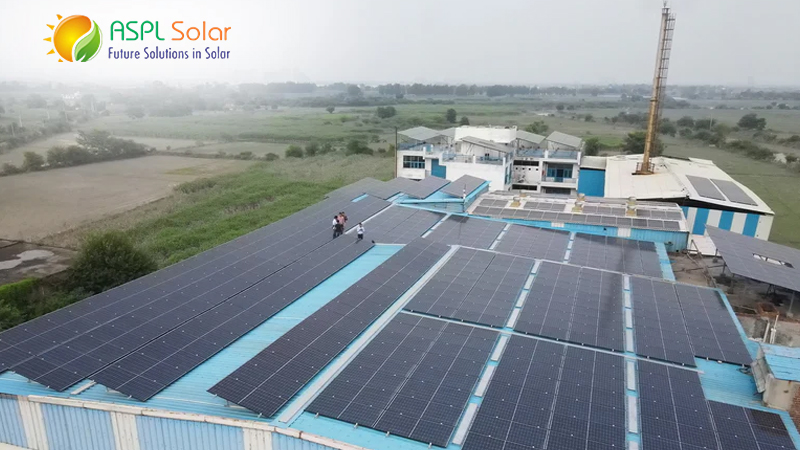
Solar Solutions for Textile Industries in Tamil Nadu with ROI, payback & 30–50% cost reduction. Get FREE EB bill analysis & solar feasibility study from ASPL.
If you run a textile mill in Tamil Nadu, electricity is not just an expense — it is one of your biggest operational risks.
Spinning mills, weaving units, dyeing units, and processing factories operate with:
High motor loads
Continuous machine operation
Compressors & humidification systems
High daytime consumption
With rising industrial electricity tariffs in Tamil Nadu, textile industries are under increasing cost pressure.
The real question is:
How long can your textile unit absorb rising power costs without affecting margins?
This is where Solar Solutions for Textile Industries in Tamil Nadu become a financial strategy — not just a sustainability move.
Why Textile Industries in Tamil Nadu Face High Electricity Costs
Textile manufacturing is energy-intensive.
Major power consumption areas:
Ring frames & spinning machines
Looms
Dyeing & processing units
Air compressors
HVAC & humidity control systems
Electricity tariffs include:
Energy charges (per unit cost)
Demand charges (kVA-based)
Fixed charges
Peak-hour penalties
Even a ₹1 per unit increase can impact annual profitability by lakhs.
Example:
50,000 units/month × ₹1 increase
= ₹50,000 extra per month
= ₹6,00,000 per year
Over 5 years → ₹30 lakhs additional cost.
This is why Solar Solutions for Textile Industries in Tamil Nadu are gaining serious attention.
How Solar Solutions Help Textile Mills Reduce Electricity Cost
Industrial Rooftop Solar for Textile Industries directly offsets daytime energy consumption.
Textile factories typically operate during daylight hours — perfect for solar utilization.
Benefits:
✔ Reduce electricity cost by 30–50%
✔ Lower demand charges
✔ Improve industrial solar ROI
✔ Hedge against tariff hikes
✔ Improve long-term cost stability
Solar becomes an asset — not an expense.
Example: 250 kW Solar Plant for Textile Industry
Let’s take a practical scenario.
Textile unit consumption: 50,000 units/month
Tariff: ₹8 per unit
Annual electricity cost: ₹48,00,000
250 kW rooftop solar generates approx. 3,75,000 units annually.
Annual savings ≈ ₹30 lakhs (approximate example depending on load pattern).
Payback period: 3–5 years.
System lifespan: 25+ years.
Post-payback savings: Crores over lifetime.
This is the financial power of Solar Solutions for Textile Industries in Tamil Nadu.
Want to Know Your Exact Savings?
ASPL provides FREE Textile Industry Solar Feasibility Study.
You get:
✔ EB bill analysis
✔ Solar plant capacity recommendation
✔ ROI & payback calculation
✔ 10-year savings projection
✔ Rooftop technical evaluation
Share your last 3 EB bills.
Receive structured report within 48 hours.
Textile Industry-Specific Advantages of Solar
Unlike many industries, textile mills benefit strongly because:
High daytime operation
Large rooftop area
Consistent base load
Long working hours
Solar generation aligns with textile load profile.
This improves solar payback period significantly.
What Happens If Textile Industries Delay Solar Adoption?
If tariffs rise by ₹1.5 over next 5 years:
50,000 units × ₹1.5 × 12 months
= ₹9,00,000 extra annually
5-year impact ≈ ₹45 lakhs.
That amount alone could fund a large portion of a solar system.
Delay has measurable cost.
Industrial Solar Plant Cost for Textile Units in Tamil Nadu
Industrial solar plant cost depends on:
System size (100 kW, 250 kW, 500 kW, 1 MW)
Roof type (RCC / sheet roofing)
Mounting structure
Inverter configuration
Electrical integration
Net metering compliance
Choosing the right EPC partner is critical.
Poor engineering increases payback period.
Common Concerns Textile Owners Have
Is rooftop solar safe for factory roof?
Structural assessment ensures load-bearing safety.
What about dust in textile environment?
Regular cleaning & maintenance ensure optimal generation.
Will solar affect power quality?
Proper integration maintains stable electrical performance.
What about maintenance cost?
Minimal compared to annual savings.
Solar + Demand Optimization for Textile Mills
Solar reduces:
Grid dependency
Peak kVA draw
Excess demand penalties
This improves:
Industrial energy cost reduction
Solar ROI for manufacturing units
Long-term profitability
Solar becomes a strategic energy cost optimization tool.
Why Choose ASPL for Textile Industry Solar in Tamil Nadu?
ASPL, the solar division of Anushri Systech Private Limited, specializes in industrial solar EPC services.
We provide:
Textile-specific load analysis
EB tariff breakdown
Solar feasibility study
Customized ROI report
Turnkey installation
Long-term AMC support
We focus on financial clarity and engineering precision.
Not generic quotations.
How to Get Your Textile Industry Solar Report
Step 1 – Share last 3 EB bills
Step 2 – Rooftop feasibility study
Step 3 – Solar savings & payback calculation
Step 4 – Proposal discussion
Clear. Structured. Transparent.
FREE Solar Cost & ROI Analysis for Textile Industries
If you operate a spinning mill, weaving unit, or dyeing factory in Tamil Nadu:
Get your FREE Solar Solutions Report from ASPL.
Includes:
✔ Electricity cost breakdown
✔ Solar plant sizing
✔ Payback period calculation
✔ 10-year savings forecast
No obligation.
Just financial clarity.
Final Thought
Solar Solutions for Textile Industries in Tamil Nadu are no longer optional.
They are a strategic cost control decision.
Textile units that adopt rooftop solar early gain:
Lower electricity cost
Protection from tariff hikes
Stronger profit margins
Competitive pricing advantage
The real question is:
Will your textile unit continue absorbing rising power costs
Or convert rooftop space into long-term financial savings?
📞 Contact ASPL today and begin your textile industry solar feasibility assessment.
Turn your factory rooftop into a long-term energy asset.