
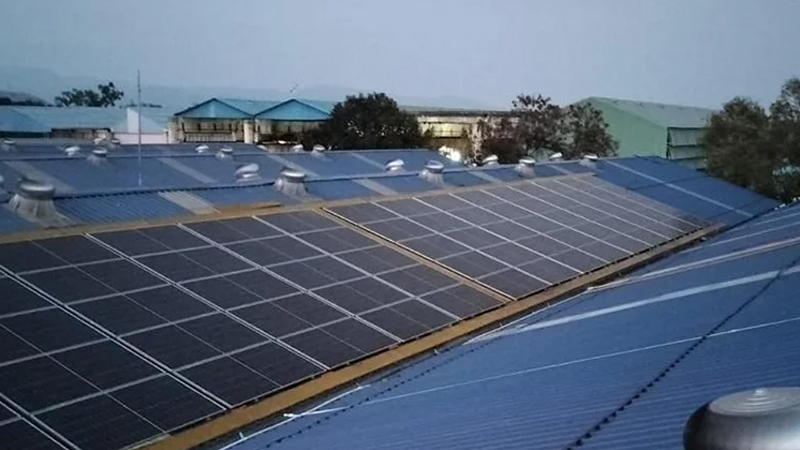
Solar ROI Calculation for Manufacturing Units in Tamil Nadu is becoming one of the most important financial evaluations for factory owners, plant heads, and CFOs.
Electricity cost in Tamil Nadu continues to rise due to tariff revisions, demand charges, and grid dependency. For manufacturing industries, power is not just an operational expense — it directly affects production cost, competitiveness, and profitability.
Before investing in rooftop solar, decision-makers want clarity:
What is the real return on investment?
What is the payback period?
How much can my factory save annually?
Is industrial solar financially safe?
This guide explains Solar ROI Calculation for Manufacturing Units in Tamil Nadu step by step.
Why Solar ROI Calculation for Manufacturing Units in Tamil Nadu Is Important
Many factories first ask about installation cost per kW.
But experienced financial planners evaluate:
Annual savings
Payback period
Internal Rate of Return (IRR)
10-year savings projection
Long-term tariff escalation impact
Industrial Solar Installation in Tamil Nadu should be evaluated as a long-term financial asset — not a short-term expense.
Step-by-Step Solar ROI Calculation for Manufacturing Units in Tamil Nadu
Let’s understand the process clearly.
Step 1: Analyze Current Electricity Consumption
Collect the last 3 EB bills and check:
Monthly unit consumption
Average per-unit tariff
Demand charges
Peak-hour penalties
Daytime load percentage
Example:
Monthly consumption: 35,000 units
Average tariff: ₹8 per unit
Monthly electricity expense: ₹2,80,000
Annual electricity expense: ₹33,60,000
This becomes your financial baseline.
Step 2: Decide Solar Capacity
Solar capacity depends on:
Rooftop area
Structural strength
Daytime consumption
Future expansion plan
For example:
A 100 kW rooftop solar system generates around 12,000–14,000 units per month in Tamil Nadu.
Step 3: Calculate Annual Solar Generation
Average monthly generation: 13,000 units
Annual generation:
13,000 × 12 = 1,56,000 units
Generation depends on:
System design quality
Panel efficiency
Tilt angle
Maintenance
Engineering quality directly impacts Solar ROI Calculation for Manufacturing Units in Tamil Nadu.
Step 4: Calculate Annual Savings
If EB tariff = ₹8 per unit:
1,56,000 × ₹8 = ₹12,48,000 annual savings
If tariff increases to ₹9 per unit:
1,56,000 × ₹9 = ₹14,04,000 annual savings
Solar protects against electricity tariff inflation.
Step 5: Determine Total Investment
Industrial Solar Plant Cost in Tamil Nadu depends on:
Capacity (100 kW, 250 kW, 500 kW, etc.)
Roof structure (RCC / metal sheet)
Inverter configuration
Mounting structure
Electrical integration
Net metering compliance
Avoid selecting a vendor based only on lowest quote.
Poor engineering reduces generation and ROI.
Step 6: Calculate Payback Period
Payback Period = Total Investment ÷ Annual Savings
Typical industrial solar payback period in Tamil Nadu: 3 to 5 years
System lifespan: 25+ years
After payback, electricity generation becomes significantly lower in cost for 20+ years.
Solar ROI Scenario for Manufacturing Unit
| Parameter | Value |
|---|---|
| Monthly Consumption | 35,000 units |
| Solar Capacity | 100 kW |
| Annual Generation | 1,56,000 units |
| Annual Savings | ₹12.5 Lakhs |
| Payback Period | 3–4 Years |
| System Life | 25 Years |
Post-payback savings (approx. 20 years):
₹12.5 lakhs × 20 = ₹2.5 Crores (excluding tariff escalation)
This shows the long-term financial strength of Solar ROI Calculation for Manufacturing Units in Tamil Nadu.
What Happens If You Delay Solar Investment?
If tariffs increase by ₹1 per unit over the next 5 years:
Your factory could pay ₹50–₹80 lakhs extra cumulatively.
Delaying solar investment has financial consequences.
Key Factors That Influence Solar ROI
Electricity Tariff
Higher tariff = higher savings.
Daytime Load Utilization
Manufacturing units operating during daylight maximize benefits.
System Design & EPC Quality
Proper engineering ensures optimal generation.
Net Metering Policy
Compliance with Tamil Nadu Electricity Regulatory Commission ensures smooth energy accounting.
(Tamil Nadu Electricity Regulatory Commission)
Maintenance & Monitoring
Routine O&M ensures long-term performance stability.
Additional Financial Benefits
Accelerated Depreciation
Solar assets may qualify for depreciation benefits under applicable tax rules.
Energy Cost Stability
Solar protects factories from unpredictable tariff hikes.
ESG & Sustainability Advantage
Export-oriented manufacturing units benefit from sustainability positioning.
Why Choose ASPL for Solar ROI Calculation?
ASPL, the solar division of Anushri Systech Private Limited, provides:
Detailed EB bill analysis
Customized Solar ROI Calculation for Manufacturing Units in Tamil Nadu
Payback estimation
10-year savings projection
Industrial Solar EPC services
Long-term AMC support
Learn more about our Industrial Solar EPC Services (internal link).
We provide data-driven clarity before installation.
ASPL 4-Step Solar ROI Process
Collect last 3 EB bills
Analyze consumption pattern
Conduct rooftop feasibility study
Provide structured ROI report
Transparent process builds financial confidence.
FREE Solar ROI Calculation for Manufacturing Units in Tamil Nadu
If you operate a factory in Tamil Nadu and want accurate financial evaluation:
ASPL offers:
✔ Free EB Bill Review
✔ Customized ROI Report
✔ Payback Period Calculation
✔ 10-Year Savings Projection
✔ Site Feasibility Study
Share your EB bills.
Receive financial clarity within 48 hours.
No obligation.
FAQs – Solar ROI Calculation for Manufacturing Units in Tamil Nadu
What is the payback period for industrial solar?
Typically 3–5 years depending on tariff and usage.
Is solar profitable for manufacturing units?
Yes, especially for factories with high daytime consumption.
How accurate is Solar ROI Calculation for Manufacturing Units in Tamil Nadu?
When based on real EB bills and proper feasibility study, projections are highly reliable.
Final Thought
Solar ROI Calculation for Manufacturing Units in Tamil Nadu is not guesswork.
It is financial mathematics.
Factories that evaluate solar early gain:
Long-term cost advantage
Protection from tariff hikes
Greater energy stability
Stronger profit margins
The question is not:
“Is solar expensive?”
The real question is:
“How much will your factory save over the next 25 years?”
📞 Contact ASPL today and begin your industrial solar ROI assessment.
Turn your rooftop into a measurable financial asset.