
Engineering and heavy machinery industries are among the highest electricity-consuming manufacturing sectors in India.
From CNC machining centers and laser cutting systems to welding lines, foundry equipment, compressors, EOT cranes, and heat treatment furnaces power consumption is massive and continuous.
With rising industrial electricity tariffs, increasing demand charges, and tighter profit margins, engineering manufacturers are actively searching for long-term energy cost optimization.
This is why Solar for Engineering & Heavy Machinery Industries is becoming a strategic financial decision — not just an environmental initiative.
If your factory electricity bill is ₹40–80 lakhs annually, the real question is:
How much of that can solar reduce — and how quickly can you recover the investment?
Let’s break it down.
Why Engineering & Heavy Machinery Industries Have High Electricity Costs
Engineering units typically operate:
High-load CNC machines
Heavy motors and drives
Induction furnaces
Welding and fabrication lines
Hydraulic presses
Compressors
Electricity bills include:
Energy charges (₹ per kWh)
Maximum demand charges (₹ per kVA)
Fixed charges
Power factor penalties
Peak-hour tariffs
Even a ₹1 per unit tariff increase can significantly impact annual cost.
Example:
Monthly consumption: 80,000 units
₹1 increase = ₹80,000 extra per month
Annual impact = ₹9,60,000
Over 5 years → ₹48+ lakhs additional burden.
This is why Solar for Engineering & Heavy Machinery Industries is gaining serious attention.
How Solar for Engineering & Heavy Machinery Industries Reduces Electricity Cost
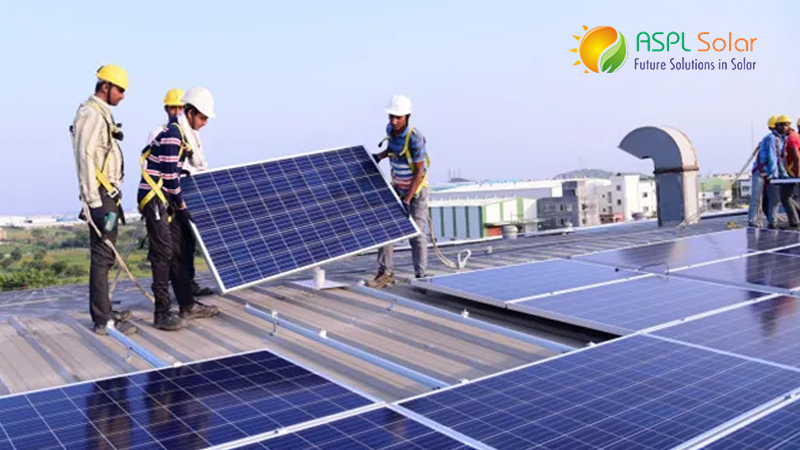
Industrial rooftop solar directly offsets daytime electricity usage.
Engineering factories typically operate during daylight shifts — perfect for solar generation alignment.
Benefits:
✔ Reduce electricity cost by 30–50%
✔ Lower grid dependency
✔ Reduce demand charge exposure
✔ Improve Industrial Solar ROI
✔ Achieve 3–5 year payback period
✔ Create long-term cost stability
Solar converts recurring electricity expense into long-term capital asset.
Example: 300 kW Solar Plant for Engineering Factory
Factory consumption: 80,000 units/month
Annual consumption: 9,60,000 units
300 kW rooftop solar generates approx. 4,50,000–5,00,000 units annually.
If tariff = ₹8 per unit:
Annual savings ≈ ₹36–40 lakhs
Estimated payback period: 3–5 years (depending on plant cost and load utilization).
System lifespan: 25+ years.
Post-payback savings over 20 years: Several crores.
This demonstrates the strong industrial solar ROI for heavy machinery industries.
Want to Know Your Exact Payback Period?
ASPL offers FREE Industrial Solar Feasibility Study for engineering factories.
You receive:
✔ Detailed EB bill analysis
✔ Solar capacity sizing
✔ Industrial solar plant cost estimation
✔ Payback period calculation
✔ 10-year savings projection
✔ Rooftop structural evaluation
Share your last 3 EB bills.
Get structured financial report within 48 hours.
Demand Charges – Hidden Cost in Heavy Industries
Heavy machinery industries often face high maximum demand charges due to:
Simultaneous motor startup
Furnace load spikes
Compressor peak demand
Shift change load surge
Solar reduces daytime grid kVA draw.
This helps:
✔ Reduce excess demand penalties
✔ Improve electricity cost control
✔ Shorten solar payback period
Solar acts as both energy and demand optimization solution.
Solar vs Grid Electricity – Long-Term Financial Comparison
| Factor | Grid Electricity | Industrial Solar |
|---|---|---|
| Tariff Stability | Variable | Fixed after installation |
| Payback | No recovery | 3–5 years |
| Lifespan | Continuous payments | 25+ years |
| Asset Creation | No | Yes |
| Cost Control | Low | High |
Solar for Engineering & Heavy Machinery Industries improves financial predictability.
What Happens If You Delay Solar Installation?
If tariff increases ₹1.5 over next 5 years:
Additional annual cost ≈ ₹14 lakhs
5-year cumulative impact ≈ ₹70 lakhs
That amount could fund a large portion of a solar system.
Delay has measurable opportunity cost.
Industrial Solar Plant Cost – What Affects It?
Cost depends on:
Capacity (100 kW – 1 MW+)
Roof type (RCC / sheet)
Mounting structure design
Inverter configuration
Electrical integration complexity
Net metering compliance
Choosing experienced industrial solar EPC partner ensures:
✔ Accurate generation estimation
✔ Engineering safety
✔ Faster ROI
✔ Long-term system reliability
Common Concerns from Engineering Industry Owners
Will solar affect heavy machine performance?
No. Solar integrates with grid supply and supports load without disrupting operations.
What about roof load capacity?
Structural analysis ensures safe installation.
What about maintenance?
Industrial solar requires minimal maintenance compared to annual savings.
Can solar support night shift operations?
Solar reduces daytime load. Night operations continue on grid unless battery system is installed.
ESG & Competitive Advantage
Many engineering exporters face increasing ESG expectations from global clients.
Adopting solar:
✔ Reduces carbon footprint
✔ Improves brand positioning
✔ Enhances supplier credibility
✔ Supports green manufacturing initiatives
Solar strengthens both financial and reputational position.
Why Choose ASPL?
ASPL, the solar division of Anushri Systech Private Limited, specializes in industrial solar EPC services for engineering and heavy machinery industries.
We provide:
Industry-specific load analysis
EB tariff breakdown
Solar feasibility study
Customized ROI report
Payback period calculation
Turnkey installation
Long-term AMC support
We focus on measurable financial clarity before execution.
Not generic proposals.
How to Get Your Engineering Factory Solar Report
Step 1 – Share last 3 EB bills
Step 2 – Rooftop feasibility assessment
Step 3 – Solar sizing & ROI calculation
Step 4 – Proposal presentation
Clear. Structured. Transparent.
FREE Solar Cost & ROI Report for Engineering Industries
If you operate an engineering or heavy machinery manufacturing unit:
Get your FREE Solar Feasibility Study from ASPL.
Includes:
✔ Electricity cost breakdown
✔ Solar plant capacity recommendation
✔ Payback period analysis
✔ 10-year savings forecast
No obligation.
Only financial clarity.
Final Thought
Solar for Engineering & Heavy Machinery Industries is no longer optional.
It is a strategic cost control decision.
Factories that adopt rooftop solar early gain:
Lower electricity cost
Protection from tariff hikes
Improved margins
Long-term energy stability
The real question is:
Will your factory continue absorbing rising electricity bills —
Or convert rooftop space into 20+ years of savings?
📞 Contact ASPL today and begin your industrial solar feasibility assessment.
Turn your factory rooftop into a long-term financial asset.