
In today’s manufacturing environment, power quality is directly linked to productivity, machine life, and operational cost. Across India—especially in industrial regions of Tamil Nadu—factories frequently face voltage fluctuation, low voltage, overvoltage, phase imbalance, harmonics, and sudden load variations. These issues lead to machine trips, controller faults, motor overheating, scrap generation, and unplanned downtime.
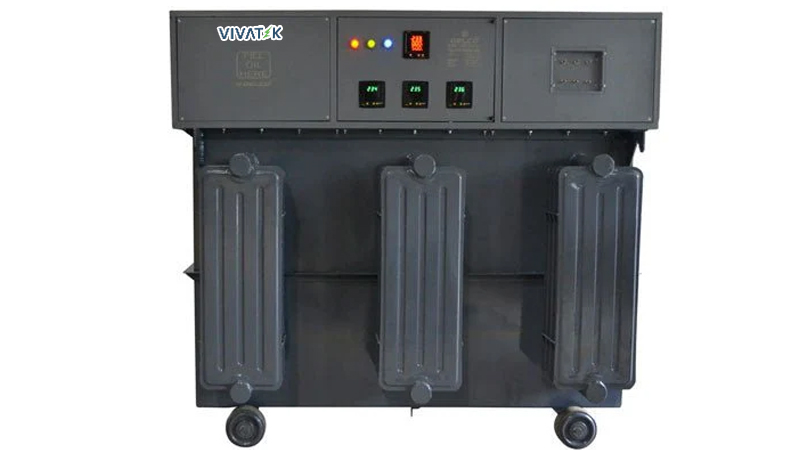
A servo voltage stabilizer for industrial applications is not an optional accessory. It is a core power-conditioning system designed to protect heavy-duty machinery, CNC machines, VFD-driven motors, automation panels, and continuous production lines.
This blog is written only for B2B and industrial buyers and is structured to help factory owners, plant managers, maintenance engineers, EPC contractors, and procurement teams make an informed decision.
Who Should Use This Industrial Servo Voltage Stabilizer?
This solution is designed for:
Factory owners & industrial entrepreneurs
Plant / production managers
Electrical & maintenance engineers
EPC contractors & consultants
Purchase and procurement teams
If your facility operates three phase motors, CNC machines, VMC/HMC, compressors, chillers, elevators, VFDs, PLC panels, or automation systems, a servo voltage stabilizer is essential.
What Is a Servo Voltage Stabilizer?
A servo voltage stabilizer is an automatic voltage regulation system that maintains a constant output voltage despite wide input voltage fluctuations. It works using:
A servo motor–driven variable transformer (variac)
A control circuit (microprocessor / digital controller)
Continuous voltage feedback
The servo motor adjusts the transformer smoothly, providing step-less and precise voltage correction, unlike relay-type stabilizers.
Why Industrial Applications Require Servo Stabilizers
Industrial power conditions are harsh and unpredictable. Common issues include:
Low voltage during peak load hours
Overvoltage damaging electronic components
Phase imbalance in three phase systems
Sudden load changes from motors and CNC machines
Harmonics generated by VFDs and drives
These problems can cause:
CNC alarms and machine shutdowns
Servo drive and control card failures
Motor overheating and insulation damage
Reduced accuracy and product quality
Production loss and higher maintenance costs
A servo voltage stabilizer eliminates these risks by supplying stable, regulated power at all times.
Key Benefits of Servo Voltage Stabilizer for Industrial Use
✔ High Voltage Accuracy
Maintains output voltage typically within ±1%, critical for precision industrial equipment.
✔ Fast Correction Speed
Response time of 10–50 milliseconds, preventing machine trips and control errors.
✔ Step-less Voltage Regulation
Smooth correction without switching shocks, ideal for CNC and automation systems.
✔ Handles Unbalanced Three Phase Loads
Designed for real-world industrial load conditions.
✔ High Efficiency
Up to 98% efficiency, suitable for continuous factory operation.
✔ Long Equipment Life
Reduces electrical and thermal stress on motors and electronics.
Oil Cooled vs Air Cooled Servo Voltage Stabilizers
Oil Cooled Servo Voltage Stabilizer (Recommended for Factories)
Best for:
Heavy-duty industrial applications
Continuous 24/7 operation
High kVA requirements
Advantages:
Superior heat dissipation
Higher overload capacity
Longer service life
Stable performance in harsh environments
Air Cooled Servo Voltage Stabilizer
Suitable for:
Small and medium industries
Intermittent operation
Lower kVA loads
Typical Specifications for Industrial Servo Voltage Stabilizers
| Parameter | Industrial Requirement |
|---|---|
| Type | Servo controlled voltage stabilizer |
| Phase | Three phase (unbalanced load) |
| Input Voltage Range | Wide range (customizable) |
| Output Voltage | 415V ±1% |
| Response Time | < 50 ms |
| Cooling | Oil cooled / Air cooled |
| Efficiency | Up to 98% |
| Protection | Overload, short circuit, phase failure |
| Control | Digital / microprocessor |
Industrial Applications Covered
Servo voltage stabilizers are widely used in:
CNC turning centers, VMC, HMC, grinding machines
Textile and spinning mills
Injection molding and rubber processing
Pharmaceutical and food processing plants
Steel, foundry, and metal fabrication units
Automation and assembly lines
Data centers, IT parks, and hospitals
Elevators, chillers, compressors, and pumps
Servo Stabilizer vs Relay Type Stabilizer (Industrial Comparison)
| Feature | Servo Stabilizer | Relay Stabilizer |
|---|---|---|
| Voltage Regulation | Continuous & step-less | Step-based |
| Accuracy | ±1% | ±5% or more |
| Response Time | Very fast | Slow |
| CNC / VFD Compatibility | Excellent | Not suitable |
| Load Handling | Heavy & unbalanced | Limited |
| Industrial Reliability | High | Low |
For factories, relay stabilizers are not recommended. Servo stabilizers are the industrial standard.
How to Select the Right Servo Voltage Stabilizer
Step 1: Calculate Load
Include all connected equipment and add 20–30% margin for future expansion.
Step 2: Evaluate Voltage Conditions
Low-voltage or fluctuation-prone areas require wide input range stabilizers.
Step 3: Choose Cooling Type
Oil cooled models are ideal for continuous industrial duty.
Step 4: Ensure Compatibility
Stabilizer must handle VFD loads, harmonics, and sudden load changes.
Why Industries Choose Vivatek
Vivatek designs and manufactures industrial servo voltage stabilizers specifically for factory and B2B applications.
What Makes Vivatek Suitable for Industrial Buyers
Application-specific design (not generic products)
Solutions for CNC, VFD, automation, and heavy motor loads
Oil cooled and air cooled options
Designed for Indian grid conditions
Reliable performance for continuous operation
Custom kVA and voltage range options
Frequently Asked Questions (FAQs)
Is a servo stabilizer mandatory for factories?
Yes. Factories using CNC, VFDs, motors, or automation systems require stable voltage to avoid damage and downtime.
Which is better for factories: oil cooled or air cooled?
Oil cooled servo stabilizers are preferred for heavy-duty and continuous industrial use.
Can servo stabilizers handle unbalanced loads?
Yes. Industrial servo stabilizers are designed for unbalanced three phase systems.
Do servo stabilizers work with CNC machines and VFDs?
Yes. They are ideal for CNC, servo drives, and VFD-based equipment.
What is the service life of an industrial servo stabilizer?
With proper design and maintenance, it offers long-term reliable performance.
Looking for a Servo Voltage Stabilizer for Your Factory?
If your plant faces:
Voltage fluctuation
Machine trips
Power-related downtime
CNC or motor failures
A custom-engineered servo voltage stabilizer from Vivatek can provide a long-term solution.
✔ Free load calculation
✔ Site voltage assessment
✔ Custom kVA design
✔ Industrial-grade manufacturing
Contact Vivatek today for an industrial quotation.
Conclusion
A servo voltage stabilizer for industrial applications is a critical investment that protects machinery, improves productivity, and ensures stable operations. For factories focused on quality, uptime, and long-term reliability, choosing the right stabilizer is essential.
With application-driven design and industrial focus, Vivatek servo voltage stabilizers support manufacturing units across India with dependable power protection.