
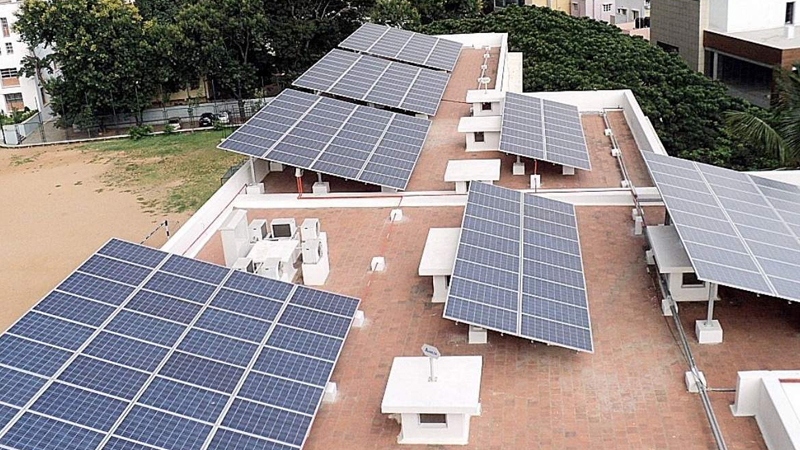
Rooftop Solar for Warehouses reduces electricity cost by 30–60% with 3–5 year payback. Get FREE solar feasibility study & ROI report from ASPL.
Warehouses consume significant electricity — especially logistics hubs, e-commerce fulfillment centers, cold storage units, and distribution facilities.
Lighting, HVAC systems, refrigeration units, material handling systems, and charging stations all increase power demand.
With rising commercial electricity tariffs and increasing demand charges, warehouse operators are actively looking for cost optimization strategies.
This is why Rooftop Solar for Warehouses is becoming one of the fastest-growing commercial solar solutions in India.
If you operate a warehouse facility, the real question is:
How much can rooftop solar reduce your electricity cost — and how fast can it pay back?
Let’s break it down clearly.
Why Warehouses Are Ideal for Rooftop Solar
Warehouses are structurally perfect for solar installation because:
Large, uninterrupted roof area
Minimal rooftop obstruction
Daytime electricity consumption
Long building lifespan
Stable base load
Unlike residential buildings, warehouses allow installation of large-scale commercial solar plants (100 kW to 2 MW+).
This makes Rooftop Solar for Warehouses financially attractive.
Electricity Cost Structure in Warehouses
Warehouse electricity bills typically include:
Energy charges (₹ per unit)
Maximum demand charges (kVA)
Fixed charges
Peak-hour tariffs
Power factor penalties
Even a ₹1 per unit increase impacts annual operating cost significantly.
Example:
Monthly consumption: 1,20,000 units
₹1 increase = ₹1,20,000 extra per month
Annual impact = ₹14,40,000
Over 5 years → ₹70+ lakhs additional expense.
This is why warehouse owners are evaluating solar seriously.
How Rooftop Solar for Warehouses Reduces Electricity Cost
Commercial rooftop solar directly offsets daytime energy consumption.
Benefits:
✔ Reduce electricity bills by 30–60%
✔ Lower grid dependency
✔ Reduce demand charges
✔ Improve cost predictability
✔ Hedge against tariff hikes
✔ Enhance sustainability profile
Solar transforms warehouse electricity from expense to asset.
Example: 500 kW Rooftop Solar for Warehouse
Warehouse consumption: 1,20,000 units/month
Annual consumption: 14,40,000 units
500 kW rooftop solar generates approx. 7–8 lakh units annually (location dependent).
If tariff = ₹8 per unit:
Annual savings ≈ ₹56–64 lakhs
Estimated payback period: 3–5 years
System lifespan: 25+ years
Post-payback savings over 20 years: Multiple crores.
This shows the strong ROI potential of Rooftop Solar for Warehouses.
Want to Know Your Exact Savings?
ASPL offers FREE Warehouse Solar Feasibility Study.
You get:
✔ EB bill analysis
✔ Solar plant sizing
✔ ROI & payback calculation
✔ 10-year savings projection
✔ Structural feasibility assessment
Share your last 3 EB bills.
Receive a detailed financial report within 48 hours.
Demand Charges in Warehouse Facilities
Warehouses often face high maximum demand charges due to:
Simultaneous HVAC startup
Refrigeration load spikes
EV charging systems
Conveyor & material handling systems
Solar reduces grid kVA draw during daylight hours.
This helps:
✔ Reduce excess demand penalties
✔ Improve commercial solar ROI
✔ Stabilize electricity cost
Solar is both energy generation and demand optimization tool.
Industrial Solar Plant Cost for Warehouses
Commercial solar plant cost depends on:
Capacity (100 kW, 250 kW, 500 kW, 1 MW+)
Roof type (metal sheet / RCC)
Mounting structure
Inverter configuration
Electrical integration
Net metering compliance
Choosing experienced commercial solar EPC partner ensures:
Accurate generation estimation
Safe installation
Faster payback
Long-term reliability
What Happens If You Delay Solar Installation?
Assume ₹1.5 tariff increase in next 5 years.
Additional annual cost ≈ ₹21 lakhs (for 1.2 lakh units/month warehouse)
5-year cumulative impact ≈ ₹1+ crore.
That amount alone can finance a large solar system.
Delay increases opportunity cost.
ESG & Sustainability Advantage for Warehouses
Logistics and e-commerce companies increasingly require:
Renewable energy usage
Carbon footprint reduction
Green warehouse certification
Rooftop Solar for Warehouses improves:
✔ ESG rating
✔ Brand reputation
✔ Tenant attraction
✔ Long-term property value
Solar becomes competitive advantage.
Common Questions Warehouse Owners Ask
Is rooftop solar safe for metal sheet roofing?
Yes, with proper structural design and mounting system.
What about roof leakage?
Professional installation prevents leakage issues.
What about maintenance?
Minimal maintenance compared to annual savings.
Can solar operate during power cuts?
Grid-tied systems require grid presence unless battery backup is installed.
Why Choose ASPL for Commercial Solar?
ASPL, the solar division of Anushri Systech Private Limited, specializes in industrial and commercial rooftop solar projects.
We provide:
Detailed EB bill review
Warehouse-specific load analysis
Solar feasibility study
ROI & payback calculation
Turnkey installation
Long-term AMC support
We focus on financial clarity before installation.
No generic proposals. Only data-backed analysis.
How to Get Your Warehouse Solar Cost Report
Step 1 – Share last 3 EB bills
Step 2 – Rooftop feasibility assessment
Step 3 – Solar capacity recommendation
Step 4 – ROI & savings presentation
Clear. Structured. Transparent.
FREE Rooftop Solar Analysis for Warehouses
If you operate a warehouse, logistics hub, or cold storage unit:
Get your FREE Solar Feasibility Study from ASPL.
Includes:
✔ Electricity cost breakdown
✔ Solar plant sizing
✔ Payback period estimation
✔ 10-year savings forecast
No obligation.
Only financial clarity.
Final Thought
Rooftop Solar for Warehouses is no longer optional.
It is a strategic cost optimization tool.
Warehouse operators who act early gain:
Lower operating cost
Protection from tariff hikes
Stronger profit margins
Improved property value
The real question is:
Will your warehouse continue absorbing rising electricity costs
Or convert unused rooftop space into long-term savings?
📞 Contact ASPL today and begin your warehouse solar feasibility assessment.
Turn your rooftop into a long-term financial asset.