
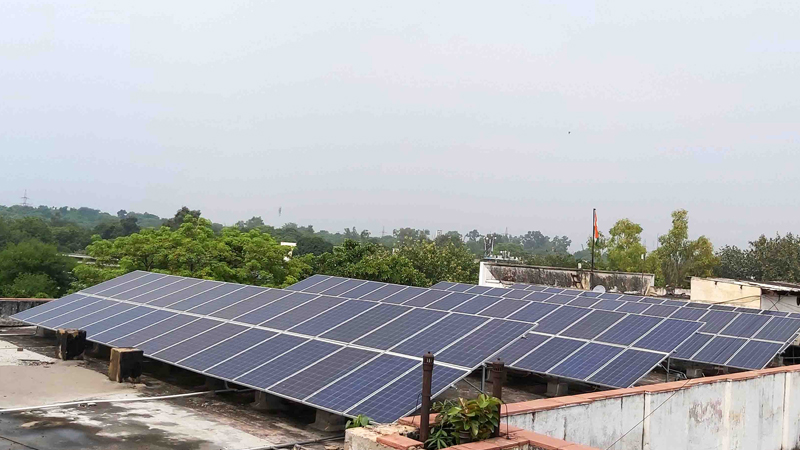
If your factory is paying ₹25–50 lakhs per year in electricity bills, and tariffs continue increasing, how long can you absorb this cost?
The Payback Period of Industrial Solar in India has become one of the most critical financial evaluations for manufacturing units, plant heads, and CFOs.
Industrial electricity tariffs are rising. Demand charges are increasing. Grid dependency creates uncertainty.
The key question is not:
“Is solar expensive?”
The real question is:
“How quickly can industrial solar recover investment and reduce electricity cost?”
This guide explains the payback period, industrial solar plant cost, ROI calculation, and long-term savings clearly and practically.
Why Payback Period of Industrial Solar in India Matters for Manufacturing Units
For factories in Tamil Nadu and across India:
Electricity is a major operational cost
Tariffs are revised periodically
Peak-hour penalties increase expenses
Production expansion increases load
Industrial Solar Installation in India converts electricity from recurring expense into a long-term asset.
If payback is 3–5 years and system life is 25+ years:
That means 20+ years of financial benefit.
How to Calculate Payback Period of Industrial Solar in India
Formula:
Payback Period = Total Solar Investment ÷ Annual Electricity Savings
Let’s understand with real example.
100 kW Industrial Solar Plant for Factory
Factory consumption: 35,000 units/month
Average EB tariff: ₹8 per unit
Annual electricity cost: ₹33,60,000
100 kW Rooftop Solar for Industries generates approx:
1,56,000 units annually
Annual savings at ₹8 tariff: ₹12,48,000
If industrial solar plant cost = ₹50 lakhs (illustrative):
Payback period ≈ 4 years
After 4 years: Electricity cost reduces significantly for next 20+ years.
Industrial Solar ROI for Manufacturing Units
Industrial Solar ROI in India depends on:
Electricity tariff
Daytime load utilization
System capacity optimization
Engineering quality
Net metering compliance
Maintenance
Higher tariff = faster payback.
Factories operating mainly during daytime benefit the most.
Solar ROI for manufacturing units is often stronger than many traditional investments.
Solar vs Grid Electricity Cost Comparison for Industries
Grid Electricity:
Tariff hikes
Demand charge increases
No cost stability
No asset creation
Industrial Rooftop Solar:
Predictable savings
3–5 year payback
25-year lifespan
Hedge against electricity inflation
Energy cost optimization
Over 10–25 years, cumulative savings can reach crores.
What Happens If You Delay Solar Investment?
Assume ₹1 tariff increase:
35,000 units × ₹1 × 12 months = ₹4,20,000 extra per year
5 years delay = ₹20+ lakhs additional cost
No asset created.
No cost control gained.
Industrial energy cost reduction becomes harder each year.
Delay has financial consequences.
Industrial Solar Plant Cost in India – What Influences It?
Industrial solar plant cost depends on:
System capacity (100 kW, 250 kW, 500 kW, 1 MW)
Roof type (RCC / metal sheet)
Mounting structure
Inverter selection
Electrical integration
Safety systems
Net metering policy
Choosing lowest cost without engineering quality increases payback period.
Proper feasibility study is essential.
Common Concerns About Industrial Solar
Is industrial solar risky?
With proper engineering and quality components, risk is minimal.
What about maintenance?
Industrial solar maintenance cost is low. Regular cleaning and monitoring ensure performance.
What if generation reduces?
High-quality panels include long-term performance warranties.
What about net metering in India?
Compliance with electricity regulatory guidelines ensures smooth integration.
Case – Manufacturing Unit
A manufacturing unit installed 100 kW rooftop solar.
Annual savings: ₹13 lakhs
Payback period: 3.8 years
System lifespan: 25 years
Projected 20-year savings after payback: ₹2.5+ crores
This demonstrates the financial impact of industrial solar investment.
Additional Financial Benefits
Accelerated Depreciation benefits
Improved ESG profile
Better energy planning
Competitive pricing advantage
Reduced exposure to grid volatility
Industrial solar installation becomes strategic advantage.
Why Choose ASPL for Industrial Solar EPC in India?
ASPL, the solar division of Anushri Systech Private Limited, specializes in:
Industrial Solar EPC Services
Solar Feasibility Study for Factory
Industrial Solar Payback Period Calculation
Solar ROI for Manufacturing Units
Rooftop Solar for Industries
Industrial Solar Plant Cost Estimation
We provide:
Detailed EB bill analysis
Customized savings projection
10-year financial forecast
Turnkey installation
Long-term AMC support
We focus on numbers, not generic quotations.
How to Get Your Industrial Solar Payback Report
Step 1 – Share last 3 EB bills
Step 2 – Rooftop feasibility assessment
Step 3 – Solar savings calculation
Step 4 – Payback & ROI presentation
Clear. Structured. Transparent.
FREE Industrial Solar Feasibility Study
If you want to know your exact Payback Period of Industrial Solar in India:
ASPL offers:
✔ Free EB Bill Review
✔ Customized ROI Report
✔ Payback Calculation
✔ 10-Year Savings Projection
✔ Site Feasibility Study
Send your EB bills.
Receive structured financial clarity within 48 hours.
No obligation.
FAQs – Payback Period of Industrial Solar in India
What is the average payback period?
Typically 3–5 years depending on tariff and load pattern.
Is industrial solar profitable?
Yes, especially for factories with high daytime electricity consumption.
Can solar reduce 30–50% of electricity bill?
Yes, depending on rooftop area and capacity installed.
Final Thought
The Payback Period of Industrial Solar in India is not a guess.
It is financial mathematics.
Factories that adopt rooftop solar early gain:
Long-term cost advantage
Protection from tariff hikes
Improved capital efficiency
Energy stability
The real decision is simple:
Continue paying rising electricity bills
Or recover investment in 3–5 years and secure 20+ years of savings.
📞 Contact ASPL today and request your industrial solar payback assessment.
Turn your factory rooftop into a long-term financial asset.