
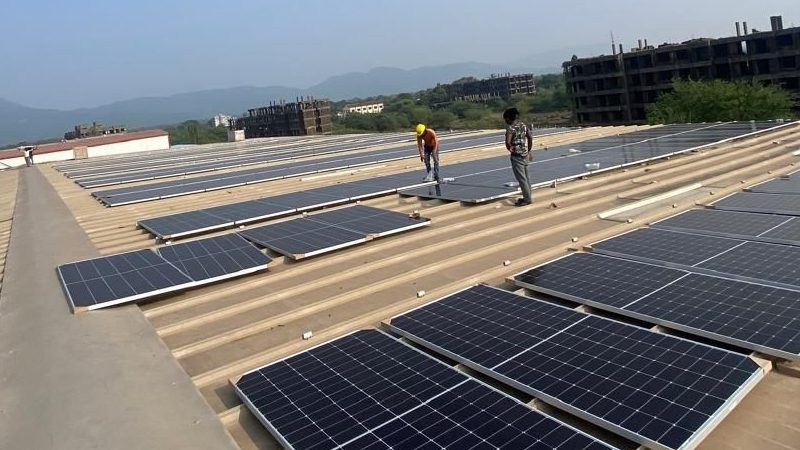
Open Access Charges in Tamil Nadu are one of the most critical factors industries must evaluate before investing in Open Access Solar in Tamil Nadu.
Many factories calculate only the solar tariff but ignore open access charges, which directly impact Industrial Solar ROI Tamil Nadu.
If your factory consumes more than 10 lakh units per year and you are considering Group Captive Solar Tamil Nadu, understanding Open Access Charges in Tamil Nadu is essential for accurate financial planning.
This guide explains:
What are open access charges
Types of charges applicable in Tamil Nadu
How they affect Solar Payback Period for Industries
Comparison with Rooftop Solar for Manufacturing Units
Risk factors
How to structure savings properly
What Is Open Access Solar in Tamil Nadu?
Open Access Solar in Tamil Nadu allows industries to procure electricity from off-site solar power plants.
Instead of installing rooftop solar, the factory:
✔ Invests in or signs agreement with solar plant
✔ Receives power via state transmission network
✔ Pays applicable Open Access Charges in Tamil Nadu
This model is common under Group Captive Solar Tamil Nadu structure.
Why Open Access Charges in Tamil Nadu Matter
Without understanding open access charges:
Industrial Solar ROI Tamil Nadu calculations may be wrong
Solar Payback Period for Industries may extend
Savings projections may be inaccurate
A proper Industrial Solar Feasibility Study must include all regulatory components.
Types of Open Access Charges in Tamil Nadu
Below are the major Open Access Charges in Tamil Nadu industries must consider:
Wheeling Charges
Wheeling charges are paid for using distribution network infrastructure.
This applies when electricity is transported from solar plant to your factory.
Transmission Charges
If solar power travels through state transmission system, transmission charges apply.
Large industries using high voltage connections must consider this carefully.
Cross Subsidy Surcharge (CSS)
CSS compensates distribution companies for revenue loss when industries purchase power from alternative sources.
Under Group Captive Solar Tamil Nadu, CSS may be exempt if eligibility conditions are met.
This significantly impacts Industrial Solar ROI Tamil Nadu.
Banking Charges
Banking allows industries to adjust surplus solar power generation in later billing cycles.
Banking rules and charges affect overall savings.
Scheduling & Regulatory Compliance Costs
Industries must comply with:
✔ Equity requirements (26%)
✔ Consumption requirement (51%)
✔ Regulatory documentation
Non-compliance can affect Open Access Solar in Tamil Nadu eligibility.
How Open Access Charges Affect Solar Payback Period for Industries
Example:
Factory consumption: 20 lakh units per year
Grid tariff: ₹9 per unit
Annual EB bill: ₹1.8 Crores
If solar effective tariff is lower, but Open Access Charges in Tamil Nadu are not calculated properly, ROI modeling may be inaccurate.
After including all charges:
✔ Industrial Solar ROI Tamil Nadu must still remain attractive
✔ Solar Payback Period for Industries should ideally be 3–5 years
Proper structuring ensures savings.
Solar vs Grid Electricity Cost Comparison for Industries
Grid Electricity
Tariff escalation risk
High cross-subsidy burden
Demand charges
Peak-hour penalties
Open Access Solar in Tamil Nadu
Lower energy cost (after charges)
Long-term electricity cost stability
Reduced exposure to tariff hikes
This comparison is essential for CFO-level decision making.
Open Access vs Rooftop Solar for Manufacturing Units
| Factor | Open Access Solar | Rooftop Solar |
|---|---|---|
| Charges | Open access charges apply | No open access charges |
| Capacity | Large scale | Limited by roof |
| Regulatory Risk | Moderate | Lower |
| Payback | 3–5 Years | 3–4 Years |
For MSME units, Rooftop Solar for Manufacturing Units may be simpler.
For high-consumption factories, Open Access Solar in Tamil Nadu offers larger scale benefits.
Risks Industries Must Consider
Before investing in Group Captive Solar Tamil Nadu:
✔ Policy revisions
✔ Changes in Open Access Charges in Tamil Nadu
✔ Banking policy updates
✔ Regulatory compliance risk
Partnering with experienced Industrial Solar EPC Services Tamil Nadu provider reduces these risks.
Industrial Solar ROI Tamil Nadu – Financial Discipline Required
Open Access Solar must be evaluated based on:
✔ 10-year electricity savings projection
✔ Energy cost reduction strategy
✔ Long-term electricity cost stability
✔ Demand charge reduction with solar (if hybrid model used)
✔ Capital allocation strategy
ROI is strong when properly structured.
Hybrid Model – Rooftop + Open Access
Many large factories adopt:
✔ Rooftop Solar for Manufacturing Units
✔ Group Captive Solar Tamil Nadu
This ensures:
Maximum electricity cost reduction
Better industrial energy cost optimization
Reduced tariff volatility exposure
Why Choose ASPL?
ASPL, the solar division of Anushri Systech Private Limited, provides:
✔ Detailed Open Access Charges in Tamil Nadu analysis
✔ Group Captive structuring support
✔ Industrial Solar Feasibility Study
✔ ROI & payback modeling
✔ Risk assessment
✔ Long-term monitoring support
We focus on financial clarity before investment.
Frequently Asked Questions
What are Open Access Charges in Tamil Nadu?
Open Access Charges in Tamil Nadu include wheeling charges, transmission charges, banking charges, and cross-subsidy surcharge applicable when industries procure power under Open Access Solar in Tamil Nadu.
Do Open Access Charges affect Industrial Solar ROI Tamil Nadu?
Yes. All Open Access Charges in Tamil Nadu must be included in ROI calculations to determine accurate Solar Payback Period for Industries.
Is Group Captive Solar Tamil Nadu exempt from cross-subsidy surcharge?
Group Captive Solar Tamil Nadu projects may receive exemption if regulatory equity and consumption conditions are met.
Is Rooftop Solar better than Open Access Solar?
For MSME units, Rooftop Solar for Manufacturing Units may be simpler. For large industries, Open Access Solar in Tamil Nadu offers scalable capacity.
How can industries calculate savings correctly?
A detailed Industrial Solar Feasibility Study including 10-year electricity savings projection is required for accurate evaluation
FREE Open Access Cost Analysis Report
If your factory consumes more than 10 lakh units annually:
Get FREE Open Access Solar in Tamil Nadu cost analysis from ASPL.
Includes:
✔ EB bill analysis
✔ Open access charge breakdown
✔ Solar Payback Period for Industries
✔ 10-year electricity savings projection
✔ Risk evaluation
Share last 3 EB bills.
Receive structured financial report within 48 hours.
Final Thought
Open Access Charges in Tamil Nadu are not a barrier.
They are a financial parameter that must be calculated correctly.
When structured properly, Open Access Solar in Tamil Nadu can:
Reduce electricity cost
Improve profit margins
Provide long-term electricity cost stability
Deliver strong Industrial Solar ROI Tamil Nadu
The real question is:
Are you calculating solar savings correctly or only looking at tariff headlines?
Factories that evaluate properly gain competitive advantage.