
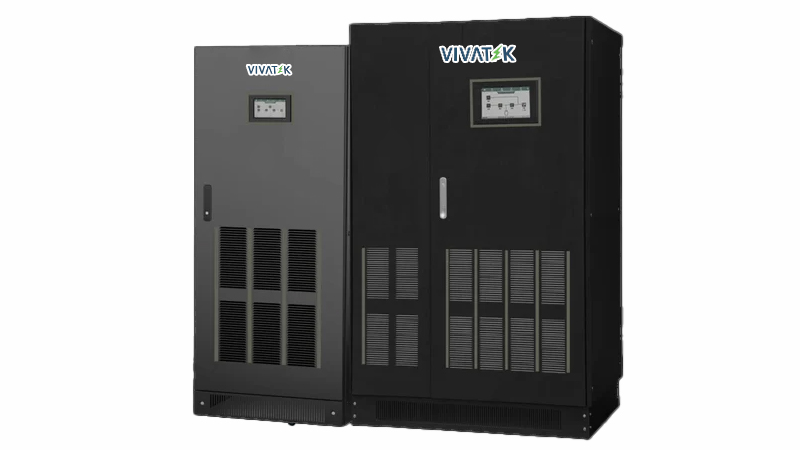
Introduction: Why Online UPS Selection Is a Business-Critical Decision
In modern industrial and commercial environments, power continuity is directly linked to productivity, safety, and profitability. Manufacturing plants, EPC projects, data centers, utilities, and infrastructure facilities operate with automation systems, PLC panels, CNC machines, IT servers, and control instrumentation that cannot tolerate power disturbances.
Voltage fluctuations, harmonics, grid failures, or improper power backup systems can cause unplanned downtime, equipment damage, data loss, and production delays. This is why selecting the right online UPS is not a routine purchase—it is a strategic infrastructure decision.
This guide explains how industries can select the right industrial online UPS for high-load and mission-critical environments, while avoiding common mistakes that lead to downtime and cost overruns.
Who This Guide
This blog is written for all stakeholders involved in UPS decisions, including:
Plant heads and factory managers
Electrical, maintenance, and automation engineers
Facility and operations managers
EPC contractors and system integrators
Data center and IT infrastructure teams
Procurement, sourcing, and project teams
Online UPS decisions are group buying decisions, and this guide supports technical, commercial, and operational evaluation.
What Is an Online UPS and Why Industries Prefer It
An online UPS (double-conversion UPS) continuously converts incoming AC power to DC and back to AC, ensuring:
Zero transfer time during power failure
Complete isolation from grid disturbances
Stable voltage and frequency output
Protection against harmonics, surges, and spikes
For factories, data centers, and critical facilities, this level of protection is essential to maintain uninterrupted operations.
Step 1: Understand Your Load Profile (kVA vs kW)
One of the most common industrial UPS mistakes is incorrect sizing.
Before selecting an online UPS, assess:
Total connected load (kW and kVA)
Power factor of equipment
Starting and surge current
Non-linear loads and harmonics
Future expansion plans
Oversizing increases capital cost, while undersizing leads to overload trips and premature failures.
📌 Professional load assessment prevents both risks.
Step 2: Choose the Right UPS Architecture
Transformer-Based Online UPS
Suitable for harsh industrial environments
Provides electrical isolation
Handles high inrush and short-circuit conditions
Ideal for factories, utilities, and heavy-duty applications
Transformerless Online UPS
Higher efficiency and compact footprint
Lower heat dissipation
Preferred for IT loads, data centers, and commercial facilities
The right choice depends on site conditions, load type, and safety requirements.
Step 3: Battery Technology & Backup Time Planning
Battery systems define runtime and reliability.
Industrial UPS systems commonly use:
VRLA SMF batteries for cost-effective backup
Tubular batteries for long backup applications
Lithium battery upgrades for higher cycle life and faster recharge
Key considerations:
Required backup duration (minutes vs hours)
Ambient temperature and ventilation
Battery maintenance and replacement planning
Proper battery management avoids unexpected shutdowns.
Mid-Blog CTA: Technical Consultation Trigger
Need Help Selecting the Right Online UPS?
Industrial power environments are complex. Factors like harmonics, generator compatibility, battery sizing, and future expansion significantly impact UPS performance.
📌 A technical discussion can help finalize the correct UPS capacity, configuration, and support model before installation.
Step 4: Installation & Commissioning — Where Reliability Is Won or Lost
A high-quality UPS can fail if installed incorrectly.
Professional installation includes:
Proper earthing and cabling
Battery rack layout with thermal planning
Integration with DG, solar, and panels
Compliance with electrical safety standards
Commissioning validates:
Load handling capability
Battery charging and discharge
Alarm, bypass, and protection functions
Correct installation ensures the UPS performs as designed.
Step 5: AMC & Service Support — Protecting Uptime Long Term
An online UPS is a long-term asset. Preventive AMC ensures:
Scheduled maintenance visits
Battery health testing
Parameter checks and firmware updates
Priority breakdown response
Reduced downtime risk
Preventive AMC vs Reactive Repairs
| Preventive AMC | Reactive Repair |
|---|---|
| Planned service | Emergency-only response |
| Early fault detection | Sudden failures |
| Stable uptime | High downtime risk |
| Lower lifecycle cost | Higher repair cost |
Step 6: Integration with Industrial Power Infrastructure
Modern facilities require UPS systems that integrate with:
Diesel generators
Solar or hybrid power systems
Industrial distribution panels
Automation and IT infrastructure
Experienced system design ensures smooth coordination between power sources.
Online UPS Selection Checklist for Decision-Makers
Before finalizing an online UPS, confirm:
Connected load (kW/kVA)
Backup duration requirement
Site temperature and dust conditions
Generator or solar integration
Space availability
Future expansion plans
AMC coverage and response SLAs
This checklist simplifies internal approvals and procurement.
Common Mistakes Industries Should Avoid
Selecting UPS based on price alone
Ignoring battery ventilation and temperature
Skipping preventive AMC
No future load planning
Poor installation practices
Avoiding these mistakes saves long-term cost and downtime.
Typical Industrial & Commercial Use Cases
Online UPS systems are widely used in:
Manufacturing plants and factories
Textile, food, pharma, and chemical industries
Data centers and IT infrastructure
Hospitals, labs, and diagnostics
EPC projects and utilities
Why Industries Choose Vivatek
Industries choose Vivatek for:
Industrial-grade online UPS manufacturing
Custom UPS solutions for factories and EPC projects
Professional installation and commissioning
AMC and long-term service support
Strong regional presence and faster response
The focus is not just on supplying UPS systems, but on delivering lifecycle power reliability.
FAQ: Common Buyer & Engineer Questions
Which UPS is best for high-load industrial environments?
Online UPS with appropriate capacity, battery configuration, and AMC support.
Is AMC mandatory for industrial UPS?
Yes. Preventive AMC significantly improves reliability and battery life.
Can online UPS work with generators and solar systems?
Yes, when properly designed and commissioned.
How often should UPS batteries be replaced?
Typically every 3–5 years depending on battery type and operating conditions.
Final CTA: Lead-Generation Close
Plan Your Industrial Online UPS with Confidence
Selecting the right online UPS requires engineering insight, not guesswork. From sizing and configuration to installation, AMC, and service support, a complete approach ensures reliable power and predictable operations.
📞 Planning a new online UPS installation or upgrading an existing system?
A technical consultation can help align capacity, performance, and support with your operational goals.
Reliable power starts with the right decision.