
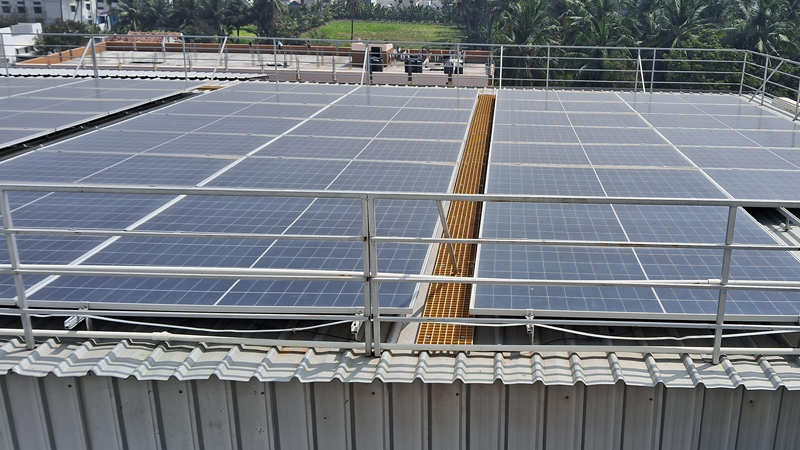
On-Grid vs Off-Grid Solar for Industries explained with ROI, cost & payback comparison. Get FREE industrial solar feasibility study from ASPL.
If you are planning industrial rooftop solar, one of the first decisions you must make is:
Should you choose On-Grid Solar or Off-Grid Solar for your factory?
Choosing the wrong system can:
Increase capital cost
Extend solar payback period
Reduce ROI
Complicate operations
Choosing the right system can:
Reduce electricity cost by 30–50%
Optimize demand charges
Improve Industrial Solar ROI
Shorten payback period
Stabilize long-term energy cost
Let’s clearly understand On-Grid vs Off-Grid Solar for Industries and which solution fits your manufacturing unit.
What Is On-Grid Solar for Industries?
On-Grid Solar (also called Grid-Tied Solar) is connected directly to the electricity grid.
How it works:
Solar panels generate electricity during daytime
Solar power is consumed instantly by factory load
Excess power (if allowed) is exported to grid through net metering
At night, factory uses grid electricity
Most industrial rooftop solar installations in India are On-Grid Solar Systems.
Benefits of On-Grid Solar for Industries
✔ Lower capital cost compared to off-grid
✔ No battery storage required
✔ Faster payback period (3–5 years)
✔ Reduced electricity cost
✔ Reduced maximum demand from grid
✔ Simple system design
For factories operating during daytime shifts, On-Grid Solar is usually the most cost-effective solution.
What Is Off-Grid Solar for Industries?
Off-Grid Solar is not connected to the electricity grid.
It includes:
Solar panels
Battery storage system
Inverter
Load management system
Electricity is stored in batteries and used when needed.
Off-Grid Solar is typically used in:
Remote industrial areas
Locations without grid connection
Critical backup applications
Challenges of Off-Grid Solar for Industrial Use
For heavy industries, off-grid solar has challenges:
High battery cost
Large battery storage requirement
Higher maintenance
Complex design
Longer payback period
Heavy machinery industries, textile mills, automobile plants, and MSME factories typically consume large power loads making full off-grid systems expensive.
On-Grid vs Off-Grid Solar for Industries – Comparison Table
| Factor | On-Grid Solar | Off-Grid Solar |
|---|---|---|
| Capital Cost | Lower | Higher |
| Battery Required | No | Yes |
| Maintenance | Low | Higher |
| Payback Period | 3–5 years | 6–10+ years |
| Ideal For | Grid-connected factories | Remote units |
| ROI | Strong | Depends on battery cost |
For most manufacturing units in Tamil Nadu and India, On-Grid Solar offers better ROI.
What About Hybrid Solar Systems?
Hybrid solar combines:
Solar panels
Grid connection
Battery storage (limited capacity)
Hybrid systems are suitable for:
Factories with frequent power cuts
Critical machinery backup
Data-sensitive operations
However, hybrid systems increase initial investment.
Proper financial feasibility study is essential before choosing.
Which Solar System Is Best for Your Industry?
Decision depends on:
Electricity tariff
EB bill structure
Demand charges
Production hours
Grid reliability
Roof space availability
Capital investment capacity
For most grid-connected industries:
✔ On-Grid Solar for Industries is financially optimal
✔ Shorter payback period
✔ Higher industrial solar ROI
✔ Simpler maintenance
FREE Industrial Solar Feasibility Study
ASPL offers FREE On-Grid vs Off-Grid Solar Evaluation for factories.
You receive:
✔ EB bill analysis
✔ Load pattern assessment
✔ Solar plant capacity recommendation
✔ Payback period calculation
✔ 10-year savings projection
✔ System type recommendation
Share your last 3 EB bills.
Receive structured report within 48 hours.
How On-Grid Solar Reduces Demand Charges
Industrial electricity bills include:
Energy charges
Maximum demand charges
Fixed charges
On-Grid Solar reduces daytime grid dependency.
This helps:
✔ Lower peak grid demand
✔ Reduce excess demand penalties
✔ Improve electricity cost control
✔ Shorten solar payback period
This is why On-Grid Solar for Manufacturing Units is preferred.
Financial Impact of Choosing the Wrong System
Let’s assume:
Off-Grid system increases capital cost by ₹40 lakhs due to battery storage.
If battery lifespan is 7–10 years, replacement cost applies.
This can:
Increase payback period
Reduce long-term ROI
Increase maintenance complexity
Without proper evaluation, industries may overinvest.
Common Questions Factory Owners Ask
Can Off-Grid Solar run heavy machinery?
Technically possible but requires very large battery systems — expensive for most industries.
Is On-Grid Solar useless during power cuts?
Yes, unless hybrid solution is added. Grid-tied systems require grid presence for safety.
Can we start with On-Grid and later add battery?
Yes, hybrid conversion is possible with proper inverter selection.
Why Choose ASPL for Industrial Solar EPC?
ASPL, the solar division of Anushri Systech Private Limited, specializes in:
✔ Industrial Solar EPC Services
✔ On-Grid Solar Installation
✔ Hybrid Solar Systems
✔ EB tariff analysis
✔ Demand charge optimization
✔ Accurate ROI & payback calculation
We focus on financial clarity before system selection.
Not one-size-fits-all solutions.
How to Decide the Right Solar System for Your Factory
Step 1 – Share last 3 EB bills
Step 2 – Load pattern evaluation
Step 3 – On-Grid vs Off-Grid cost comparison
Step 4 – ROI & payback analysis
Step 5 – Final system recommendation
Clear. Structured. Transparent.
FREE On-Grid vs Off-Grid Solar Consultation
If you are planning industrial rooftop solar:
Get your FREE Industrial Solar Consultation from ASPL.
Includes:
✔ System type recommendation
✔ Solar plant sizing
✔ Payback period analysis
✔ 10-year savings forecast
Make your decision based on numbers — not assumptions.
Final Thought
On-Grid vs Off-Grid Solar for Industries is not a technical debate.
It is a financial decision.
For most manufacturing units, On-Grid Solar offers:
Faster payback
Higher ROI
Lower capital cost
Simplified maintenance
But every factory is different.
The right decision comes from proper feasibility analysis.
📞 Contact ASPL today and find out which solar system is right for your industrial project.
Turn your rooftop into a strategic energy asset.