
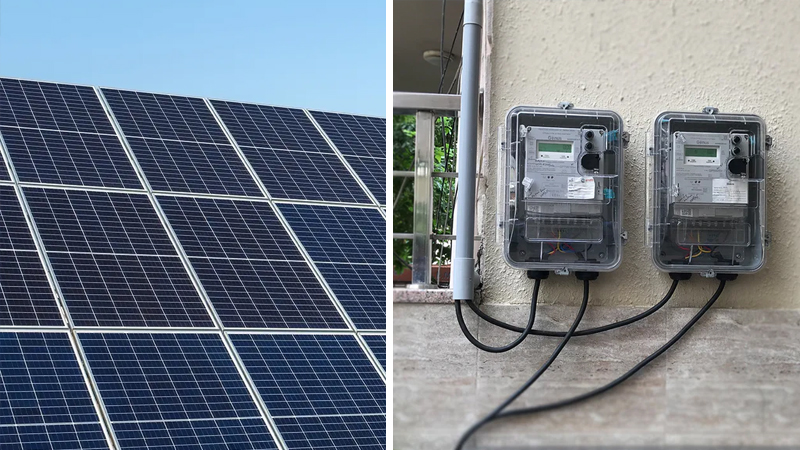
If you are planning Rooftop Solar for your factory or commercial building in Tamil Nadu, understanding the Net Metering Policy in Tamil Nadu for Businesses is critical.
Without clarity on net metering:
Your ROI calculation may be inaccurate
Your solar payback period may be misunderstood
Your energy savings may be miscalculated
For industries investing ₹30 lakhs to ₹3 crores in Industrial Solar Installation, net metering is not a technical detail, it is a financial foundation.
Let’s break it down clearly.
What Is Net Metering?
Net Metering allows a solar power system connected to the grid to export excess electricity generated during the day.
How it works:
Solar panels generate electricity
Your factory consumes solar power first
Excess electricity (if any) is exported to the grid
Exported units are adjusted against imported units
Your electricity bill is calculated on the “net” consumption.
This is why it is called Net Metering.
Why Net Metering Policy in Tamil Nadu for Businesses Matters
Tamil Nadu is one of India’s leading solar states.
Industrial electricity tariffs are high.
Net metering directly impacts:
✔ Industrial Solar ROI
✔ Solar Payback Period
✔ 10-year electricity savings projection
✔ Long-term electricity cost stability
Without net metering, excess generation may not be fully adjusted.
That affects financial viability.
How Net Metering Works for Industrial Rooftop Solar
For businesses in Tamil Nadu:
Solar energy is consumed in real time
Excess power flows to grid
Units exported are recorded
Billing is adjusted based on net consumption
Example:
Factory imports: 10,000 units
Factory exports: 2,000 units
Net billed units = 8,000 units
This reduces energy charges significantly.
Net Metering vs Gross Metering – Important Difference
| Factor | Net Metering | Gross Metering |
|---|---|---|
| Power Consumption | Solar used first | All solar exported |
| Billing | Net units billed | Separate export tariff |
| Ideal For | Industrial & commercial users | Utility-scale plants |
| ROI | Higher | Depends on export tariff |
For most manufacturing units, Net Metering Policy in Tamil Nadu for Businesses supports stronger ROI.
Key Eligibility Criteria (General Overview)
Businesses typically need:
✔ Valid electricity connection
✔ Rooftop structural feasibility
✔ System within sanctioned load limits
✔ Compliance with regulatory guidelines
Exact conditions depend on regulatory notifications.
A proper feasibility study ensures compliance.
How Net Metering Impacts Solar Payback Period
Let’s take a practical example.
Factory consumption: 50,000 units/month
Solar generation: 35,000 units/month
Excess export: 5,000 units
Net metering ensures export is adjusted.
This improves:
✔ Energy cost reduction
✔ Annual savings
✔ Solar investment return
✔ Payback period (typically 3–5 years)
Without net metering, exported units may be undervalued.
Want to Know How Net Metering Affects Your ROI?
ASPL offers FREE Industrial Solar Feasibility Study.
You receive:
✔ EB bill analysis
✔ Net metering eligibility review
✔ Solar plant sizing
✔ Payback period calculation
✔ 10-year savings projection
Share your last 3 EB bills.
Receive structured financial report within 48 hours.
Demand Charges & Net Metering
Important clarification:
Net metering primarily offsets energy charges (per unit).
It does not automatically eliminate:
Maximum demand charges
Fixed charges
However, industrial rooftop solar reduces daytime grid dependency.
This can help reduce peak demand draw and improve overall electricity cost control.
Common Concerns About Net Metering Policy in Tamil Nadu for Businesses
Will policy changes affect my solar ROI?
Regulatory policies can evolve. Feasibility study must consider current framework and long-term risk.
Is there a capacity limit for rooftop solar?
Capacity depends on sanctioned load and rooftop area.
Can MSMEs apply for net metering?
Yes, subject to regulatory compliance and technical eligibility.
Does net metering eliminate electricity bill completely?
No. It reduces energy charges significantly but other components may remain.
Risks of Not Understanding Net Metering
If export adjustments are misunderstood:
ROI projections may be wrong
Payback period may increase
Investment expectations may mismatch
Proper industrial solar EPC partner evaluates net metering impact before proposal.
Why Choose ASPL?
ASPL, the solar division of Anushri Systech Private Limited, specializes in industrial solar EPC services in Tamil Nadu.
We provide:
✔ Detailed EB tariff analysis
✔ Net metering eligibility review
✔ Industrial solar feasibility study
✔ Accurate ROI & payback calculation
✔ Demand charge evaluation
✔ Turnkey rooftop solar installation
✔ Long-term AMC support
We focus on financial clarity before execution.
Not generic quotations.
How to Get Your Net Metering & Solar Report
Step 1 – Share last 3 EB bills
Step 2 – Rooftop feasibility study
Step 3 – Net metering eligibility review
Step 4 – Solar ROI & payback calculation
Step 5 – Proposal presentation
Clear. Transparent. Data-driven.
FREE Net Metering & Solar ROI Consultation
If you are planning Rooftop Solar in Tamil Nadu:
Get your FREE Industrial Solar Consultation from ASPL.
Includes:
✔ Net metering evaluation
✔ Solar plant sizing
✔ Payback period analysis
✔ 10-year savings forecast
Make your decision based on numbers — not assumptions.
Final Thought
Net Metering Policy in Tamil Nadu for Businesses is not just a regulatory concept.
It directly affects:
Your electricity cost reduction
Your industrial solar ROI
Your payback period
Your long-term energy strategy
Factories that understand net metering before investing in solar make better financial decisions.
The question is simple:
Are you calculating your solar investment based on assumptions
Or on structured financial analysis?
📞 Contact ASPL today and get your FREE Net Metering & Industrial Solar Evaluation.
Turn your rooftop into a long-term energy asset.