
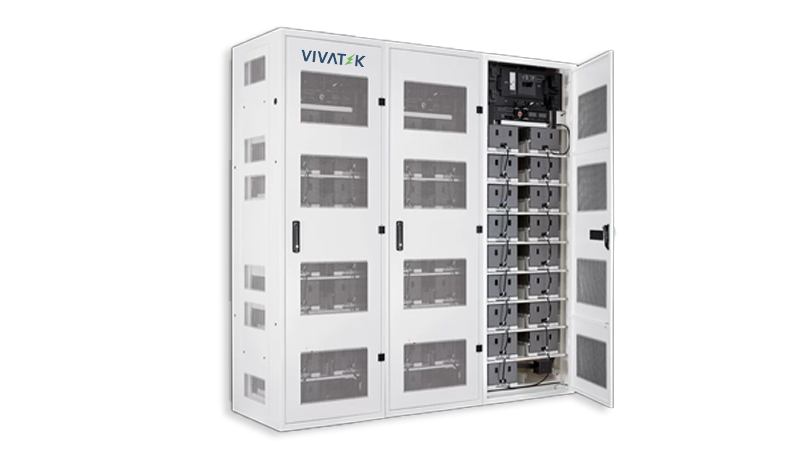
Industrial and commercial facilities operate in environments where power continuity is critical. Data centers, manufacturing plants, commercial buildings, hospitals, infrastructure facilities, and control rooms depend on UPS systems to protect operations from power disturbances, voltage fluctuations, and outages.
The adoption of lithium ion battery for UPS applications is increasing rapidly as organizations shift toward higher efficiency, longer service life, reduced maintenance, and lower lifecycle cost compared to conventional battery technologies.
Vivatek works exclusively with B2B, industrial, and project-based customers, supporting lithium ion battery solutions for UPS systems where reliability and performance are non-negotiable.
Why Lithium Ion Batteries Are Used in UPS Systems
UPS batteries must deliver instant power, maintain stable voltage, and remain reliable during long standby periods. Lithium ion technology meets these requirements while offering significant operational advantages.
Compared to traditional battery technologies, lithium ion batteries for UPS systems provide:
Higher energy density
Smaller footprint and reduced weight
Faster recharge after discharge events
Longer usable service life
Lower routine maintenance requirements
These characteristics make lithium ion batteries ideal for mission-critical UPS installations.
Industrial & Commercial Applications of Lithium Ion Battery for UPS
Lithium ion battery for UPS systems is widely deployed in environments where space efficiency, reliability, and predictable performance are essential.
Typical Applications
Data centers and IT infrastructure
Industrial manufacturing plants
Commercial buildings and campuses
Hospitals and healthcare facilities
Airports, metros, and infrastructure projects
Control rooms and automation systems
In these applications, lithium ion UPS batteries ensure equipment protection, operational continuity, and reduced downtime risk.
Key Advantages of Lithium Ion Battery for UPS
Compact & Space-Efficient
Lithium ion batteries require significantly less space than traditional battery banks, making them suitable for high-density UPS rooms and modern data centers.
Long Service Life
Extended cycle and float life reduce battery replacement frequency and operational disruption.
Fast Recharge Capability
Quick recharge improves UPS readiness after power events, increasing system resilience.
Low Maintenance
Minimal routine maintenance improves operational efficiency and reduces manpower requirements.
UPS Compatibility & Safety Considerations
For industrial buyers, compatibility and safety are critical when selecting a lithium ion battery for UPS systems.
Modern lithium ion UPS batteries include integrated Battery Management Systems (BMS) that provide:
Cell voltage and temperature monitoring
Over-charge and over-discharge protection
Short-circuit and thermal protection
Fault diagnostics and system alerts
Compatibility assessment includes:
DC bus voltage matching
Charging profile alignment
Physical integration and rack layout
Vivatek supports UPS compatibility evaluation to ensure safe and reliable lithium ion battery integration.
How Industrial Buyers Select Lithium Ion Battery for UPS
Selecting the correct lithium ion UPS battery depends on:
UPS rating and system voltage
Required backup duration
Load characteristics
Installation space and layout
Ambient temperature and ventilation
Expected service life and operating profile
Vivatek provides technical consultation and battery sizing support to ensure solutions match real operating conditions.
Replacement & Upgrade of Existing UPS Battery Systems
Many organizations are upgrading older UPS installations as part of battery replacement and modernization projects.
Vivatek supports:
Replacement of aging UPS battery banks
Lithium ion upgrade feasibility studies
Compatibility checks with existing UPS systems
This allows facilities to improve reliability without replacing the entire UPS infrastructure.
Standards, Compliance & Reliability
Industrial UPS systems often operate in regulated or mission-critical environments. Lithium ion batteries for UPS applications are selected based on:
Compliance with relevant safety standards
Suitability for continuous standby operation
Proven reliability in industrial installations
Vivatek supports technical documentation and compliance alignment for industrial, commercial, and infrastructure projects.
Focus on Total Cost of Ownership (TCO)
For industrial users, battery cost must be evaluated over the entire lifecycle, not just initial procurement.
Lithium ion UPS batteries help reduce:
Replacement cycles
Maintenance effort
Cooling and space requirements
Downtime risk
A TCO-driven approach ensures long-term operational value and predictable performance.
How We Work – B2B Engagement Process
Requirement Assessment
UPS rating, backup duration, operating environmentTechnical Recommendation
Lithium ion battery selection and configurationCommercial Proposal
Clear scope and lifecycle expectationsInstallation & Integration Support
UPS compatibility and commissioning guidanceLifecycle Support
Performance continuity and long-term reliability
FAQ
Are lithium ion batteries safe for UPS systems?
Yes. When correctly specified and installed with an integrated BMS, lithium ion batteries are safe and reliable.
Can lithium ion battery replace existing UPS batteries?
Yes. Most UPS systems can be upgraded after technical compatibility assessment.
Is lithium ion battery suitable for continuous standby UPS operation?
Yes. Lithium ion batteries are designed for long float life and stable standby performance.
Do you support only industrial UPS projects?
Yes. Vivatek works exclusively with industrial and commercial UPS applications.
Conclusion
Selecting a lithium ion battery for UPS is a strategic decision for organizations seeking higher efficiency, longer service life, and lower operational complexity.
With a pure B2B focus, application-driven expertise, and lifecycle-based approach, Vivatek supports industrial and commercial customers with reliable lithium ion UPS battery solutions designed for modern power-backup requirements.