
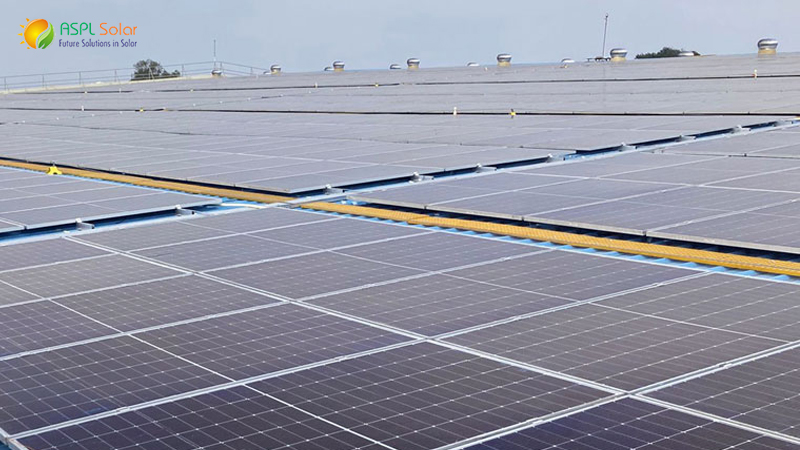
Industrial Solar Plant Cost in Tamil Nadu explained for factories and industries. Get ROI, payback details & FREE solar feasibility study from ASPL.
Industrial electricity cost in Tamil Nadu continues to rise year after year. For manufacturing units, power expenses are now one of the largest operational costs after raw materials and labor.
As a result, many industries are evaluating industrial solar plant cost in Tamil Nadu to understand whether rooftop solar is financially viable.
But one common mistake industries make is asking:
“What is the price per kW?”
The real question should be:
“What is the long-term return on investment and total savings potential?”
Why Industries in Tamil Nadu Are Considering Solar
Before discussing cost, it’s important to understand the driving factors.
Manufacturing industries in Chennai, Ambattur, Sriperumbudur, Oragadam, Coimbatore, Tiruppur, and Hosur face:
Rising electricity tariffs
Increasing demand charges
Peak-hour penalties
Grid dependency risk
Long-term cost uncertainty
Electricity tariffs may change, but production must continue.
Industrial solar installation in Tamil Nadu offers partial energy independence and long-term cost stability.
What Is the Industrial Solar Plant Cost in Tamil Nadu?
Industrial solar plant cost depends on several variables.
Instead of fixed pricing, costs vary based on:
System capacity (50 kW, 100 kW, 250 kW, 500 kW, 1 MW+)
Roof structure (RCC or metal sheet)
Shadow-free installation area
Mounting structure type
Inverter selection
Electrical integration complexity
Net metering requirements
Load profile of the factory
General Cost Range (Indicative)
While exact pricing depends on site conditions, industrial rooftop solar projects typically range depending on system size and design specifications.
Larger capacity systems generally offer better per-kW economics due to scale advantages.
However, focusing only on installation cost is misleading.
Total financial viability depends on:
EB tariff rate
Annual generation
Energy offset percentage
Solar payback period
Depreciation benefits
Example: 100 kW Industrial Solar Plant
Let’s evaluate a realistic scenario.
System Capacity: 100 kW
Average Monthly Generation: 12,000–14,000 units
EB Tariff: ₹8 per unit
Monthly Savings: ₹96,000 – ₹1,12,000
Annual Savings: ₹11–13 Lakhs
Estimated Payback Period: 3–4 Years
System Life: 25+ Years
After payback, the electricity generated effectively reduces long-term energy expenditure significantly.
For 250 kW and 500 kW systems, savings scale proportionally.
Factors That Influence Industrial Solar Plant Cost in Tamil Nadu
1️⃣ System Capacity
Higher capacity systems require more panels and larger inverter systems but reduce cost per kW.
2️⃣ Roof Type & Structural Condition
RCC roofs differ from metal sheet roofs in mounting design and engineering complexity.
Structural stability assessment is mandatory before installation.
3️⃣ Load Pattern & Working Hours
Factories operating during daytime maximize solar utilization.
Industries running mostly night shifts may require hybrid strategies.
4️⃣ Net Metering Policy
Net metering regulations in Tamil Nadu influence how excess power is managed.
Compliance and approvals must be handled correctly.
5️⃣ Quality of Components
Panel efficiency, inverter technology, and mounting systems affect long-term performance and durability.
Low-cost components reduce initial price but may affect lifecycle returns.
Industrial Solar ROI & Payback Period
When evaluating industrial solar plant cost in Tamil Nadu, ROI is more important than upfront expense.
Typical industrial solar payback period: 3–5 years
System lifespan: 25+ years
This means:
20+ years of effective cost reduction after recovery of investment.
CFOs and financial heads should evaluate:
Internal Rate of Return (IRR)
Net Present Value (NPV)
10-year savings projection
Long-term electricity inflation impact
Solar acts as a hedge against rising grid tariffs.
How Much Can Industries Reduce Electricity Cost?
Depending on roof area and consumption pattern, rooftop solar can offset 30–50% of total electricity consumption.
This leads to:
Lower monthly EB bills
Reduced exposure to tariff hikes
Improved profit margins
Predictable long-term cost structure
Industries with large daytime loads benefit the most.
Hidden Financial Advantages
Accelerated Depreciation
Industrial solar systems qualify for depreciation benefits under applicable tax regulations.
This improves effective ROI.
Energy Cost Stability
Grid electricity is unpredictable.
Solar generation is predictable.
Asset Creation
Solar installation becomes a long-term asset for the company.
Common Concerns About Industrial Solar Plant Cost
Is industrial solar expensive?
Upfront investment is required, but long-term returns outweigh initial cost.
What about maintenance?
Industrial solar systems require minimal maintenance. Periodic cleaning and monitoring ensure performance.
What if generation reduces?
High-quality panels come with long-term performance warranties.
Will the roof be damaged?
Proper structural analysis ensures safe installation.
Why Choose ASPL for Industrial Solar in Tamil Nadu?
ASPL, the solar division of Anushri Systech Private Limited, focuses exclusively on industrial and commercial solar projects.
We provide:
Detailed EB bill analysis
Customized solar feasibility study
Accurate industrial solar plant cost estimation
ROI & payback calculation
Engineering design
Turnkey installation
Long-term AMC & support
We do not promote generic pricing.
We engineer solutions based on your factory’s actual energy consumption.
The ASPL Process
EB Bill Review
Site Feasibility Study
Load Analysis
Customized Solar Proposal
Engineering & Installation
Commissioning & Monitoring
Clear process ensures transparency and confidence.
Free Industrial Solar Feasibility Study
If you want to understand the real industrial solar plant cost in Tamil Nadu for your facility, ASPL offers:
✔ Free EB Bill Analysis
✔ Customized Solar ROI Report
✔ Payback Period Calculation
✔ 10-Year Savings Projection
✔ Site Feasibility Study
Simply share your last three EB bills.
Our team will provide a structured financial analysis within 48 hours.
No obligation. Just clarity.
Final Thought
Industrial solar plant cost in Tamil Nadu should not be viewed as an expense.
It is a long-term financial strategy.
With rising electricity tariffs and increasing demand charges, industries that adopt solar early gain a cost advantage.
The real question is not:
“What is the cost per kW?”
The real question is:
“How much can your factory save over the next 25 years?”
📞 Contact ASPL today and request your free industrial solar feasibility assessment.
Turn your factory rooftop into a cost-saving asset.