
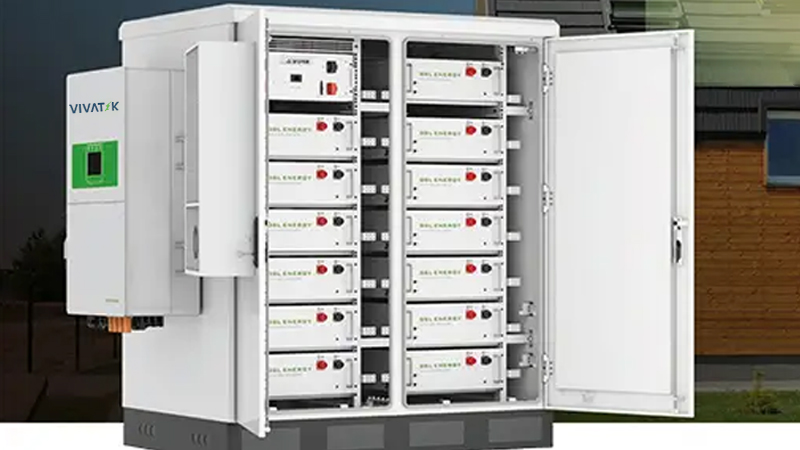
A Battery Energy Storage System (BESS) is only as strong as its Battery Management System (BMS).
For commercial and industrial energy storage projects, the BMS is not an accessory—it is the core control layer that determines safety, battery life, system performance, and ROI.
If you are searching for a Battery Management System for BESS, you are likely planning a commercial or industrial battery storage project where failure, downtime, or safety incidents are unacceptable.
ASPL designs engineering-grade BESS solutions with advanced Battery Management Systems, ensuring long-term reliability, regulatory compliance, and predictable financial returns.
Executive Summary – For Business Owners & Decision Makers
A properly engineered Battery Management System for BESS enables businesses to:
Protect battery assets worth crores of rupees
Prevent thermal runaway and fire risks
Extend battery life by 20–30%
Maintain stable charge-discharge performance
Ensure grid, safety, and insurance compliance
Safeguard long-term ROI of energy storage projects
👉 Share your load profile or electricity bill to get a FREE BESS + BMS feasibility & ROI assessment from ASPL.
Is a Commercial-Grade BMS Necessary for Your BESS Project?
A high-quality Battery Management System is critical, not optional, if your project involves:
Commercial or industrial BESS
Battery investments of ₹50 lakh or more
Lithium-ion battery energy storage systems
Daily or frequent charge-discharge cycles
Solar + battery hybrid systems
Grid-connected or peak-shaving applications
Zero tolerance for safety incidents or downtime
👉 If two or more of the above apply, a commercial-grade BMS is mandatory.
ASPL works only on ROI-positive, safety-critical BESS projects, not residential or experimental setups.
What Is a Battery Management System (BMS) for BESS?
A Battery Management System (BMS) is an intelligent electronic system that continuously monitors, controls, and protects battery packs inside a Battery Energy Storage System.
In commercial and industrial BESS projects, the BMS:
Monitors cell voltage, current, and temperature
Balances individual battery cells
Prevents over-charge and over-discharge
Detects faults and abnormal conditions
Communicates with EMS, PCS, inverters, and SCADA
Executes safety shutdowns when required
Without a properly designed BMS, even high-quality batteries can degrade rapidly or fail catastrophically.
Why Battery Management System Is Critical in Commercial & Industrial BESS
🔴 Without a Robust BMS
Uneven cell charging
Rapid battery degradation
Capacity loss within a few years
Thermal runaway and fire risk
Insurance and approval issues
Unpredictable system behavior
🟢 With an ASPL-Engineered BMS
Controlled charge-discharge cycles
Balanced cell performance
Real-time fault detection
Battery life of 10–15 years
Stable, predictable ROI
👉 Most BESS failures are BMS failures, not battery failures.
Key Functions of a Battery Management System for BESS
🔹 Cell Monitoring & Balancing
Ensures uniform voltage and temperature across all cells, preventing stress and early failure.
🔹 Thermal Management & Safety
Continuously monitors temperature to avoid overheating and thermal runaway.
🔹 SOC & SOH Estimation
Accurate State of Charge (SOC) and State of Health (SOH) data for operational planning.
🔹 Protection & Fault Isolation
Automatically disconnects unsafe conditions to protect batteries and equipment.
🔹 Communication & Integration
Seamless integration with:
Energy Management System (EMS)
Power Conversion System (PCS)
Grid and plant SCADA systems
Centralized vs Distributed BMS – What Commercial Projects Need
| Aspect | Basic / Residential BMS | ASPL Commercial BMS |
|---|---|---|
| Cell-level monitoring | Limited | Advanced |
| Safety logic | Basic | Multi-layer |
| EMS integration | ❌ | ✔ |
| Grid interaction | ❌ | ✔ |
| Scalability | Low | High |
| Industrial compliance | ❌ | ✔ |
Commercial and industrial BESS projects require scalable, industrial-grade BMS architecture, not residential solutions.
Role of BMS in Solar + BESS Hybrid Systems
In solar-integrated BESS projects, the BMS ensures:
Safe charging from variable solar generation
Controlled discharge during peak tariff hours
Protection against solar intermittency
Optimized battery cycling and longer life
ASPL designs BMS-driven solar + battery systems to maximize self-consumption and savings.
How Much Does a Commercial BMS Cost – and Why It Matters
Many buyers see BMS as an added cost. In reality, it is battery insurance.
BMS cost: ~3–7% of total BESS project value
Battery replacement cost: 30–50% of project value
👉 Saving on BMS quality can destroy the entire project economics.
A robust BMS protects:
Battery investment
System uptime
Long-term ROI
Safety, Compliance & Standards for BMS in India
A commercial Battery Management System for BESS must support:
Electrical safety compliance
Thermal and fire protection logic
Grid interconnection safety
Insurance and statutory acceptance
Utility and CEA-aligned engineering
ASPL designs approval-ready BMS logic, reducing regulatory and insurance risk.
Typical Industrial BESS + BMS Use Case
Facility profile:
High peak demand during evening shifts
Frequent diesel generator usage
Rooftop solar installed but underutilized
ASPL Solution:
Lithium battery energy storage system
Advanced BMS integrated with EMS
Peak shaving and solar optimization logic
Result:
Peak demand reduced
Diesel usage eliminated
Solar utilization increased
Electricity cost stabilized
How BMS Directly Impacts ROI of a BESS Project
A properly engineered BMS:
Extends battery life by 20–30%
Prevents premature battery replacement
Improves system availability (>99%)
Ensures predictable payback (3–6 years)
A weak BMS silently destroys ROI—even if the batteries are new.
How ASPL Designs BMS-Integrated BESS Solutions
ASPL follows an engineering-first approach, not a product-selling model.
✔ Feasibility & Usage Analysis
Load pattern and cycling analysis
Peak demand evaluation
✔ BMS & System Architecture Design
Battery chemistry compatibility
Safety and protection logic
EMS, PCS, and grid integration
✔ Installation & Commissioning
BMS configuration and testing
Communication validation
Safety verification
✔ Monitoring & Lifecycle Support
Battery health tracking
Preventive alerts
Performance optimization
What Happens After You Contact ASPL?
Once you share your project details:
Technical and financial feasibility check
BESS + BMS architecture recommendation
ROI and payback analysis
Safety and compliance validation
Execution roadmap
✔ Free ✔ Confidential ✔ No obligation
Get a FREE BMS-Enabled BESS Feasibility & ROI Assessment
👉 ASPL will provide:
Recommended BESS capacity
BMS architecture overview
Expected savings
Payback period
Execution plan
📞 Contact ASPL today and protect your battery investment with the right Battery Management System for BESS.
👉 Call / WhatsApp for Immediate Support
📧 Email: sales@anushri.info
📞 Phone: +91 9841698180 // 9566117188
📍 Address: No.2/27, Luz Avenue 3rd Street,
Mylapore, Chennai – 600004, Tamil Nadu, India