
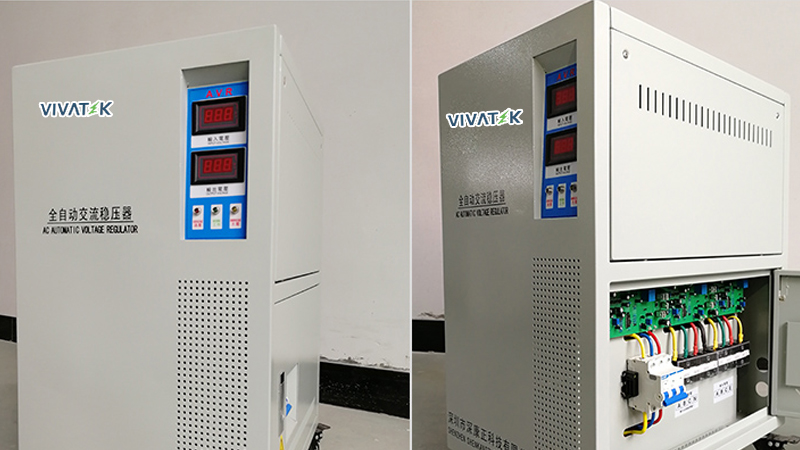
A servo stabilizer for CNC machines is a critical requirement in modern manufacturing environments where precision, uptime, and machine safety directly impact productivity and profitability. CNC machines are highly sensitive to voltage fluctuations, phase imbalance, and electrical disturbances commonly found in industrial power grids across India.
Even small voltage variations can cause spindle errors, controller alarms, tool breakage, scrap generation, or complete CNC machine shutdown. This is why industrial factories rely on industrial servo voltage stabilizers specifically designed for CNC applications.
This blog explains why CNC machines require servo stabilizers, how to select the right industrial servo stabilizer, and what features matter most for B2B manufacturing units.
What Is a Servo Stabilizer for CNC Machines?
A servo voltage stabilizer is an automatic voltage regulation system that maintains a constant output voltage using a servo motor–driven variac, buck-boost transformer, and microprocessor-based control circuit.
For CNC machines, servo stabilizers provide:
Fast voltage correction
Tight output accuracy
Smooth, step-less regulation
Protection against over-voltage and under-voltage
Stable power for CNC electronics and servo drives
Unlike relay-type stabilizers, servo stabilizers respond within milliseconds, making them ideal for CNC machines, VMCs, HMCs, and precision machining equipment.
Why CNC Machines Are Highly Voltage Sensitive
CNC machines include advanced electrical and electronic components such as:
Servo drives and servo motors
PLC controllers
VFD and spindle drives
CNC control panels
Precision encoders and sensors
Power issues like:
Low voltage
Over voltage
Phase imbalance
Voltage spikes and surges
Harmonics and electrical noise
can result in:
Unexpected CNC trips
Control card failures
Loss of machining accuracy
Servo motor overheating
Reduced machine lifespan
High maintenance costs
A dedicated industrial servo stabilizer for CNC machines eliminates these risks by delivering clean, stable, and regulated voltage continuously.
Key Benefits of Using Servo Stabilizer for CNC Machines
1. High Voltage Accuracy
Maintains output voltage typically within ±1%, ensuring CNC precision and repeatable machining accuracy.
2. Fast Correction Speed
Voltage correction within 10–50 milliseconds, preventing CNC alarms and sudden shutdowns.
3. Protection for CNC Electronics
Safeguards:
CNC controllers
Servo drives
Spindle motors
PLC and control panels
4. Improved Machine Life
Stable voltage reduces thermal and electrical stress on motors and electronic components.
5. Reduced Downtime and Scrap
Consistent power supply ensures uninterrupted production and minimal rejection.
Oil Cooled vs Air Cooled Servo Stabilizer for CNC Machines
Oil Cooled Servo Stabilizer
Best suited for:
Heavy-duty CNC machines
Continuous 24/7 operation
High kVA CNC installations
Multiple CNC machines on a common stabilizer
Advantages:
Superior heat dissipation
Higher overload handling capacity
Longer service life
Stable performance under continuous load
Ideal for industrial environments
Air Cooled Servo Stabilizer
Suitable for:
Small CNC machines
Intermittent operation
Lower kVA requirements
Limited space installations
Recommended Servo Stabilizer Specifications for CNC Machines
| Parameter | Recommended Specification |
|---|---|
| Type | Servo controlled voltage stabilizer |
| Phase | Three phase (unbalanced load) |
| Input Voltage Range | 300–460V (wide range) |
| Output Voltage | 415V ±1% |
| Response Time | < 50 milliseconds |
| Cooling | Oil cooled (preferred) |
| Protection | Overload, short circuit, phase failure |
| Control | Microprocessor / digital display |
| Efficiency | Up to 98% |
Typical Servo Stabilizer Capacity for CNC Machines
The required kVA rating depends on spindle power, number of axes, servo motors, and auxiliary loads.
Common capacity ranges:
Small CNC machines: 10–25 kVA
Medium CNC machines: 30–75 kVA
Heavy CNC machines / VMC / HMC: 100–200 kVA
Multiple CNC machines (centralized): 200 kVA and above
A margin of 20–30% additional capacity is recommended for future expansion.
How to Select the Right Servo Stabilizer for CNC Machines
Step 1: Calculate Total CNC Load
Include:
Spindle motor rating
Servo motors
Hydraulic units
Coolant pumps
Control panels
Step 2: Choose Correct Cooling Type
Oil cooled servo stabilizers are ideal for CNC machines running multiple shifts or under heavy load.
Step 3: Check Input Voltage Range
Factories in low-voltage or fluctuating grid areas require wide input range stabilizers.
Step 4: Ensure CNC Compatibility
The stabilizer must handle:
VFD loads
Harmonic currents
Sudden load changes
Unbalanced three-phase conditions
Applications of Servo Stabilizer for CNC Machines
CNC turning centers
CNC milling machines
VMC and HMC machines
CNC grinding machines
CNC plasma cutting machines
CNC laser cutting machines
CNC router machines
Injection molding CNC systems
Automotive and aerospace CNC lines
Common Problems Solved by Servo Stabilizers in CNC Units
Frequent CNC alarm trips
Servo drive failures
Spindle motor overheating
Inconsistent machining accuracy
Control panel damage
Voltage-related downtime
High maintenance and repair costs
Industrial Standards and Safety Considerations
An industrial servo stabilizer for CNC machines should feature:
Copper winding transformers
Proper insulation class
Phase sequence and phase failure protection
Overload and short-circuit protection
Rugged enclosure suitable for factory conditions
Compliance with industrial electrical standards ensures long-term reliability and safe operation.
What Determines the Price of Servo Stabilizer for CNC Machines?
The price depends on:
kVA rating
Input voltage range
Cooling type (oil cooled or air cooled)
Overload capacity
Protection features
Installation and service requirements
Industrial-grade servo stabilizers designed for CNC machines are engineered for precision loads and continuous duty, which directly influences performance and cost.
Installation, Service, and Maintenance Support
Proper installation and regular maintenance are essential for reliable stabilizer performance. Factories should ensure:
Professional installation and commissioning
Preventive maintenance schedules
Quick breakdown service support
Availability of spare parts
Annual maintenance contracts (AMC)
Strong service support minimizes downtime and protects CNC investments.
Why Factories Prefer Industrial Servo Stabilizers
Industrial buyers choose servo stabilizers because they offer:
Continuous operation capability
High efficiency (up to 98%)
Long MTBF
Low maintenance
Reliable performance in harsh industrial environments
Better return on investment
Servo Stabilizer vs UPS for CNC Machines
| Servo Stabilizer | UPS |
|---|---|
| Continuous voltage correction | Limited voltage correction |
| Handles high kVA loads | Expensive for large CNC loads |
| No battery maintenance | Battery replacement required |
| Ideal for voltage fluctuation | Best for short backup only |
Frequently Asked Questions
Can one servo stabilizer support multiple CNC machines?
Yes, a properly sized centralized servo stabilizer can support multiple CNC machines.
Is oil cooled servo stabilizer better for CNC machines?
Yes, oil cooled servo stabilizers are recommended for heavy-duty and continuous CNC operations.
What happens if CNC machines run without a stabilizer?
Running CNC machines without voltage stabilization can lead to frequent breakdowns, control failures, and reduced machine life.
Looking for a Servo Stabilizer for CNC Machines?
If your factory experiences:
Voltage fluctuation
CNC machine downtime
Frequent servo or spindle failures
Power quality issues
A custom-engineered servo stabilizer for CNC machines can permanently solve these problems.
👉 Request a quotation
👉 Get a free CNC load calculation
👉 Factory site evaluation available
👉 Custom kVA and voltage range options
Conclusion
A servo stabilizer for CNC machines is not an accessory—it is a critical industrial investment. It protects expensive CNC equipment, ensures precision machining, reduces downtime, and improves overall factory efficiency.
For manufacturers focused on high productivity, consistent quality, and long-term reliability, choosing the right industrial servo stabilizer is essential.