
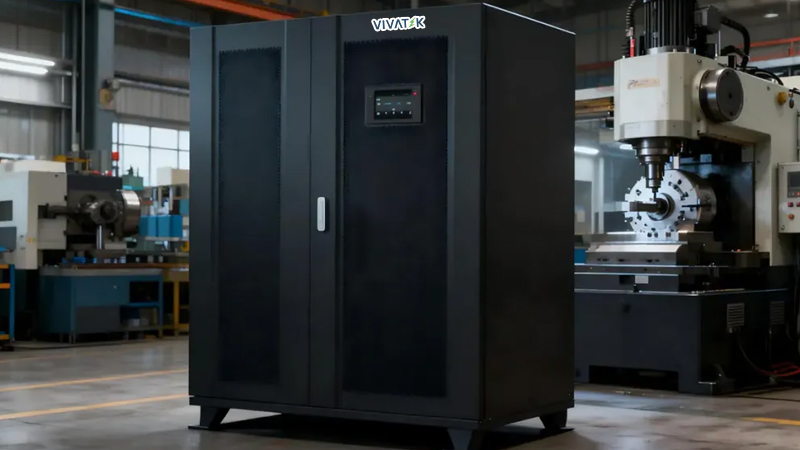
In modern manufacturing plants, uninterrupted power is not a luxury—it is a business necessity. Even a few seconds of power disturbance can halt production lines, damage sensitive equipment, corrupt control systems, and result in costly downtime. This is why online UPS systems for manufacturing plants have become a critical infrastructure investment for factories across India.
Manufacturing environments operate heavy machinery, automation panels, PLCs, CNC machines, robotics, testing labs, and IT systems that demand clean, stable, and continuous power. An industrial-grade online UPS ensures that these operations continue seamlessly, even during grid failures, voltage fluctuations, or generator changeovers.
Why Manufacturing Plants Need Online UPS Systems
Manufacturing facilities face power challenges that are very different from commercial offices or residential setups. Frequent voltage dips, harmonics, phase imbalance, and sudden outages can directly impact production quality and safety.
An online UPS (double conversion UPS) continuously supplies power from the inverter, ensuring zero transfer time. This means your machines never experience power interruption—no matter what happens on the input side.
Key reasons manufacturing plants rely on online UPS systems include:
Preventing unplanned production downtime
Protecting CNC machines, PLCs, and automation equipment
Avoiding data loss in SCADA, MES, and control systems
Ensuring consistent product quality
Safeguarding motors, drives, and instrumentation
How Online UPS Works in Industrial Applications
Unlike offline or line-interactive UPS systems, an online UPS converts incoming AC power to DC and then back to AC continuously. This process isolates connected equipment completely from grid disturbances.
For manufacturing plants, this delivers:
Zero millisecond transfer time
Stable voltage and frequency
Low harmonic distortion
Clean sine-wave output
Seamless generator synchronization
This makes online UPS systems ideal for factories that cannot afford even momentary power disruptions.
Typical Applications in Manufacturing Plants
Online UPS systems are widely used across various manufacturing operations, including:
CNC machining centers
Textile spinning and weaving units
Pharmaceutical production lines
Food and beverage processing plants
Electronics and PCB manufacturing
Automotive assembly lines
Packaging and printing presses
Testing labs and quality control units
Each application requires precise power control to avoid machine errors, rejects, or safety hazards.
Choosing the Right Online UPS for Your Factory
Selecting the right UPS system is not just about kVA rating. A proper industrial UPS solution considers multiple operational factors:
1. Load Analysis
Understanding whether the load is linear, non-linear, motor-based, or IT-based is essential for correct UPS sizing.
2. Backup Time Requirement
Some plants require only a few minutes of backup to switch to generators, while others need extended backup for controlled shutdowns.
3. Input Power Conditions
Factories located in industrial zones often face unstable grid conditions. UPS input tolerance and harmonic handling become critical.
4. Scalability
Growing plants need UPS systems that can be expanded as production capacity increases.
5. Environmental Conditions
Dust, heat, vibration, and humidity must be considered while selecting enclosure type and cooling design.
Importance of Professional Installation
Even the best online UPS system can fail if installed incorrectly. Industrial UPS installation requires:
Proper cable sizing and routing
Correct earthing and grounding
Load balancing across phases
Battery bank layout planning
Integration with generator and switchgear
Professional installation ensures the UPS performs reliably under real factory conditions.
Why AMC and Preventive Maintenance Matter
Manufacturing plants operate year-round. UPS failure during peak production can cause losses far greater than the cost of maintenance.
An Annual Maintenance Contract (AMC) helps by:
Preventing unexpected breakdowns
Extending battery and UPS lifespan
Identifying early signs of component wear
Ensuring compliance with safety standards
Maintaining consistent backup performance
Preventive maintenance is especially important in high-load industrial environments.
Downtime Cost: The Hidden Risk in Manufacturing
Many plants underestimate the true cost of downtime. Apart from production loss, downtime affects:
Raw material wastage
Machine recalibration time
Labor idle costs
Delayed deliveries
Customer dissatisfaction
An online UPS acts as insurance against these risks by ensuring continuous operations during power disturbances.
Scalable UPS Solutions for Growing Industries
Manufacturing plants rarely stay static. New machines, automation upgrades, and capacity expansions increase power demand over time.
A well-designed online UPS system allows:
Modular or parallel expansion
Easy battery bank upgrades
Integration with future automation systems
Long-term cost efficiency
This future-ready approach avoids frequent replacement and protects capital investment.
Industries Benefiting from Online UPS Systems
Online UPS systems are essential across multiple manufacturing sectors:
Automotive & auto components
Textiles & garments
Pharmaceuticals & healthcare manufacturing
Food processing & cold storage
Electronics & semiconductor units
Heavy engineering & fabrication
Each sector benefits from reduced downtime, improved reliability, and better equipment protection.
How to Proceed with the Right UPS Solution
For decision-makers, engineers, and consultants, the first step is understanding the actual power requirement and risk profile of the plant.
A structured approach includes:
Evaluating connected loads
Identifying critical machines
Reviewing power quality issues
Assessing backup time needs
Planning installation and service support
This ensures the UPS system delivers real operational value—not just backup on paper.
Online UPS vs Other Power Backup Options
Many manufacturing plants still use inverters or line-interactive UPS systems, assuming they provide adequate protection. However, these solutions are not designed for industrial environments.
An inverter or line-interactive UPS switches to battery only when power fails, causing a small transfer delay. For CNC machines, PLCs, automation panels, and servers, even a millisecond delay can result in faults, resets, or shutdowns.
An online UPS, on the other hand:
Supplies power continuously through the inverter
Has zero transfer time
Completely isolates equipment from grid disturbances
Handles industrial harmonics and load fluctuations
For factories where uptime and precision matter, online UPS systems are the safest and most reliable option.
Battery Technologies Used in Industrial Online UPS
The performance of an online UPS depends heavily on the battery system used. Manufacturing plants typically choose based on backup duration, temperature, and maintenance preference.
Common battery options include:
VRLA (SMF) Batteries
Widely used for industrial UPS systems, offering reliable performance and cost efficiency.Tubular Batteries
Suitable for long backup requirements where space and maintenance are manageable.Lithium Battery Integration (Optional)
Increasingly adopted for high cycle life, faster charging, reduced footprint, and lower long-term maintenance.
The right battery selection ensures optimal runtime, longer service life, and predictable performance in factory conditions.
Compliance, Safety & Standards
Safety, Compliance, and Industrial Standards
Manufacturing plants operate under strict safety and quality norms. An industrial online UPS must comply with applicable electrical and operational standards.
A properly designed UPS system supports:
Electrical safety and insulation requirements
Proper earthing and grounding
Safe battery charging and protection
Controlled shutdown during emergencies
Reliable operation under high load conditions
Compliance-ready UPS systems help factories meet internal audits, customer quality requirements, and regulatory expectations.
FAQ
Frequently Asked Questions (FAQs)
Q1: How do I select the right kVA rating for my manufacturing plant?
UPS sizing depends on connected load, power factor, starting currents, and future expansion plans. A load study is recommended before selection.
Q2: Can an online UPS work with a diesel generator?
Yes. Industrial online UPS systems are designed to work seamlessly with generators and handle voltage and frequency variations during changeover.
Q3: How long do UPS batteries last in factory environments?
Battery life depends on temperature, load, and maintenance. With proper AMC and operating conditions, batteries typically last several years.
Q4: Is AMC really necessary for an industrial UPS?
Yes. Preventive maintenance significantly reduces failure risk, improves uptime, and extends system life.
Q5: Can the UPS be expanded later if production increases?
Yes. Scalable and modular UPS designs allow capacity expansion without replacing the entire system.
Final Thoughts
An online UPS system for manufacturing plants is a strategic investment that protects productivity, equipment, and business continuity. With the right system design, professional installation, and reliable AMC support, factories can operate confidently—even in challenging power conditions.
If uninterrupted production, equipment safety, and long-term reliability matter to your operations, investing in the right online UPS solution is not optional—it’s essential.
📌 Need a Technical Review or UPS Recommendation?
A detailed assessment of your manufacturing plant’s power requirements can help identify the most suitable online UPS solution before downtime becomes a costly issue.