
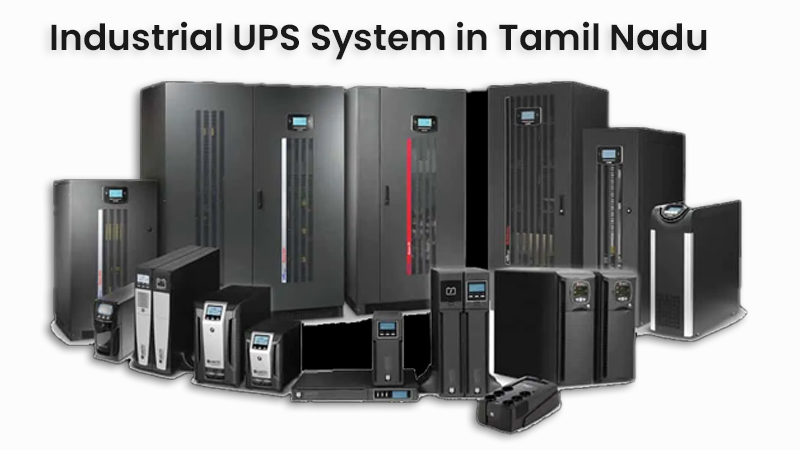
Tamil Nadu is one of India’s most industrially active states, supporting manufacturing plants, data centers, hospitals, and large infrastructure projects. In such environments, power interruptions, voltage fluctuations, and poor power quality directly impact productivity, equipment life, and safety. This has made the industrial UPS system in Tamil Nadu a critical component of modern operations.
At VIVATEK, industrial UPS systems are designed and manufactured with a clear B2B objective: to deliver stable, continuous, and predictable power for mission-critical operations. This blog is written for factory owners, plant heads, EPC contractors, consultants, and procurement teams who are evaluating industrial UPS systems for long-term use.
Why Industrial UPS Systems Are Essential in Tamil Nadu
Industrial facilities in Tamil Nadu face several power-related challenges:
Grid voltage variations and frequency instability
Sudden outages during peak demand and seasonal loads
High sensitivity of modern equipment to power quality
Continuous operation requirements in process industries
An industrial UPS system helps organizations by:
Providing zero or near-zero transfer time during outages
Protecting equipment from voltage dips, surges, and harmonics
Ensuring stable power for automation, IT, and control systems
Reducing downtime, rework, and equipment stress
For many industries, an industrial UPS is no longer optional—it is part of operational risk management.
Who Should Consider an Industrial UPS System
This solution is relevant for:
Manufacturing plants and industrial units
EPC and electrical contractors
Data centers and IT infrastructure operators
Hospitals and diagnostic facilities
Utilities and infrastructure projects
Government and institutional buyers
If uninterrupted power directly affects output, compliance, or safety, an industrial UPS system becomes a strategic investment.
VIVATEK’s Engineering Approach to Industrial UPS Systems
VIVATEK follows an engineering-driven, B2B-first approach when designing industrial UPS systems. The focus is not only on capacity, but on how the system performs over years of operation.
Key principles include:
Built for continuous industrial duty cycles
Optimized for Indian grid and site conditions
Scalable architecture for future load growth
Ease of maintenance and serviceability
Lifecycle planning, not just initial installation
Each system is configured based on actual load behavior, operating environment, and expansion plans, avoiding both oversizing and underperformance.
Types of Industrial UPS Systems Available
🔹 Single Phase Industrial UPS
Used for:
IT equipment and server rooms
Laboratories and testing facilities
Control panels and instrumentation
These systems provide clean, stable power for sensitive loads.
🔹 3 Phase Industrial UPS Systems
Designed for:
Manufacturing plants and production lines
CNC machines and automation systems
Hospitals and critical infrastructure
3-phase industrial UPS systems are engineered to handle high loads, overload conditions, and continuous operation.
🔹 Modular Industrial UPS Systems
Ideal for:
Data centers and IT infrastructure
Facilities with phased or uncertain load growth
Applications requiring N+1 or N+X redundancy
Modular architecture allows capacity expansion without replacing the entire system, reducing downtime and long-term cost.
Applications of Industrial UPS Systems
Industrial UPS systems in Tamil Nadu are widely used in:
Manufacturing & Automation – CNC machines, PLC panels, robotics
Data Centers & IT Infrastructure – servers, networking, storage
Hospitals & Healthcare Facilities – diagnostic and critical care equipment
Textile, Pharma & Food Processing – process control and instrumentation
Utilities & Infrastructure – control rooms, substations, telecom systems
Each application requires different UPS sizing, backup duration, and redundancy planning, which is addressed during system design.
Battery Options & Backup Planning
Industrial UPS systems support multiple battery technologies based on operational needs:
SMF / VRLA batteries
Tubular batteries for long backup (LTBR)
Lithium-ion battery integration
Custom backup durations from minutes to several hours
Battery selection is guided by outage patterns, discharge cycles, space constraints, and lifecycle cost.
Manufacturing Quality & System Testing
Before deployment, industrial UPS systems undergo structured testing, including:
Functional and safety validation
Full-load and overload testing
Thermal and electrical performance checks
Battery charge–discharge verification
Support for Factory Acceptance Testing (FAT)
This ensures consistent performance under real operating conditions.
What Happens After Installation
For industrial buyers, post-installation support is critical. After commissioning, support typically includes:
On-site commissioning and validation
Preventive maintenance scheduling
Battery health monitoring and replacement planning
Support during load expansion or layout changes
Structured AMC and service escalation
This lifecycle-focused approach helps maintain reliability year after year.
Addressing Common Buyer Concerns
Before finalizing an industrial UPS system, buyers often ask:
What if our load increases later?
Systems can be designed with headroom or modular scalability.How much backup time is required?
Backup duration is planned using real outage data, not assumptions.Will maintenance affect operations?
Maintenance bypass and redundancy options are considered during design.Is long-term service available?
Preventive maintenance and AMC planning reduce operational risk.
How to Choose the Right Industrial UPS System
Selecting the right industrial UPS system depends on several practical factors:
Type of load – IT and control systems require cleaner power
Criticality of operations – zero-downtime environments benefit from redundancy
Future expansion plans – scalable or modular systems reduce future cost
Maintenance expectations – bypass-supported systems minimize disruption
A structured evaluation helps avoid under-sizing, over-sizing, and premature replacement.
Designed for B2B, EPC & Project Procurement
Industrial UPS systems in Tamil Nadu are commonly procured through:
Project-based and bulk supply
EPC coordination and site readiness support
Documentation for audits and internal approvals
Long-term maintenance and lifecycle planning
This makes the solution suitable for industrial projects, infrastructure deployments, and institutional requirements.
Industrial UPS Supply & Support Across Tamil Nadu
Industrial UPS systems are supplied and supported across major industrial regions of Tamil Nadu, including manufacturing clusters, industrial estates, and infrastructure zones.
Local coordination enables faster:
Site surveys
Installation planning
Commissioning
Ongoing service and AMC support
This is especially important for facilities operating continuous or mission-critical processes.
Compliance & Industrial Standards Consideration
Industrial UPS systems are typically evaluated against relevant electrical, safety, and performance standards. During system selection and documentation, aspects such as power quality, protection, and operational safety are considered as part of the overall project requirement.
This ensures alignment with industrial audits, internal approvals, and long-term operational reliability.
What Information Helps Us Recommend the Right Industrial UPS
To begin a meaningful technical discussion, it helps to share:
Connected load (kW or kVA)
Type of equipment (manufacturing, IT, medical, automation)
Required backup time
Site location and power conditions
Expected future expansion
Even partial details are enough to start the evaluation.
📞 Start with a Technical Conversation
If you are evaluating an industrial UPS system in Tamil Nadu for a factory, data center, hospital, or infrastructure project, the best first step is a technical discussion.
VIVATEK works with organizations to:
Understand real operating conditions
Define the right UPS architecture
Plan backup, redundancy, and lifecycle support
Avoid oversizing, undersizing, and future constraints
Share your requirement at any stage. The goal is clarity first, commitment later.
FAQ
Q1. How do I decide the right kVA for an industrial UPS?
UPS sizing depends on connected load, load type, backup time, and future expansion. A basic load assessment helps avoid incorrect sizing.
Q2. Is a modular UPS better than a traditional industrial UPS?
Modular UPS systems are preferred where scalability and redundancy are required, while traditional systems suit fixed high-load applications.
Q3. Can industrial UPS systems work with generators or solar power?
Yes, when planned correctly, industrial UPS systems can operate alongside generators and hybrid power sources.
Q4. How often do industrial UPS batteries need replacement?
Battery life depends on type, usage pattern, and environment. Periodic health checks help plan replacements without downtime.
Final Perspective
An industrial UPS system is not just a backup device—it is part of an operational reliability strategy. In Tamil Nadu’s industrial environment, choosing the right UPS system and the right manufacturing partner directly impacts uptime, safety, and long-term cost.